
SIU Director’s Report - Case # 26-OFD-024
Warning:
This page contains graphic content that can shock, offend and upset.
Contents:
Mandate of the SIU
The Special Investigations Unit is a civilian law enforcement agency that investigates incidents involving an official where there has been death, serious injury, the discharge of a firearm at a person or an allegation of sexual assault. Under the Special Investigations Unit Act, 2019 (SIU Act), officials are defined as police officers, special constables of the Niagara Parks Commission and peace officers under the Legislative Assembly Act. The SIU’s jurisdiction covers more than 50 municipal, regional and provincial police services across Ontario.
Under the SIU Act, the Director of the SIU must determine based on the evidence gathered in an investigation whether there are reasonable grounds to believe that a criminal offence was committed. If such grounds exist, the Director has the authority to lay a criminal charge against the official. Alternatively, in cases where no reasonable grounds exist, the Director cannot lay charges. Where no charges are laid, a report of the investigation is prepared and released publicly, except in the case of reports dealing with allegations of sexual assault, in which case the SIU Director may consult with the affected person and exercise a discretion to not publicly release the report having regard to the affected person’s privacy interests.
Information Restrictions
Special Investigations Unit Act, 2019
Pursuant to section 34, certain information may not be included in this report. This information may include, but is not limited to, the following:
- The name of, and any information identifying, a subject official, witness official, civilian witness or affected person.
- Information that may result in the identity of a person who reported that they were sexually assaulted being revealed in connection with the sexual assault.
- Information that, in the opinion of the SIU Director, could lead to a risk of serious harm to a person.
- Information that discloses investigative techniques or procedures.
- Information, the release of which is prohibited or restricted by law.
- Information in which a person’s privacy interest in not having the information published clearly outweighs the public interest in having the information published.
Freedom of Information and Protection of Personal Privacy Act
Pursuant to section 14 (i.e., law enforcement), certain information may not be included in this report. This information may include, but is not limited to, the following:
- Confidential investigative techniques and procedures used by law enforcement agencies; and
- Information that could reasonably be expected to interfere with a law enforcement matter or an investigation undertaken with a view to a law enforcement proceeding.
Pursuant to section 21 (i.e., personal privacy), protected personal information is not included in this report. This information may include, but is not limited to, the following:
- The names of persons, including civilian witnesses, and subject and witness officials;
- Location information;
- Witness statements and evidence gathered in the course of the investigation provided to the SIU in confidence; and
- Other identifiers which are likely to reveal personal information about individuals involved in the investigation.
Personal Health Information Protection Act, 2004
Pursuant to this legislation, any information related to the personal health of identifiable individuals is not included.
Other proceedings, processes, and investigations
Information may also have been excluded from this report because its release could undermine the integrity of other proceedings involving the same incident, such as criminal proceedings, coroner’s inquests, other public proceedings and/or other law enforcement investigations.
Mandate Engaged
Pursuant to section 15 of the SIU Act, the SIU may investigate the conduct of officials, be they police officers, special constables of the Niagara Parks Commission or peace officers under the Legislative Assembly Act, that may have resulted in death, serious injury, sexual assault or the discharge of a firearm at a person.
A person sustains a “serious injury” for purposes of the SIU’s jurisdiction if they: sustain an injury as a result of which they are admitted to hospital; suffer a fracture to the skull, or to a limb, rib or vertebra; suffer burns to a significant proportion of their body; lose any portion of their body; or, as a result of an injury, experience a loss of vision or hearing.
In addition, a “serious injury” means any other injury sustained by a person that is likely to interfere with the person’s health or comfort and is not transient or trifling in nature.
This report relates to the SIU’s investigation into the death of a 33-year-old man (the “Complainant”).
The Investigation
Notification of the SIU[1]
On January 16, 2026, at 5:59 a.m., the Brantford Police Service (BPS) contacted the SIU with the following information.
On January 16, 2026, at 2:18 a.m., the BPS received a 911 call from the upstairs residents of a house in the area of Wayne Gretzky Parkway and Lynden Road, Brantford, reporting a loud domestic disturbance in the lower level. The Complainant, armed with a knife, was heard dragging his wife, Civilian Witness (CW) #1, into a bedroom. The Complainant was captured on police communications recordings saying, “If this door opens, I will kill my wife.” At 2:27 a.m., BPS officers arrived and began communications with the Complainant. During negotiations, CW #1 indicated the Complainant was holding her hostage and had a knife to her throat. At 4:28 a.m., Emergency Response Team (ERT) officers entered the residence, and a police officer discharged his firearm, striking the Complainant. CW #1 had sustained stab wounds while the Complainant was pronounced deceased.
The Team
Date and time team dispatched: 2026/01/16 at 6:28 a.m.
Date and time SIU arrived on scene: 2026/01/16 at 8:48 a.m.
Number of SIU Investigators assigned: 5
Number of SIU Forensic Investigators assigned: 2
Affected Person (aka “Complainant”)
33-year-old male; deceased
Civilian Witnesses
CW #1 Interviewed
CW #2 Interviewed
CW #3 Interviewed
CW #4 Interviewed
The civilian witnesses were interviewed between January 16 and 17, 2026.
Subject Officials
SO #1 Declined interview and to provide notes, as is the subject official’s legal right
SO #2 Declined interview and to provide notes, as is the subject official’s legal right
SO #3 Declined interview and to provide notes, as is the subject official’s legal right
Witness Official / Officials
WO #1 Interviewed; notes received and reviewed
WO #2 Interviewed; notes received and reviewed
WO #3 Interviewed; notes received and reviewed
WO #4 Interviewed; notes received and reviewed
WO #5 Interviewed; notes received and reviewed
WO #6 Interviewed; notes received and reviewed
WO #7 Not interviewed; notes reviewed, and interview deemed unnecessary
WO #8 Not interviewed; notes reviewed, and interview deemed unnecessary
WO #9 Not interviewed; notes reviewed, and interview deemed unnecessary
WO #10 Not interviewed; notes reviewed, and interview deemed unnecessary
WO #11 Not interviewed; notes reviewed, and interview deemed unnecessary
The witness officials were interviewed between January 22 and 23, 2026.
Evidence
The Scene
The events in question transpired in and around a basement bedroom of a residence in the area of Wayne Gretzky Parkway and Lynden Road, Brantford.
Physical Evidence
SIU forensic services attended and processed the scene. The residence housed two families, one on the main floor and the Complainant and CW #1 in the basement.
The basement apartment contained a living area, three bedrooms, a bathroom, and a combination kitchen/laundry room. The bedroom in the northeast corner of the basement where the incident occurred contained a pool of blood on the floor and a blood-soaked black T-shirt outside the door. To the left side of the bedroom door was a police ram. The bedroom door had a locking door handle, opened inward, and was hinged on the right (east side). The door was damaged from being forced. The bedroom was 3.7 metres deep by 2.8 metres wide. There was a bed in the northwest corner of the room and a dresser along the south wall. There were items stored behind the door that prevented it opening fully. Blood staining and spatter were present at the foot of the bed. There were two apparent bullet defects to the west wall at the foot of the bed. There were blood smears that led from the foot of the bed to the blood pool outside the bedroom door. One .223 fired cartridge case was on the floor between the bed and door while another fired cartridge case was on the end of the bed. Next to it was a folding knife in the open position with blood stains on the blade. There was a police ballistic shield on the floor partially under the bed. Beside the shield were two suspected projectiles. The blankets on the bed were removed, revealing four .223 fired cartridge cases and one 9 mm cartridge case.
Bullet defects in the west wall were examined. The holes were not circular and had satellite marks around them indicating that they might have passed through another item before hitting the wall. The lower defect had black fabric adhering to the wall next to the defect, suggesting it might have passed through the Complainant’s clothing and carried the fabric onto the wall. Two cellphones were recovered from the room.
SIU forensic services examined the police firearms that had reportedly been discharged in the course of the incident.
SO #1 was assigned a Colt IUR 5.56 rifle. The removed magazine had a capacity of 30 cartridges[2] and contained 27 cartridges.
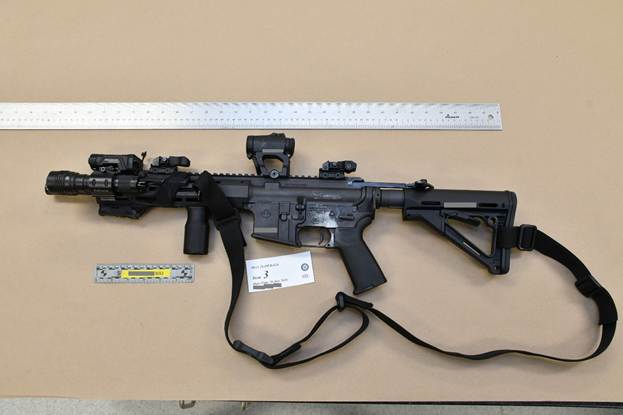
Image – SO #1 firearm
SO #2 was assigned a Colt IUR 5.56 rifle. The removed magazine had a capacity of 30 cartridges[3] and contained 23 cartridges.
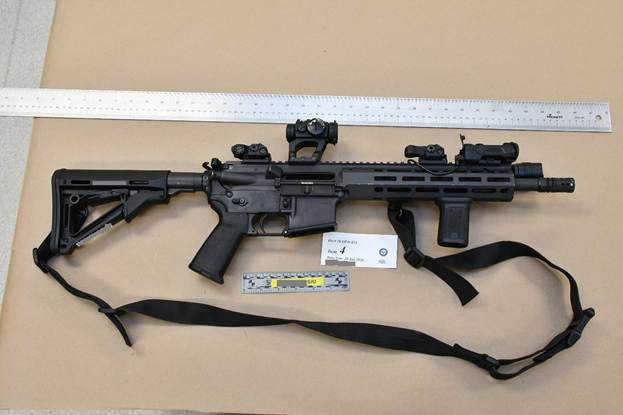
Image – SO #2’s firearm
SO #3 was assigned a Glock 17, Gen 5 with a barrel flashlight and an optical laser sight. The firearm was collected together with three Glock 9mm magazines with 17-cartridge capacity, each holding 17 9mm live cartridges.
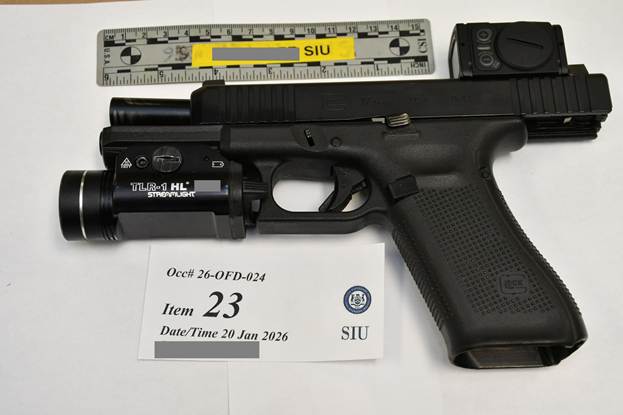
Image – SO #3’s firearm
SIU forensic services collected a knife from the scene.
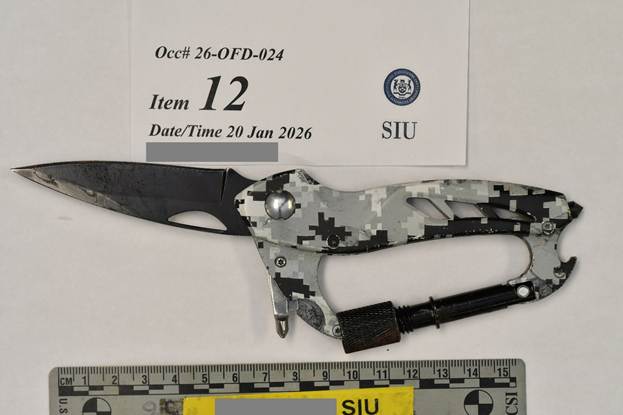
Image – Knife collected from scene
Forensic Evidence
Firearms Report from Centre of Forensic Sciences
The semi-automatic Colt IUR 5.56 rifle assigned to SO #1 functioned as designed. The test fired cartridge cases generated were examined and compared to recovered fired cases. The firearm was confirmed to be the source of one fired cartridge cases recovered at the scene.
The semi-automatic Colt IUR 5.56 rifle assigned to SO #2 functioned as designed. The test fired cartridge cases generated were examined and compared to recovered fired cases. The firearm was confirmed to be the source of five fired cartridge cases recovered at the scene.
The semi-automatic Glock 17, Gen 5 pistol assigned to SO #3 functioned as designed. The test fired cartridge cases generated were examined and compared to recovered fired cases. The firearm was confirmed to be the source of one fired cartridge case recovered at the scene.
Video/Audio/Photographic Evidence[4]
BPS Body-worn Camera (BWC) Footage
On January 16, 2026, starting a 2:26 a.m., police officers entered the residence and proceeded to the basement apartment. They focused their attention on a closed door on the north side of the apartment [later determined to contain the Complainant and CW #1]. A police officer tried the doorknob and indicated it was locked. CW #1 was crying and told the police officers not to open the door, indicating the Complainant had a knife and was going to kill her. Police officers said they were not in trouble and directed them to come out of the room. SO #3 asked the Complainant what he could do to end the situation. The Complainant responded that he could not come out. SO #3 said he wanted the incident to end peacefully. The Complainant engaged SO #3 and asked how they could resolve the situation. CW #1 was crying. SO #3 indicated he would not open the door but asked the Complainant to drop the knife. He asked the Complainant to allow CW #1 to leave the room. A police officer asked the Complainant to open the door so they could see him, assuring him they would not enter.
Starting at 2:37 a.m., WO #5 introduced himself to the Complainant. The Complainant said he would not hurt CW #1 if they left. WO #5 indicated they could not leave. The Complainant was asked what they could do to end the situation. CW #1 said the Complainant had a knife. The Complainant indicated he did not want to hurt CW #1. The Complainant was asked to put the knife down and what his intentions were with it. His response was unintelligible. The Complainant refused to open the door and acknowledged that the police officers could not leave the residence. CW #1 indicated she was behind the door and the Complainant was pointing the knife at her back. The Complainant told the police officers not to open the door. He refused to put the knife down. CW #1 indicated the Complainant believed she had another man. The Complainant told the police officers not to open the door and indicated he would not drop the knife. The Complainant stated that he would not hurt CW #1 if the police officers did not open the door.
Starting at 3:03 a.m., WO #2 broadcast on the police radio that if there was to be any indication that the Complainant was “active” and there was concern for loss of life, officers were to act using the most appropriate level of force available. Reasonable grounds were said to exist to arrest the Complainant for assault, assault with a weapon, weapons dangerous, and uttering threats.
Starting at 3:05 a.m., the Complainant was speaking on his cellphone to his father.
Starting at 3:18 a.m., the Complainant advised that he would open the door and let CW #1 out once he finished speaking with his family.
Starting at 3:28 a.m., the Complainant advised he would let CW #1 exit. While being provided instructions on how to safely do so, he requested five more minutes. CW #1 advised that the Complainant had the knife pressed to her side.
Starting at 3:52 a.m., the Complainant advised he still had the knife in his hand against CW #1. He just wanted her to tell him the truth. CW #1 was crying and saying she was telling him the truth. The Complainant indicated he did not want to hurt her.
Starting at 4:10 a.m., CW #1 advised she was still behind the door and the Complainant had the knife pressed to her side.
Starting at 4:14 a.m., SO #2 positioned himself outside the bedroom door and commenced negotiations as the primary crisis negotiator.
Due to difficulties hearing the Complainant through the door, SO #2 suggested he call him on his cellphone; the Complainant declined.
Starting at 4:24 a.m., SO #2 assured the Complainant they would not rush into the bedroom.
Starting at 4:27 a.m., SO #2 requested that the Complainant open the door so they could talk and resolve the incident. The Complainant’s response was unintelligible.
Starting at 4:28:50 a.m., the bedroom door opened and CW #1 appeared. She screamed and returned to the room with the door closing behind her. SO #1 and SO #3 advanced quickly, and SO #3 kicked the door to force entry. When that was unsuccessful, WO #5 breached the door using a ram. Once opened, SO #3 entered first followed by SO #1 and SO #2. The Complainant grabbed CW #1 and directed her to a sitting position on the floor. He held a knife in his right hand while holding her head with his left arm/hand. He was crouched over top of her with the knife positioned at the back of her neck/head, and he was thrusting the knife forward as police officers yelled at him.
SO #1, SO #3 and SO #2 simultaneously discharged their firearms and incapacitated the Complainant. CW #1 was removed from the bedroom and provided first aid for knife lacerations. The Complainant was provided emergency first aid.
BPS Communications Recordings
On January 16, 2026, starting at 2:17 a.m., BPS communications centre received a 911 call from a woman [CW #3] at a residence in the area of Wayne Gretzky Parkway and Lynden Road, Brantford, reporting that the Complainant and CW #1 were quarrelling. The Complainant had dragged CW #1 into a room. CW #1 screamed not to open the door, and the Complainant was said to have a knife and was going to kill her.
Starting at 2:19 a.m., police officers were dispatched to the residence for a domestic disturbance involving a knife. They were advised that the Complainant would kill his wife if police officers forced entry to the room where they were located. CW #1 indicated that if the police were called, the Complainant would kill her.
Starting at 2:28 a.m., WO #9 advised that CW #1 had said through the door that the Complainant would kill her if police officers opened the door. Police officers were attempting to convince the Complainant to exit the room.
Starting at 2:31 a.m., CW #1 stated the Complainant was holding a knife to her neck. WO #2 advised that the Complainant and CW #1 were contained in a lower bedroom. The other occupants of the residence had been evacuated and negotiations were underway for a peaceful surrender. Attempts were being made to call-out the Complainant.
Starting at 3:02 a.m., WO #2 advised if there was any indication the Complainant went active and CW #1’s life was in danger, police officers would enter and preserve life using the most appropriate level of force. Grounds existed for the arrest of the Complainant for multiple criminal offences.
Starting at 4:16 a.m., ERT officers relieved patrol officers and had control of the lower level.
Starting at 4:28 a.m., police officers made entry and shots were fired.
Materials Obtained from Police Service
Upon request, the SIU received the following materials from the BPS between January 16, 2026, and January 26, 2026:
- Names and roles of involved police officers
- Civilian Witness List
- General Report
- Communications recordings
- Computer-aided Dispatch Report
- BWC footage
- Notes - WO #2, WO #6, WO #7, WO #1, WO #3, WO #4, WO #5, WO #8, WO #9, WO #10 and WO #11
- BPS policies - Active Attacker/Threat Incidents; Domestic Occurrences; Emergency Response/Perimeter Control and Containments/Tactical Units/Hostage Rescue; Use of Force
Materials Obtained from Other Sources
The SIU obtained the following records from the following other sources between January 16, 2026, and February 26, 2026:
- Firearms Report from Centre of Forensic Sciences
- Video footage from private residence
- Preliminary Autopsy Findings Report from Ontario Forensic Pathology Service
Incident Narrative
The evidence collected by the SIU, including interviews with witnesses (police and non-police) and video footage that captured the incident, gives rise to the following scenario. As was their legal right, the subject officials did not agree interviews with the SIU or the release of their notes.
In the early morning of January 16, 2026, BPS officers were dispatched to a residence in the area of Wayne Gretzky Parkway and Lynden Road, Brantford. One of the homeowners had called police to report a domestic disturbance between the couple residing in the basement apartment – the Complainant and CW #1. The Complainant had a knife and was threatening to kill CW #1.
Officers arrived on scene in the basement apartment at about 2:30 a.m. to find that CW #1 was being held in a locked bedroom by the Complainant. CW #1 indicated through the door that the Complainant was holding a knife to her neck and would kill her if police opened the door. SO #3 and other officers attempted to negotiate a peaceful resolution with the Complainant. They assured the Complainant that they were not there to hurt him and encouraged him to open the door and allow CW #1 to leave. The Complainant refused to open the bedroom door. He said he would not hurt CW #1 if the officers did not enter the room.
ERT officers, including SO #1 and SO #2, began arriving on scene and assumed charge of police operations outside the bedroom door at about 4:15 a.m. At a distance of several metres from the bedroom door, SO #2, a trained negotiator, tried to engage the Complainant in conversation but he was mostly unresponsive. At about 4:30 a.m., the bedroom door opened and CW #1 appeared in the doorway’s threshold. The Complainant had left her side and she had seized the opportunity to try to escape. Before she could exit through the door, however, the Complainant grabbed her by the hair, pulled her back into the room, and locked the bedroom door.
The officers decided to storm the bedroom. The door was forced open and SO #3 was the first one into the room, followed by SO #1 and SO #2. The Complainant grabbed CW #1 from behind and held the knife to the back of her neck and head. From a distance of no more than a metre or two, SO #3 fired his semi-automatic handgun a single time at the Complainant at the same time as SO #1 and SO #2 fired their C8 rifles, once and five times, respectively. The Complainant sustained multiple gunshot wounds to the upper body and was immediately incapacitated. CW #1 was not struck.
The Complainant was provided emergency medical attention but could not be saved. He was pronounced deceased at 4:46 a.m.
Cause of Death
The pathologist at autopsy was of the preliminary view that the Complainant’s death was attributable to gunshot wounds of the neck and shoulder.
Relevant Legislation
Section 34, Criminal Code - Defence of Person – Use or Threat of Force
34 (1)A person is not guilty of an offence if
(a) They believe on reasonable grounds that force is being used against them or another person or that a threat of force is being made against them or another person;
(b) The act that constitutes the offence is committed for the purpose of defending or protecting themselves or the other person from that use or threat of force; and
(c) The act committed is reasonable in the circumstances.
(2) In determining whether the act committed is reasonable in the circumstances, the court shall consider the relevant circumstances of the person, the other parties and the act, including, but not limited to, the following factors:
(a) the nature of the force or threat;
(b) the extent to which the use of force was imminent and whether there were other means available to respond to the potential use of force;
(c) the person’s role in the incident;
(d) whether any party to the incident used or threatened to use a weapon;
(e) the size, age, gender and physical capabilities of the parties to the incident;
(f) the nature, duration and history of any relationship between the parties to the incident, including any prior use or threat of force and the nature of that force or threat;
(f.1) any history of interaction or communication between the parties to the incident;
(g) the nature and proportionality of the person’s response to the use or threat of force; and
(h) whether the act committed was in response to a use or threat of force that the person knew was lawful.
(3) Subsection (1) does not apply if the force is used or threatened by another person for the purpose of doing something that they are required or authorized by law to do in the administration or enforcement of the law, unless the person who commits the act that constitutes the offence believes on reasonable grounds that the other person is acting unlawfully.
Analysis and Director’s Decision
The Complainant passed away on January 16, 2026, from gunshot wounds following a confrontation with BPS officers. The SIU was notified of the incident and initiated an investigation. Three officers were identified as having discharged their firearms and were designated subject officials – SO #1, SO #2 and SO #3. The investigation is now concluded. On my assessment of the evidence, there are no reasonable grounds to believe that any of the subject officials committed a criminal offence in connection with the Complainant’s death.
Section 34 of the Criminal Code provides that conduct that would otherwise constitute an offence is legally justified if it was intended to deter a reasonably apprehended assault, actual or threatened, and was itself reasonable. The reasonableness of the conduct is to be assessed in light of all the relevant circumstances, including with respect to such considerations as the nature of the force or threat; the extent to which the use of force was imminent and whether there were other means available to respond to the potential use of force;whether any party to the incident used or threatened to use a weapon; and, the nature and proportionality of the person’s response to the use or threat of force.
The subject officials were lawfully placed through the series of events culminating in gunfire. Police had been called to the address to deal with an emergency situation in which a woman was being held hostage at knifepoint by her partner. They were duty bound to respond to the scene to do what they could to prevent harm coming to CW #1 and take the Complainant into custody. The evidence indicates that they did just that. They took control of the space around the bedroom and evacuated the upstairs residents. Negotiations were conducted reasonably and given a fair chance to succeed. When CW #1 suddenly appeared and then disappeared behind the door, the officers understandably concluded that her life was in imminent danger and that they needed to immediately force entry into the bedroom.
Once inside the bedroom, I am satisfied that the officers who discharged their firearms did so to protect CW #1 from a reasonably apprehended attack. Though the subject officials, as was their legal right, chose not to interview with the SIU to provide that evidence firsthand, their mindset is safely inferred from the circumstances. By the time they fired their weapons, the Complainant had grabbed CW #1 and given every indication of stabbing her with the knife in his right hand.
I am also satisfied that the officers’ resort to gunfire constituted reasonable force in defence of CW #1. The Complainant was stabbing or was just about to stab CW #1 when the subject officials fired their weapons. Her life was in danger at that moment and it is difficult to see what else the officers could have done in defence of her life. A physical engagement would have put the officers at risk of being injured by the knife while leaving time for the Complainant to potentially inflict a grievous or mortal wound on CW #1. And less-lethal force did not have the immediate stopping power required of the moment. On this record, the evidence establishes that the subject officials comported themselves reasonably when they chose to meet a lethal threat with a resort to lethal force of their own.
For the foregoing reasons, there is no basis for proceeding with criminal charges in this case. The file is closed.
Date: May 13, 2026
Electronically approved by
Joseph Martino
Director
Special Investigations Unit
Endnotes
- 1) Unless otherwise specified, the information in this section reflects the information received by the SIU at the time of notification and does not necessarily reflect the SIU’s finding of facts following its investigation. [Back to text]
- 2) Reportedly, the normal practice was to load 28 cartridges. [Back to text]
- 3) Reportedly, the normal practice was to load 28 cartridges. [Back to text]
- 4) The following records contain sensitive personal information and are not being released pursuant to section 34(2) of the Special Investigations Unit Act, 2019. The material portions of the records are summarized below. [Back to text]
Note:
The signed English original report is authoritative, and any discrepancy between that report and the French and English online versions should be resolved in favour of the original English report.