
SIU Director’s Report - Case # 25-OFD-512
Warning:
This page contains graphic content that can shock, offend and upset.
Contents:
Mandate of the SIU
The Special Investigations Unit is a civilian law enforcement agency that investigates incidents involving an official where there has been death, serious injury, the discharge of a firearm at a person or an allegation of sexual assault. Under the Special Investigations Unit Act, 2019 (SIU Act), officials are defined as police officers, special constables of the Niagara Parks Commission and peace officers under the Legislative Assembly Act. The SIU’s jurisdiction covers more than 50 municipal, regional and provincial police services across Ontario.
Under the SIU Act, the Director of the SIU must determine based on the evidence gathered in an investigation whether there are reasonable grounds to believe that a criminal offence was committed. If such grounds exist, the Director has the authority to lay a criminal charge against the official. Alternatively, in cases where no reasonable grounds exist, the Director cannot lay charges. Where no charges are laid, a report of the investigation is prepared and released publicly, except in the case of reports dealing with allegations of sexual assault, in which case the SIU Director may consult with the affected person and exercise a discretion to not publicly release the report having regard to the affected person’s privacy interests.
Information Restrictions
Special Investigations Unit Act, 2019
Pursuant to section 34, certain information may not be included in this report. This information may include, but is not limited to, the following:
- The name of, and any information identifying, a subject official, witness official, civilian witness or affected person.
- Information that may result in the identity of a person who reported that they were sexually assaulted being revealed in connection with the sexual assault.
- Information that, in the opinion of the SIU Director, could lead to a risk of serious harm to a person.
- Information that discloses investigative techniques or procedures.
- Information, the release of which is prohibited or restricted by law.
- Information in which a person’s privacy interest in not having the information published clearly outweighs the public interest in having the information published.
Freedom of Information and Protection of Personal Privacy Act
Pursuant to section 14 (i.e., law enforcement), certain information may not be included in this report. This information may include, but is not limited to, the following:
- Confidential investigative techniques and procedures used by law enforcement agencies; and
- Information that could reasonably be expected to interfere with a law enforcement matter or an investigation undertaken with a view to a law enforcement proceeding.
Pursuant to section 21 (i.e., personal privacy), protected personal information is not included in this report. This information may include, but is not limited to, the following:
- The names of persons, including civilian witnesses, and subject and witness officials;
- Location information;
- Witness statements and evidence gathered in the course of the investigation provided to the SIU in confidence; and
- Other identifiers which are likely to reveal personal information about individuals involved in the investigation.
Personal Health Information Protection Act, 2004
Pursuant to this legislation, any information related to the personal health of identifiable individuals is not included.
Other proceedings, processes, and investigations
Information may also have been excluded from this report because its release could undermine the integrity of other proceedings involving the same incident, such as criminal proceedings, coroner’s inquests, other public proceedings and/or other law enforcement investigations.
Mandate Engaged
Pursuant to section 15 of the SIU Act, the SIU may investigate the conduct of officials, be they police officers, special constables of the Niagara Parks Commission or peace officers under the Legislative Assembly Act, that may have resulted in death, serious injury, sexual assault or the discharge of a firearm at a person.
A person sustains a “serious injury” for purposes of the SIU’s jurisdiction if they: sustain an injury as a result of which they are admitted to hospital; suffer a fracture to the skull, or to a limb, rib or vertebra; suffer burns to a significant proportion of their body; lose any portion of their body; or, as a result of an injury, experience a loss of vision or hearing.
In addition, a “serious injury” means any other injury sustained by a person that is likely to interfere with the person’s health or comfort and is not transient or trifling in nature.
This report relates to the SIU’s investigation into the death of a 19-year-old male (the “Complainant”).
The Investigation
Notification of the SIU[1]
On December 11, 2025, at 5:04 p.m., the Peel Regional Police (PRP) contacted the SIU with the following information.
On December 11, 2025, at 2:30 p.m., a caller contacted PRP reporting a break-in to his residence in the area of Britannia Road and Winston Churchill Boulevard, Mississauga. Reportedly, a man [now known to be Civilian Witness (CW) #1] had entered his residence in need of medical attention after being stabbed by a family member [now known to be the Complainant]. Tactical Rescue Unit (TRU) officers responded to the residence and attempted communications with the Complainant. With no response, police officers entered and located him in a basement bathroom. They issued commands and eventually deployed a conducted energy weapon (CEW), which was ineffective. The Complainant produced a knife towards the police officers and was shot with a C8 rifle. He was transported to hospital with no vital signs.
The Team
Date and time team dispatched: 2025/12/11 at 5:40 p.m.
Date and time SIU arrived on scene: 2025/12/11 at 8:25 p.m.
Number of SIU Investigators assigned: 3
Number of SIU Forensic Investigators assigned: 3
Affected Person (aka “Complainant”)
19-year-old male; deceased
Civilian Witnesses (CW)
CW #1 Interviewed
CW #2 Interviewed
The civilian witnesses were interviewed between December 11 and 12, 2025.
Subject Official (SO)
SO Declined interview and to provide notes, as is the subject official’s legal right
Witness Officials (WO)
WO #1 Interviewed; notes received and reviewed
WO #2 Interviewed; notes received and reviewed
WO #3 Interviewed; notes received and reviewed
The witness officials were interviewed on December 15, 2025.
Evidence
The Scene
The events in question transpired in and around a bathroom/laundry room in the basement of a residence in the area of Britannia Road and Winston Churchill Boulevard, Mississauga.
Physical Evidence
On December 11, 2025, at 8:25 p.m., SIU Forensic Services arrived at the scene. The front door’s frame was damaged and the door had a small dent in it. Blood was visible on a set of stairs leading to the second floor. Blood drops were visible on the main floor, near the front door, and leading into the kitchen. Boot prints were visible on the main floor. Pieces of wood from the door frame were resting in the kitchen. Blood footprints were visible on the kitchen floor. These footprints led in and out of the kitchen. A silver-handled chef’s knife was resting on the counter. Red staining was visible on the knife’s handle. The blood drops were visible from the kitchen area, on some boots and shoes, and on a door. The blood drops continued to a set of stairs. These stairs led to the basement area. Blood was visible on the hand railing and stairs leading to the basement.
The finished basement consisted of a washroom/laundry room, a small kitchen, a furnace room, an entertainment room and a bedroom. The washroom/laundry room, furnace room and kitchen occupied the northern half of the basement, while the entertainment room and bedroom occupied the southern half of the basement. The washroom/laundry room, the furnace room and a large section of the entertainment room were situated along the eastern portion of the basement. The kitchen, the bedroom and a large section of the entertainment room were situated along the western portion of the basement. Blood was visible on the floor in all areas of the basement. Two large pools of blood and an open jug of bleach were visible in the entertainment room. A clothes dryer, with blood transfer and a dent on it, and a section of door panel, were resting in the kitchen area, between the washroom/laundry room and the furnace room. A circular glass table and four chairs in the kitchen appeared to have been pushed aside. One of the chairs was resting on its side, while the others were upright. A small pair of scissors with blood on them was resting on the glass table. A brown-handled cleaver was resting on the kitchen counter. The dryer, section of door panel and the table hindered access to the entertainment room and bedroom. Police equipment - a pry bar, a crow bar, a sledge hammer and a battering ram - were resting on the floor in the kitchen area. A brown-coloured cell phone was resting on the floor in the entertainment room, near the entrance to the bedroom. A large, black-coloured sheath was resting on the bed in the bedroom. A black-coloured cell phone was resting on a couch in the entertainment room. A stretcher and an Emergency Medical Services (EMS) trauma bag were resting on the floor near the north wall of the kitchen.
Blood was visible on the tiled floor of the washroom/laundry room. The door leading into the washroom/laundry room had been forcibly removed. Part of the door rested on the washroom/laundry room floor, and another section was resting on the kitchen floor. A clothes washer was resting near the north wall. A small section of drywall near an electrical outlet, designed for the clothes dryer, was damaged. Dryer vent tubing and a folded ironing board were resting on the floor near the north wall. A larger section of drywall along the same wall was missing. A single shower stall was situated on the south side of the washroom/laundry room. Water from the shower’s faucet continued to run and it was turned off. Blood was visible on the shower stall wall and glass enclosure. A silver-grey paring knife, with blood on it, was resting on the shower stall floor. Four fired cartridge cases were visible near the north wall. Three were resting on the floor tile and one was resting on the section of door. A damaged bullet/projectile was resting on the top surface of the clothes washer.
Blood was visible on the stairs and hand rail leading up to the second floor. Blood footprints were visible on the rug near the washroom. A large knife with a curved blade was resting on a black bag on the washroom sink counter. The knife had a partially serrated blade with blood on it. The overall length of the knife was 60 cm – the blade was 45 cm in length and the handle was 15 cm in length. A box of razors was also resting on the counter. A single, blood-covered razor was resting on the counter. Blood was visible in the sink, the washroom floor and in the bathtub. A black-coloured cell phone was resting on the floor between the bathtub and the toilet.
During a subsequent search of the washroom/laundry room, a fifth fired cartridge case was located.
Items of evidence were collected by SIU Forensic Services. The scene was photographed and video-recorded. A 3D scan of the scene was conducted.
SIU Forensic Services received the involved police rifle, peripherals, and the deceased’s clothing.
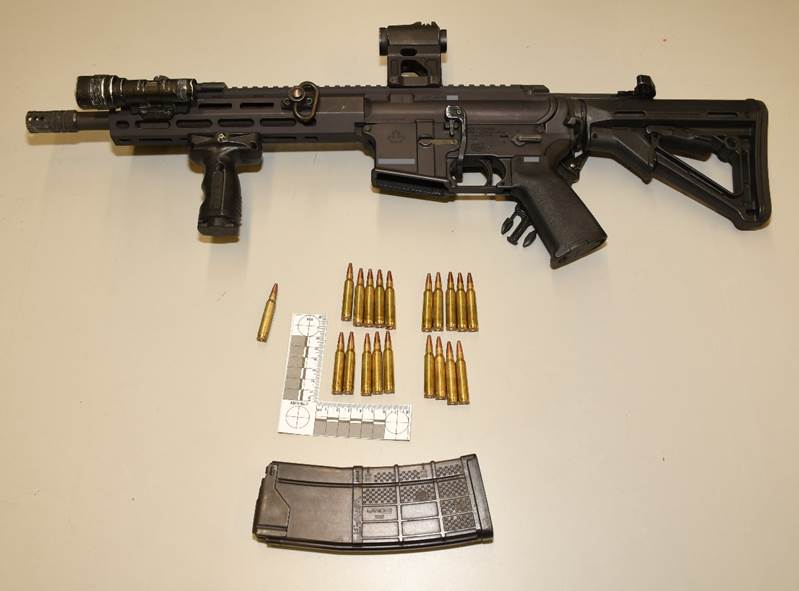
Figure 1 - The SO’s Colt C8 Rifle with light and laser scope. The magazine contained 20 live rounds of ammunition.
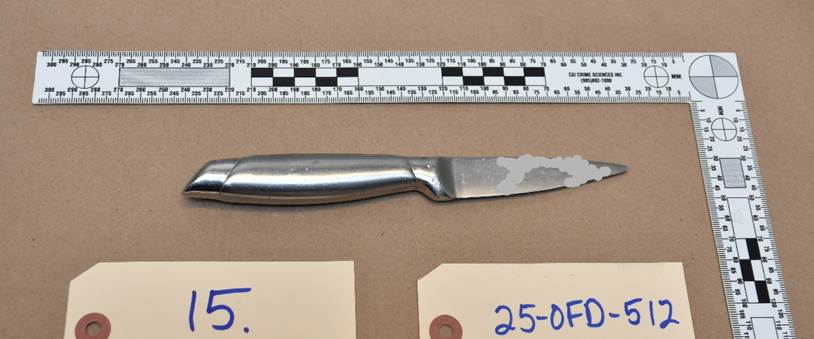
Figure 2 – Knife recovered at the scene
Forensic Evidence
Ontario Forensic Pathology Service (OFPS) Preliminary Autopsy Findings Report
The Forensic Pathologist was of the preliminary view that the Complainant’s death was attributable to “Multiple Gunshot Wounds in a Man with Sharp Force Trauma”.
CEW Deployment Data - WO #2’s Taser X7 CEW
Starting at 3:24:32 p.m.,[2] December 11, 2025, the weapon was armed and the safety disengaged.
Starting at 3:25:16 p.m., the trigger was pulled and cartridge one deployed. Electricity was discharged for 4.299 seconds.
Starting at 3:25:21 p.m., the trigger was pulled and cartridge two deployed. Electricity was discharged for 5.007 seconds.
Starting at 3:25:45 p.m., the safety was engaged.
Video/Audio/Photographic Evidence[3]
PRP Body-worn Camera (BWC) Footage - WO #1 and WO #2, WO #3 and the SO
On December 11, 2025, starting at 2:53 p.m., WO #1 was on scene.
Starting at 3:01 p.m., WO #1 learned from another family member that the Complainant had mental health issues and a history of drug use, and was not taking his prescribed medication. The family member was unsure if the Complainant was capable of self-harm. WO #1 explained that TRU officers were en route, and they were hoping the incident would end by opening the residence door, calling out to the Complainant and having him walk out and surrender. TRU officers were briefed by WO #1, which briefing included mention of a machete. It was determined exigent circumstances existed to breach and hold at the front door and call out to the Complainant.
Starting at 3:10 p.m., WO #1, WO #2, the SO, WO #3 and Officer #1[4] assembled on the front porch of the residence.
Starting at 3:11 p.m., WO #3 struck the door with a ram and announced the presence of police officers. Police officers repeatedly announced it was the PRP tactical unit and requested that the Complainant come to the front door with his hands raised and empty. No response was received. Blood was visible on the main floor and up the stairs leading to the second floor.
Starting at 3:14 p.m., police officers entered and searched the main floor. Loud music filled the residence.
Starting at 3:17 p.m., WO #3 announced from the top of the basement stairs that it was the police and directed the Complainant to appear with his hands raised and empty. No response was received. Blood was visible in the stairway. Police officers descended the stairs and searched the basement rooms except for one which had the door closed [now known to be the bathroom where the Complainant was barricaded].
Starting at 3:20 p.m., the SO kicked the bathroom door, but was unsuccessful in gaining entry, recognizing it was barricaded from the inside. The Complainant was told repeatedly to open the door and exit. There was no response.
Starting at 3:23 p.m., WO #3 struck and broke open the door using a sledgehammer. The SO positioned himself at the threshold.
Starting at 3:24 p.m., the SO told the Complainant repeatedly to raise his hands. He could not see the Complainant. He maneuvered around a clothes dryer and pointed his rifle towards the corner glass shower enclosure where the Complainant was lying motionless on his back on the floor. The SO indicated he may be deceased. The SO entered and noted the Complainant was breathing. The Complainant was directed repeatedly to show his hands. WO #2 pointed a CEW at the Complainant. WO #1 asked the officers what the Complainant held in his right hand.
Starting at 3:25 p.m., the SO indicated the Complainant’s right hand was under his body. He directed the Complainant twice to remove his hand. The Complainant was lying on his back with the back of his head resting against the wall in a slightly raised position and his left hand on his stomach. The Complainant raised his head momentarily and lowered it back to the floor. WO #2 told the Complainant to show his hands and deployed his CEW. The Complainant’s legs lifted off the floor.
The SO and WO #2 directed that the Complainant be dragged out of the shower. As WO #1 took hold of his leg, the Complainant sat upright, removed his right hand from under his back and extended his arm outward. He was holding a knife in his right hand pointing it towards the SO. The Complainant gripped the left side of the shower wall with his left hand, placed his feet on the floor and started to stand. His right arm was extended past the door as he advanced forward.
A police officer shouted, “Hands,” as WO #2 deployed his CEW and the SO discharged[5] his rifle striking the Complainant. The Complainant was directed repeatedly to drop the knife. A metal object was heard striking a solid surface. The Complainant was removed from the bathroom and emergency first aid was initiated.
PRP Communications Recordings – Telephone
On December 11, 2025, starting 2:31 p.m., CW #2 telephoned the PRP Communications Centre and reported that a man [now known to be CW #1] had entered his house. CW #1 was bleeding heavily and said somebody [now known to be the Complainant] had tried to kill him, stabbing him in the arm and back. CW #1 told the call-taker that the Complainant had asked him to go downstairs and, when he did, the Complainant emerged from a furnace room armed with a machete and stabbed him in the arm, back and leg. CW #1 fought to get out of the basement and ran to CW #2’s residence.
PRP Communications Recordings – Radio
Starting at 2:40 p.m., December 11, 2025, WO #1 arrived on scene and applied a tourniquet to CW #1’s wounds.
Starting at 3:12 p.m., TRU officers were at the Complainant’s residence calling out to him and were going to make entry.
Starting at 3:25 p.m., WO #1 reported shots fired and EMS were required.
Starting at 3:33 p.m., EMS arrived.
Starting at 3:45 p.m., the Complainant was without vital signs.
Starting at 3:51 p.m., the Complainant arrived at the hospital.
Materials Obtained from Police Service
Upon request, the SIU received the following materials from the PRP between December 11, 2025, and January 20, 2026:
- Names and roles of involved police officers
- Civilian Witness List
- Occurrence Details Report
- Incident Details Report
- Incident History Summary
- Communications recordings
- BWC footage
- CEW deployment download
- The SO’s training records
- Notes - WO #1, WO #2 and WO #3
- PRP policies - Mental Health and Addiction; Incident Response; Critical Incident Response; Tactical and Hostage Rescue Operations
Materials Obtained from Other Sources
The SIU obtained the following records from the following other sources between December 13, 2025, and January 7, 2026:
- The Complainant’s medical records from Trillium Health Partners - Mississauga Hospital (MH), provided by a family member
- CW #1’s medical records from MH
- Preliminary Autopsy Findings Report from the OFPS
Incident Narrative
The evidence collected by the SIU, including interviews with police eyewitnesses and video footage that captured the incident in part, gives rise to the following scenario. As was his legal right, the SO did not agree an interview with the SIU or the release of his notes.
In the afternoon of December 11, 2025, CW #1 was attacked by a family member - the Complainant – in the basement of his home in the area of Britannia Road and Winston Churchill Boulevard, Mississauga. The Complainant, having invited CW #1 downstairs, rushed at him with a knife, stabbing him in the left shoulder. CW #1 fled upstairs and out to a neighbour’s house, from which location he called police.
WO #1 and other uniformed police arrived on scene and set up containment around the house. Another family member arrived at the address at about 3:00 p.m. and explained that the Complainant’s mental health had been deteriorating and he was not taking his medication. She noted he had expressed suicidal ideation in the past.
A team of TRU officers was dispatched to the scene, including WO #2, the SO and WO #3. The initial plan was to breach the front door and call out to the Complainant to have him surrender. That changed when, having forced open the door and received no response to their hails, the officers observed blood and became concerned with the Complainant’s well-being. At that point, WO #1, WO #2, the SO and WO #3 entered the home and began to search for the Complainant.
The TRU officers cleared the home and determined that the Complainant was barricaded in the basement bathroom. They repeatedly directed him to step out of the bathroom with his hands up and empty. Again, not receiving any response, the officers decided to force open the door. Using a sledgehammer, WO #3 smashed through the upper half of the wooden door, after which the rest of the door was opened. A clothes dryer that had been placed behind the door was removed from the bathroom.
The SO, with a C8 rifle at the ready, was the first into the bathroom. He was followed by WO #2 with a less-lethal shotgun. WO #1 and WO #3 were just outside the threshold of the door. To the right of the door at the far corner of the small bathroom, the Complainant was lying face up on the floor of the glass-enclosed shower. The shower was on and water was pouring on him. His head was partially propped up against the back wall of the shower and his legs extended through the open shower door. There was blood on the floor. The Complainant was unresponsive as officers ordered him to show his hands. At 3:25 p.m., WO #2 discharged his CEW at the Complainant. The Complainant’s right leg rose from the ground for a couple of seconds before he began to lift himself from the floor and lunge forward at the SO with a knife in his right hand. WO #2 deployed his CEW again, followed immediately by the SO firing three rounds in quick succession, striking the Complainant and knocking him back into the shower on his back. He fired a fourth round about half-a-second later, and a fifth and final round a couple of seconds after that. Officers shouted at him to drop the knife and it fell from his hands onto the shower floor.
Following the gunfire, officers dragged the Complainant out of the bathroom, handcuffed his arms behind the back and began to administer first aid.
Paramedics arrived on scene and transported the Complainant to hospital. He was pronounced deceased at 4:04 p.m.
Cause of Death
The pathologist at autopsy was of the preliminary view that the Complainant’s death was attributable to multiple gunshot wounds in a man with sharp force trauma.
Relevant Legislation
Section 34, Criminal Code - Defence of Person – Use or Threat of Force
34 (1)A person is not guilty of an offence if
(a) They believe on reasonable grounds that force is being used against them or another person or that a threat of force is being made against them or another person;
(b) The act that constitutes the offence is committed for the purpose of defending or protecting themselves or the other person from that use or threat of force; and
(c) The act committed is reasonable in the circumstances.
(2) In determining whether the act committed is reasonable in the circumstances, the court shall consider the relevant circumstances of the person, the other parties and the act, including, but not limited to, the following factors:
(a) the nature of the force or threat;
(b) the extent to which the use of force was imminent and whether there were other means available to respond to the potential use of force;
(c) the person’s role in the incident;
(d) whether any party to the incident used or threatened to use a weapon;
(e) the size, age, gender and physical capabilities of the parties to the incident;
(f) the nature, duration and history of any relationship between the parties to the incident, including any prior use or threat of force and the nature of that force or threat;
(f.1) any history of interaction or communication between the parties to the incident;
(g) the nature and proportionality of the person’s response to the use or threat of force; and
(h) whether the act committed was in response to a use or threat of force that the person knew was lawful.
(3) Subsection (1) does not apply if the force is used or threatened by another person for the purpose of doing something that they are required or authorized by law to do in the administration or enforcement of the law, unless the person who commits the act that constitutes the offence believes on reasonable grounds that the other person is acting unlawfully.
Analysis and Director’s Decision
The Complainant died on December 11, 2025, the result of gunshot wounds inflicted by a PRP officer. The SIU was notified of the incident and initiated an investigation, naming the SO the subject official. The investigation is now concluded. On my assessment of the evidence, there are no reasonable grounds to believe that the SO committed a criminal offence in connection with the Complainant’s death.
Section 34 of the Criminal Code provides that conduct that would otherwise constitute an offence is legally justified if it was intended to deter a reasonably apprehended assault, actual or threatened, and was itself reasonable. The reasonableness of the conduct is to be assessed in light of all the relevant circumstances, including with respect to such considerations as the nature of the force or threat; the extent to which the use of force was imminent and whether there were other means available to respond to the potential use of force; whether any party to the incident used or threatened to use a weapon; and, the nature and proportionality of the person’s response to the use or threat of force.
The TRU officers were lawfully placed and in the exercise of their duties through the series of events culminating in the SO’s gunfire. The officers, dispatched to a call involving a knife attack by the Complainant on a family member, were duty bound to attend at the scene do what they reasonably could to ensure public safety, including the Complainant’s safety, and take him into custody. Their entry into the basement of the home was justified by the exigent circumstances, including a legitimate concern that the Complainant might harm himself. In fact, by the time they found him in the basement bathroom, the Complainant had self-inflicted knife wounds to his neck and left wrist.
The evidence indicates that the SO discharged his C8 rifle to protect himself from a reasonably apprehended knife attack by the Complainant. While the SO did not provide that evidence firsthand in an interview with the SIU, as was his legal right, the inference is safely drawn from the circumstantial evidence, most emphatically, the knife attack by the Complainant on the officer that precipitated the shooting. Confronted by the Complainant thrusting a knife in his direction at close quarters, I am satisfied that the officer would have rightfully believed that defensive force was necessary to preserve himself from grievous bodily harm or death.
With respect to the force used by the SO, namely, five rounds from his C8 rifle, there is insufficient evidence to reasonably conclude it was unjustified. The first three shots, I am satisfied, fell squarely within the ambit of section 34. The Complainant had suddenly lifted himself and lunged at the SO with the knife (undeterred by WO #2’s CEW deployment), coming within a metre or so of the officer. In that moment, the SO’s life was in imminent peril and he was entitled to protect himself from a lethal threat with a resort to lethal force of his own. The fourth and fifth shots are subject to closer scrutiny. The Complainant had fallen backward into the shower after the first three shots and it is unclear on the available BWC footage whether he attempted to advance again on the officer. That said, there is evidence that the Complainant still had a hold of the knife and remained a threat during this time, including the fact that the Complainant was told to drop the knife following the third shot, BWC footage capturing officers directing the Complainant to drop the knife and the clanging sound of metal impacting a hard surface after the last round (consistent with the knife being dropped by the Complainant or falling from his hand), and the accounts of officers in the vicinity of the SO indicating that they perceived the Complainant as a threat through the gunfire. Add to this the fact that the SO was in a precarious position at the time, within striking range of the Complainant and backed up against the wall opposite the shower with nowhere to go. All of this suggests the real possibility that the Complainant had not been incapacitated by the first three shots and remained a present and serious danger or, alternatively, that the SO reasonably, albeit, perhaps, mistakenly, believed that to be the case. In either event, the SO is entitled to the protection of section 34. In arriving at this conclusion, I am mindful of the common law principle that officers involved in dangerous and dynamic situations are not expected to tailor their defensive force with precision; what is required is a reasonable response, not an exacting one: R. v. Nasogaluak, [2010] 1 SCR 206; R. v. Baxter (1975), 27 CCC (2d) 96 (Ont. CA).
For the foregoing reasons, there is no basis for proceeding with criminal charges in this case. The file is closed.
Date: April 13, 2026
Electronically approved by
Joseph Martino
Director
Special Investigations Unit
Endnotes
- 1) Unless otherwise specified, the information in this section reflects the information received by the SIU at the time of notification and does not necessarily reflect the SIU’s finding of facts following its investigation. [Back to text]
- 2) The times are derived from the internal clock of the weapon, which are not necessarily synchronous with actual time. [Back to text]
- 3) The following records contain sensitive personal information and are not being released pursuant to section 34(2) of the Special Investigations Unit Act, 2019. The material portions of the records are summarized below. [Back to text]
- 4) TRU officer in a support role and not designated as a witness official. [Back to text]
- 5) The initial discharge appeared to be a volley of three rounds in rapid succession, followed by a pause, a fourth shot, another short pause, and a fifth and final round. [Back to text]
Note:
The signed English original report is authoritative, and any discrepancy between that report and the French and English online versions should be resolved in favour of the original English report.