
SIU Director’s Report - Case # 25-PFD-297
Warning:
This page contains graphic content that can shock, offend and upset.
Contents:
Mandate of the SIU
The Special Investigations Unit is a civilian law enforcement agency that investigates incidents involving an official where there has been death, serious injury, the discharge of a firearm at a person or an allegation of sexual assault. Under the Special Investigations Unit Act, 2019 (SIU Act), officials are defined as police officers, special constables of the Niagara Parks Commission and peace officers under the Legislative Assembly Act. The SIU’s jurisdiction covers more than 50 municipal, regional and provincial police services across Ontario.
Under the SIU Act, the Director of the SIU must determine based on the evidence gathered in an investigation whether there are reasonable grounds to believe that a criminal offence was committed. If such grounds exist, the Director has the authority to lay a criminal charge against the official. Alternatively, in cases where no reasonable grounds exist, the Director cannot lay charges. Where no charges are laid, a report of the investigation is prepared and released publicly, except in the case of reports dealing with allegations of sexual assault, in which case the SIU Director may consult with the affected person and exercise a discretion to not publicly release the report having regard to the affected person’s privacy interests.
Information Restrictions
Special Investigations Unit Act, 2019
Pursuant to section 34, certain information may not be included in this report. This information may include, but is not limited to, the following:
- The name of, and any information identifying, a subject official, witness official, civilian witness or affected person.
- Information that may result in the identity of a person who reported that they were sexually assaulted being revealed in connection with the sexual assault.
- Information that, in the opinion of the SIU Director, could lead to a risk of serious harm to a person.
- Information that discloses investigative techniques or procedures.
- Information, the release of which is prohibited or restricted by law.
- Information in which a person’s privacy interest in not having the information published clearly outweighs the public interest in having the information published.
Freedom of Information and Protection of Personal Privacy Act
Pursuant to section 14 (i.e., law enforcement), certain information may not be included in this report. This information may include, but is not limited to, the following:
- Confidential investigative techniques and procedures used by law enforcement agencies; and
- Information that could reasonably be expected to interfere with a law enforcement matter or an investigation undertaken with a view to a law enforcement proceeding.
Pursuant to section 21 (i.e., personal privacy), protected personal information is not included in this report. This information may include, but is not limited to, the following:
- The names of persons, including civilian witnesses, and subject and witness officials;
- Location information;
- Witness statements and evidence gathered in the course of the investigation provided to the SIU in confidence; and
- Other identifiers which are likely to reveal personal information about individuals involved in the investigation.
Personal Health Information Protection Act, 2004
Pursuant to this legislation, any information related to the personal health of identifiable individuals is not included.
Other proceedings, processes, and investigations
Information may also have been excluded from this report because its release could undermine the integrity of other proceedings involving the same incident, such as criminal proceedings, coroner’s inquests, other public proceedings and/or other law enforcement investigations.
Mandate Engaged
Pursuant to section 15 of the SIU Act, the SIU may investigate the conduct of officials, be they police officers, special constables of the Niagara Parks Commission or peace officers under the Legislative Assembly Act, that may have resulted in death, serious injury, sexual assault or the discharge of a firearm at a person.
A person sustains a “serious injury” for purposes of the SIU’s jurisdiction if they: sustain an injury as a result of which they are admitted to hospital; suffer a fracture to the skull, or to a limb, rib or vertebra; suffer burns to a significant proportion of their body; lose any portion of their body; or, as a result of an injury, experience a loss of vision or hearing.
In addition, a “serious injury” means any other injury sustained by a person that is likely to interfere with the person’s health or comfort and is not transient or trifling in nature.
This report relates to the SIU’s investigation into the death of a 23-year-old man (the “Complainant”).
The Investigation
Notification of the SIU[1]
On July 31, 2025, at 12:35 p.m. Eastern Standard Time (EST), the Ontario Provincial Police (OPP) contacted the SIU with the following information about a shooting in the community of Wapekeka First Nation.
On July 31, 2025, at 11:06 a.m. Central Standard Time (CST), an OPP officer shot the Complainant when the Complainant approached the officer with a knife.
In a subsequent call to the SIU, the OPP reported that the incident occurred inside a youth centre that had been temporarily converted to a courtroom. The Complainant had been shot, taken to a nursing station, and pronounced deceased.
The Team
Date and time team dispatched: 2025/07/31 at 2:15 p.m. (EST)
Date and time SIU arrived on scene: 2025/08/01 at 7:15 a.m. (CST)
Number of SIU Investigators assigned: 3
Number of SIU Forensic Investigators assigned: 2
Affected Person (aka “Complainant”)
23-year-old male; deceased
Civilian Witnesses (CW)
CW #1 Interviewed
CW #2 Interviewed
CW #3 Interviewed
CW #4 Interviewed
CW #5 Interviewed
CW #6 Interviewed
CW #7 Interviewed
CW #8 Interviewed
CW #9 Interviewed
CW #10 Interviewed
CW #11 Interviewed
CW #12 Interviewed
CW #13 Interviewed
CW #14 Interviewed
CW #15 Interviewed
CW #16 Interviewed
CW #17 Interviewed
CW #18 Interviewed
The civilian witnesses were interviewed between August 1, 2025, and August 21, 2025.
Subject Official (SO)
SO Declined interview and to provide notes, as is the subject official’s legal right
Service Employee Witness (SEW)
SEW Interviewed; notes received and reviewed
The service employee witness was interviewed on August 7, 2025.
Investigative Delay
Delay was incurred in the process of filing an application for access to a courtroom audio recording. The audio recording was received on November 26, 2025.
An expert medical opinion was sought and received by the SIU in December 2025.
Evidence
The Scene
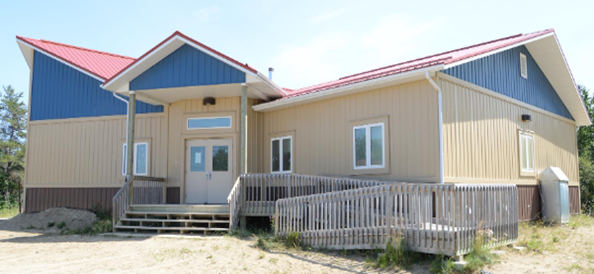
Wapekeka First Nation is a remote northern Ontario community. The events in question transpired inside the community’s youth centre, a one-storey structure that was serving as an Ontario Court of Justice satellite court on the day of the incident. SIU forensic services investigators attended the scene.
Scene Diagram[2]
![Scene Diagram[fn]2/[fn]](/images/2026-02-10-11-35-55_image003.png)
Physical Evidence
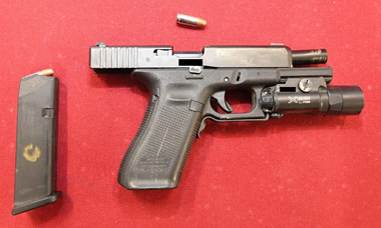
SIU forensic services examined the SO’s Glock Model 17M. One live 9 mm Winchester Luger cartridge was in the breech and 14 were in the seated magazine.
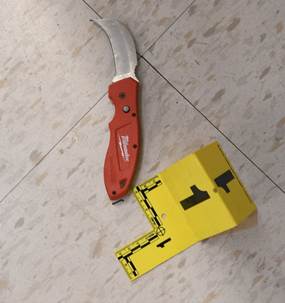
The SIU collected a Milwaukee knife from the scene.
A damaged bullet was recovered by SIU forensic services from the exterior siding of a house across the street from the youth centre. The location of the bullet was consistent with an impact mark in an interior northwest facing window of the youth centre indicating the path of one of the SO’s shots. A second damaged bullet was recovered from the front vertical section of the elevated stage while a third damaged bullet was recovered in the chest of the deceased at the autopsy.
Three fired 9 mm Winchester Luger cartridge casings were recovered from the floor of the youth centre, consistent with the number of damaged bullets recovered.
Forensic Evidence
Preliminary Autopsy Findings Report
On August 3, 2025, the autopsy of the Complainant was completed at the Provincial Forensic Pathology Unit. The preliminary cause of death was identified as a gunshot wound of the chest.
Report of Postmortem Examination
The report was received by the SIU on December 2, 2025. The pathologist confirmed that the Complainant’s death was caused by a gunshot wound to the chest. The wound entered the lateral left chest, injuring the heart and lungs, and lodged in the subcutaneous tissue of the right chest. It travelled left to right, upward, and slightly front to back in the body.
Centre of Forensic Sciences (CFS) Firearms Report
The SO’s firearm was in firing condition and functioned as a semi-automatic pistol. The three fired 9 mm Luger cartridge cases recovered at the scene were fired by the SO’s pistol. It could not be determined whether the three damaged fired bullets that were recovered were fired from the SO’s pistol.
Conducted Energy Weapon (CEW) Deployment Data – The SO’s CEW
The SO’s CEW download summary for July 31, 2025, indicated no activity. The result was consistent with the absence of physical evidence at the scene that would support a CEW deployment.
Expert Evidence
By way of letter to the SIU, dated December 17, 2025, the Ontario Forensic Pathology Service advised that the Complainant’s death was a foregone conclusion given the nature of the injuries he suffered in the shooting. The Ontario Forensic Pathology Service noted that the bullet damaged the heart and lungs causing rapidly fatal internal bleeding. Asked whether the absence of timely emergency first-aid / CPR endangered the Complainant’s life or contributed to his death, the Ontario Forensic Pathology Service answered in the negative. According to the Ontario Forensic Pathology Service, the Complainant’s gunshot wound of the chest was inevitably fatal and unsurvivable.
Video/Audio/Photographic Evidence[3]
OPP Body-worn Camera (BWC) Footage – The SO[4]
Starting at 11:05:10 a.m., July 31, 2025, the Complainant was captured standing at the entrance of a courtroom, while the judge (CW #3), CW #4 and CW #7 were seated at the front to the SO’s right.
Starting at 11:05:13 a.m., the Complainant walked into the court while holding a knife in his right hand at waist level and appearing to look at the SO.
Starting at 11:05:17 a.m., the SEW turned and looked towards the SO before rising from her chair and walking towards him.
Starting at 11:05:19 a.m., the Complainant walked to the centre of the court while appearing to remain focussed in the SO’s direction. The Complainant raised his left arm and hand to head level and returned it to his side.
Starting at 11:05:23 a.m., the Complainant stood in front of CW #3 with his left hand in his left pant pocket and his right hand at waist level. He advanced towards the SO.
Starting at 11:05:24 a.m., the SO pointed at the Complainant with his left hand. The Complainant, holding a knife in his right hand, angled his body towards the officer. The SO moved towards the Complainant as the Complainant backed away and shifted to his right. The Complainant held the knife out front at waist level before raising it to chest height. He jockeyed back and forth with the knife held high.
Starting at 11:05:27 a.m., the SO raised his pistol in his right hand and pointed it at the Complainant. The Complainant advanced towards the SO as he raised the knife.
Starting at 11:05:29 a.m., the SO moved backwards behind a table as the Complainant advanced towards him between two tables. The Complainant was illuminated by a light believed to be from the SO’s pistol-mounted flashlight.
Starting at 11:05:30 a.m., the Complainant bent over at the waist and fell to one knee.
Starting at 11:05:31 a.m., the Complainant returned to a standing position and turned towards the SO. He held the knife at chest level, blade pointed forwards. He advanced towards the SO and took a bladed stance with his left leg forward.
Starting at 11:05:33 a.m., the SO threw a garbage can at the Complainant as he raised the knife to chest height, blade pointed upwards and advanced towards him.
Starting at 11:05:34 a.m., the Complainant bent over at the waist and fell to the ground.
Starting at 11:05:39 a.m., the BWC audio track kicked-in. The Complainant rolled onto his stomach with his arms and hands under his chest. The SO repeatedly shouted at him to drop the knife and get down.
The Complainant rolled onto his right side as blood pooled on the floor. The SO directed the Complainant to drop the knife and get down. The Complainant was moving slightly before becoming motionless.
Audio Recording of Courtroom Proceedings
The SIU filed an application with the Ontario Court of Justice for access to the Wapekeka First Nation court recording from July 31, 2025. On November 26, 2025, a justice official granted SIU access, subject to a number of conditions.
BWC Footage – Officer #1
Starting at 11:41 a.m., July 31, 2025, Officer #1 entered the youth centre. Officer #2 was standing inside the doors and informed her police officers were clearing the building of any other dangers. Officer #1 advised that medical personnel were outside. Officer #2 indicated when the building was cleared, they would check the Complainant.
Starting at 11:44 a.m., Officer #2 and two police officers approached the Complainant who was laying on the floor in what appeared to be his final resting position after the shooting. Officer #2 knelt beside him and returned to a standing position indicating the Complainant had no pulse and there was no movement. There was a discussion between Officer #2 and Officer #1 about informing the Wapekeka Band Council Deputy Chief of the circumstances, and where to have medical personnel enter.
Starting at 11:45:09 a.m., Officer #2 moved the knife from beside the Complainant.
Starting at 11:48 a.m., Officer #1 exited the youth centre where community and band council members were congregated. She learned that medical drivers and a vehicle were present, but nurses had not been called. She advised not to have nurses attend until she was given further direction from police officers inside.
Starting at 12:01 p.m., Officer #2 told Officer #1 to have medical personnel attend. Officer #1 went outside and told the Wapekeka Band Council Deputy Chief of the circumstances. The Deputy Chief addressed the community from the front steps.
OPP Communications Recordings & CAD Report
Radio
Starting at 11:06 a.m., July 31, 2025, the SO advised the Provincial Communications Centre (PCC) that shots were fired at Wapekeka First Nation court and one male [now known to be the Complainant] was down. His injuries were unknown. He had fired a few shots when the Complainant attacked him with a knife.
Starting at 11:08 a.m., the Complainant was still moving, and a request was made for a medical van and more police officers.
Starting at 11:13 a.m., Officer #2 advised the Complainant was down and not moving.
PCC advised a medical van was on its way.
Officer #2 required additional police officers to secure the front of the building. He would not be approaching the Complainant until more police officers arrived.
Starting at 11:23 a.m., there was a crowd outside the front door. Officer #2 was concerned, and he did not want people trying to get inside as the building had yet to be cleared. One police officer was required to secure the front while two more were required inside to secure the Complainant and clear the building.
Starting at 11:25 a.m., the Complainant was still down and not breathing. Officer #2 was pointing his firearm at him and waiting for police officers to arrive before approaching him.
Starting at 11:39 a.m., police officers were to enter through the front doors. Officer #2 still had the Complainant at gunpoint.
Telephone
Starting at 11:08 a.m., PCC called the Kitchenuhmaykoosib Inninuwug (KI) First Nation nursing station and requested a medical van. [PCC incorrectly called KI rather than Wapekeka First Nation.]
Starting at 11:12 a.m., PCC called the Wapekeka First Nation medical clinic advising a police officer had shot a man at the youth centre and a medical van was required. It was urgent. The man was down and not moving.
Starting at 11:14 a.m., PCC called Wapekeka First Nation medical clinic and confirmed a driver was en route.
Starting at 11:25 a.m., the SO advised PCC he was at Wapekeka First Nation Youth Centre and having communication difficulties. A man [now known to be the Complainant] came at him with a knife. The SEW assumed communications with PCC, requesting medical attention as soon as possible. The Complainant was said to have come at the judge with a knife and then the SO. Officer #2 assumed communications with PCC and indicated the Complainant was on the floor, not moving, with the knife. Officer #2 was pointing his firearm at him. When additional police officers arrive, the officer required the exterior secured and one or two police officers to enter and check the other rooms. The Complainant was down, and he (Officer #2) was not approaching him until more police officers arrived.
Officer #2 subsequently advised PCC that nurses had attended, and pronounced the Complainant deceased at 1:05 p.m.
Materials Obtained from Police Service
Upon request, the SIU obtained the following records from the OPP between July 31, 2025, and October 29, 2025:
- Names and roles of involved police officers
- Civilian witness list and statements provided
- General Occurrence Report
- BWC footage
- Computer-aided Dispatch Report
- Communications recordings
- Use of force qualifications for the SO
- Ontario Court of Justice docket
- Notes - the SEW
- CEW deployment data
- Policy - Use of Force
Materials Obtained from Other Sources
The SIU obtained the following records from the following other sources between August 3, 2025, and December 17, 2025:
- Preliminary Autopsy Findings Report from the Ontario Forensic Pathology Service
- Report of Postmortem Examination from the Coroner’s Office
- Audio recording of courtroom proceedings from the Ontario Court of Justice
- Firearms Report from the CFS
- Expert medical opinion from the Ontario Forensic Pathology Service
Incident Narrative
The evidence collected by the SIU, including interviews with civilian eyewitnesses, and video footage that largely captured the incident, gives rise to the following scenario. As was his legal right, the SO chose not to interview with the SIU or authorize the release of his notes.
In the morning of July 31, 2025, the Ontario Court of Justice, with CW #3 presiding, was in session in a room of the youth centre in Wapekeka First Nation. The judge and court staff sat at a table at the east end of the room. Other court participants, including defence and duty counsel, the prosecutor, probation and victim services personnel, sat at rectangular tables organized around the perimeter and centre of the room, and on an elevated stage at the north side of the room. Members of the Wapekeka First Nation were also present, standing against the west wall and sitting on the stage. The Complainant entered the room at around 11:00 a.m. He stood briefly at the west end of the room before starting to walk towards the judge’s table. In his right hand was a knife.
From her seat left of the prosecutor, at a table on the south side of the room, the SEW noticed the Complainant walking towards the centre of the room and stood to alert the SO. The SO, providing court security, was standing to the left of the judge’s table, by the southeast corner of the room. As the Complainant proceeded past the north end of the table in the middle of the room, continuing to advance towards the judge’s table, the officers saw the knife in his right hand. They ordered him to stop.
The Complainant temporarily halted his progress. He angled his body in the direction of the SO and jockeyed back and forth, the knife pointed forward in the SO’s direction. The SO raised his firearm at the Complainant and fired one or two shots as the Complainant closed the distance between them. The time was 11:05 a.m.
The Complainant continued towards the officer, maneuvering through the small opening between the judge’s table to the east and the prosecutor’s table to the south, before stumbling and falling into the southeast corner of the room. By this time, realizing what was happening, the court clerk had removed the judge from her seat to the floor, draping her body with her own. Others were fleeing the area. The Complainant quickly lifted himself from the floor, the knife still in his right hand. The SO, having retreated backwards a distance behind the south table, picked up a garbage bin and threw it at the Complainant as he resumed his advance on the officer. The bin pushed the Complainant backwards but only for a moment. The Complainant moved forward again and was shot at once or twice by the officer at a range of about a metre.[5]
The Complainant tumbled onto his left side and rolled onto his front. He had suffered a gunshot wound, the bullet entering the left side of his chest and lodging in the right side of the chest. The SO moved backwards, the gun still trained on the Complainant on the floor, and repeatedly yelled at him to drop the knife and get down. The Complainant rolled onto his right side and then again onto his stomach. His right hand was positioned under his torso. The officer continued to yell at him to drop the knife and extend his hands, while radioing that shots had been fired and requesting emergency medical services. The SEW joined the SO and also directed the Complainant to drop the knife. The SO radioed that the Complainant was still moving. He continued to point his gun at the Complainant on the floor. At several points, the officer openly voiced frustration with what had occurred. He stated out loud that he thought the Complainant was probably dead but noted that he still had the knife in his hand.
Officer #2 arrived on scene inside the youth centre at about 11:13 a.m. He relieved the SO and stood guard over the Complainant on the floor, his gun pointed at the body. The SO was escorted into another room where he alternately sat and paced about.
Additional officers began arriving at the scene. The police decided they would check the building for any more threats before allowing emergency medical personnel to enter.
At about 11:45 a.m., Officer #2 and two other police officers approached the Complainant on the floor. Officer #2 knelt beside the Complainant and returned to a standing position, indicating that the Complainant was without a pulse. At about 12:00 p.m., Officer #2 directed Officer #1 to have medical personnel attend.
Cause of Death
The pathologist later determined that the Complainant’s death was attributable to a gunshot wound of the chest.
Relevant Legislation
Section 34, Criminal Code - Defence of Person – Use or Threat of Force
34 (1) A person is not guilty of an offence if
(a) They believe on reasonable grounds that force is being used against them or another person or that a threat of force is being made against them or another person;
(b) The act that constitutes the offence is committed for the purpose of defending or protecting themselves or the other person from that use or threat of force; and
(c) The act committed is reasonable in the circumstances.
(2) In determining whether the act committed is reasonable in the circumstances, the court shall consider the relevant circumstances of the person, the other parties and the act, including, but not limited to, the following factors:
(a) the nature of the force or threat;
(b) the extent to which the use of force was imminent and whether there were other means available to respond to the potential use of force;
(c) the person’s role in the incident;
(d) whether any party to the incident used or threatened to use a weapon;
(e) the size, age, gender and physical capabilities of the parties to the incident;
(f) the nature, duration and history of any relationship between the parties to the incident, including any prior use or threat of force and the nature of that force or threat;
(f.1) any history of interaction or communication between the parties to the incident;
(g) the nature and proportionality of the person’s response to the use or threat of force; and
(h) whether the act committed was in response to a use or threat of force that the person knew was lawful.
(3) Subsection (1) does not apply if the force is used or threatened by another person for the purpose of doing something that they are required or authorized by law to do in the administration or enforcement of the law, unless the person who commits the act that constitutes the offence believes on reasonable grounds that the other person is acting unlawfully.
Section 215, Criminal Code - Failure to Provide Necessaries
215 (1) Every one is under a legal duty
(c) to provide necessaries of life to a person under his charge if that person
(i) is unable, by reason of detention, age, illness, mental disorder or other cause, to withdraw himself from that charge, and
(ii) is unable to provide himself with necessaries of life.
(2) Every person commits an offence who, being under a legal duty within the meaning of subsection (1), fails without lawful excuse to perform that duty, if
(b) with respect to a duty imposed by paragraph (1)(c), the failure to perform the duty endangers the life of the person to whom the duty is owed or causes or is likely to cause the health of that person to be injured permanently.
Sections 219 and 220, Criminal Code of Canada - Criminal Negligence Causing Death
219 (1) Every one is criminally negligent who
(a) in doing anything, or
(b) in omitting to do anything that it is his duty to do,
shows wanton or reckless disregard for the lives or safety of other persons.
(2) For the purposes of this section, duty means a duty imposed by law.
220 Every person who by criminal negligence causes death to another person is guilty of an indictable offence and liable
(a) where a firearm is used in the commission of the offence, to imprisonment for life and to a minimum punishment of imprisonment for a term of four years; and
(b) in any other case, to imprisonment for life.
Analysis and Director’s Decision
The Complainant passed away on July 31, 2025, the result of a police shooting. The SIU was notified of the incident and initiated an investigation, naming the officer who fired his gun – the SO – the subject official. The investigation is now concluded. On my assessment of the evidence, there are no reasonable grounds to believe that the SO committed a criminal offence in connection with the Complainant’s death.
Section 34 of the Criminal Code provides that conduct that would otherwise constitute an offence is legally justified if it was intended to deter a reasonably apprehended assault, actual or threatened, and was itself reasonable. The reasonableness of the conduct is to be assessed in light of all the relevant circumstances, including with respect to such considerations as the nature of the force or threat; the extent to which the use of force was imminent and whether there were other means available to respond to the potential use of force;whether any party to the incident used or threatened to use a weapon; and, the nature and proportionality of the person’s response to the use or threat of force. I am satisfied that the SO’s gunfire fell within the ambit of the provision’s protection.
The evidence indicates that the SO fired his gun at the Complainant to defend himself from a reasonably apprehended attack. Though the SO, as was his legal right, did not provide that evidence in an interview with the SIU, his mindset can safely be inferred from the circumstances that prevailed at the time, most emphatically, the Complainant advancing towards the officer with a knife when he discharged his weapon.
The evidence also indicates that the SO’s gunfire constituted reasonable force. With a knife in his right hand, the Complainant walked towards the judge’s table before turning his attention to the SO. Told repeatedly to stop, the Complainant instead brandished the knife in the officer’s direction at close range. There is no doubt that the lives of the officer and the judge, and the court staff seated with her, were in peril at that moment and that something needed to be done to immediately deter the Complainant. The use by the SO of his firearm made sense in the circumstances. A resort to less-lethal weaponry, such as a conducted energy weapon, was less certain to immediately stop the threat, and would have exposed the SO and those in his proximity to a greater risk of a knife attack. On this record, I am satisfied that the SO’s initial gunfire was legally justified. For the same reasons, his subsequent gunfire was also justified. By this time, the Complainant had picked himself up from the floor and was again attacking the officer, this time at even closer range and undeterred by a garbage bin thrown in his direction.
The fact that it took about 40 minutes between the time the Complainant was shot and officers first approached his body on the floor is subject to legitimate scrutiny under sections 215 and 220 of the Criminal Code, which prescribe the offences of failure to provide the necessaries of life and criminal negligence causing death, respectively. Both require something more than a simple want of care to give rise to liability. The former is predicated, in part, on conduct that amounts to a marked departure from the level of care that a reasonable person would have exercised in the circumstances. The latter is premised on even more egregious conduct that demonstrates a wanton or reckless disregard for the lives or safety of other persons. It is not made out unless the neglect constitutes a marked and substantial departure from a reasonable standard of care. In the instant case, the question is whether there was any want of care on the part of the SO, sufficiently serious to attract criminal sanction, that endangered the Complainant’s life or contributed to his death. In my view, there was not.
The SO refrained from approaching the Complainant after the shooting for fear that he was still armed with a knife and represented a threat. He repeatedly yelled at the Complainant to drop the knife and extend his arms, one of which (his right arm) was tucked underneath his torso. That concern seemed less a risk as the minutes wore on and the Complainant remained motionless on the floor, bleeding from his wounds. Arguably, the SO should have approached the Complainant to assess his condition and administer first-aid shortly after the shooting, particularly as the SEW was also present and could have been enlisted to assist with the task. That said, the medical evidence in this case makes clear that the failure of the officer to do so did not endanger the Complainant’s life or contribute to his death. Tragically, the wounds the Complainant suffered in the shooting were catastrophic and it is unlikely that any amount of emergency first-aid administered shortly after the shooting could have saved him.
For the foregoing reasons, there is no basis for proceeding with criminal charges in this case.
I note what appears to have been conduct on the part of the SO in possible contravention of sections 9 and 19 of the Police Code of Conduct. Though vested with a duty to preserve and protect life, there is evidence to suggest that the SO unnecessarily delayed in rendering first-aid to the Complainant after the shooting. I will be raising this matter in my reporting letter to the OPP Commissioner. I will also be referring the matter to the Law Enforcement Complaints Agency pursuant to this office’s legal obligation under section 35.1 of the Special Investigations Unit Act, 2019.
Date: February 2, 2026
Electronically approved by
Joseph Martino
Director
Special Investigations Unit
Endnotes
- 1) Unless otherwise specified, the information in this section reflects the information received by the SIU at the time of notification and does not necessarily reflect the SIU’s findings of fact following its investigation. [Back to text]
- 2) The side with the stage is notionally the north side of the courtroom in this report. [Back to text]
- 3) The following records contain sensitive personal information and are not being released pursuant to section 34(2) of the Special Investigations Unit Act, 2019. The material portions of the records are summarized below. [Back to text]
- 4) Times denoted in CST [Back to text]
- 5) The SO fired a total of three shots over two rounds of gunfire. It is unclear whether he fired a single shot and followed that by two discharges after throwing the bin at the Complainant, or vice versa. [Back to text]
Note:
The signed English original report is authoritative, and any discrepancy between that report and the French and English online versions should be resolved in favour of the original English report.