
SIU Director’s Report - Case # 25-OVI-238
Warning:
This page contains graphic content that can shock, offend and upset.
Contents:
Mandate of the SIU
The Special Investigations Unit is a civilian law enforcement agency that investigates incidents involving an official where there has been death, serious injury, the discharge of a firearm at a person or an allegation of sexual assault. Under the Special Investigations Unit Act, 2019 (SIU Act), officials are defined as police officers, special constables of the Niagara Parks Commission and peace officers under the Legislative Assembly Act. The SIU’s jurisdiction covers more than 50 municipal, regional and provincial police services across Ontario.
Under the SIU Act, the Director of the SIU must determine based on the evidence gathered in an investigation whether there are reasonable grounds to believe that a criminal offence was committed. If such grounds exist, the Director has the authority to lay a criminal charge against the official. Alternatively, in cases where no reasonable grounds exist, the Director cannot lay charges. Where no charges are laid, a report of the investigation is prepared and released publicly, except in the case of reports dealing with allegations of sexual assault, in which case the SIU Director may consult with the affected person and exercise a discretion to not publicly release the report having regard to the affected person’s privacy interests.
Information Restrictions
Special Investigations Unit Act, 2019
Pursuant to section 34, certain information may not be included in this report. This information may include, but is not limited to, the following:
- The name of, and any information identifying, a subject official, witness official, civilian witness or affected person.
- Information that may result in the identity of a person who reported that they were sexually assaulted being revealed in connection with the sexual assault.
- Information that, in the opinion of the SIU Director, could lead to a risk of serious harm to a person.
- Information that discloses investigative techniques or procedures.
- Information, the release of which is prohibited or restricted by law.
- Information in which a person’s privacy interest in not having the information published clearly outweighs the public interest in having the information published.
Freedom of Information and Protection of Personal Privacy Act
Pursuant to section 14 (i.e., law enforcement), certain information may not be included in this report. This information may include, but is not limited to, the following:
- Confidential investigative techniques and procedures used by law enforcement agencies; and
- Information that could reasonably be expected to interfere with a law enforcement matter or an investigation undertaken with a view to a law enforcement proceeding.
Pursuant to section 21 (i.e., personal privacy), protected personal information is not included in this report. This information may include, but is not limited to, the following:
- The names of persons, including civilian witnesses, and subject and witness officials;
- Location information;
- Witness statements and evidence gathered in the course of the investigation provided to the SIU in confidence; and
- Other identifiers which are likely to reveal personal information about individuals involved in the investigation.
Personal Health Information Protection Act, 2004
Pursuant to this legislation, any information related to the personal health of identifiable individuals is not included.
Other proceedings, processes, and investigations
Information may also have been excluded from this report because its release could undermine the integrity of other proceedings involving the same incident, such as criminal proceedings, coroner’s inquests, other public proceedings and/or other law enforcement investigations.
Mandate Engaged
Pursuant to section 15 of the SIU Act, the SIU may investigate the conduct of officials, be they police officers, special constables of the Niagara Parks Commission or peace officers under the Legislative Assembly Act, that may have resulted in death, serious injury, sexual assault or the discharge of a firearm at a person.
A person sustains a “serious injury” for purposes of the SIU’s jurisdiction if they: sustain an injury as a result of which they are admitted to hospital; suffer a fracture to the skull, or to a limb, rib or vertebra; suffer burns to a significant proportion of their body; lose any portion of their body; or, as a result of an injury, experience a loss of vision or hearing.
In addition, a “serious injury” means any other injury sustained by a person that is likely to interfere with the person’s health or comfort and is not transient or trifling in nature.
This report relates to the SIU’s investigation into the serious injury of a 71-year-old woman (the “Complainant”).
The Investigation
Notification of the SIU[1]
On June 11, 2025, at 3:45 p.m., the London Police Service (LPS) contacted the SIU with the following information.
The Subject Official (SO) was operating a marked LPS cruiser west on Queens Avenue near the criminal courthouse at 80 Dundas Street. The road was a one-way street with one lane for traffic and, to the right of that lane, another lane designated for buses only. Directly in front of the criminal court, the SO turned right to enter a parking lot at 100 Queens Avenue and, in doing so, cut off a bus in the bus lane to his right. A 71-year-old woman, the Complainant, was on the bus. She was taken to hospital and diagnosed with a broken clavicle and collapsed lung.
The Team
Date and time team dispatched: 2025/06/11 at 3:58 p.m.
Date and time SIU arrived on scene: 2025/06/11 at 6:49 p.m.
Number of SIU Investigators assigned: 2
Number of SIU Forensic Investigators assigned: 2
Number of SIU Collision Reconstructionists assigned: 1
Affected Person (aka “Complainant”):
71-year-old female; interviewed; medical records obtained and reviewed
The Complainant was interviewed on June 11, 2025.
Civilian Witness (CW)
CW Interviewed
The civilian witness was interviewed on July 4, 2025.
Subject Official (SO)
SO #1 Declined interview and to provide notes, as is the subject official’s legal right
Witness Official (WO)
WO Interviewed; notes received and reviewed
The witness official was interviewed on June 30, 2025.
Evidence
The Scene
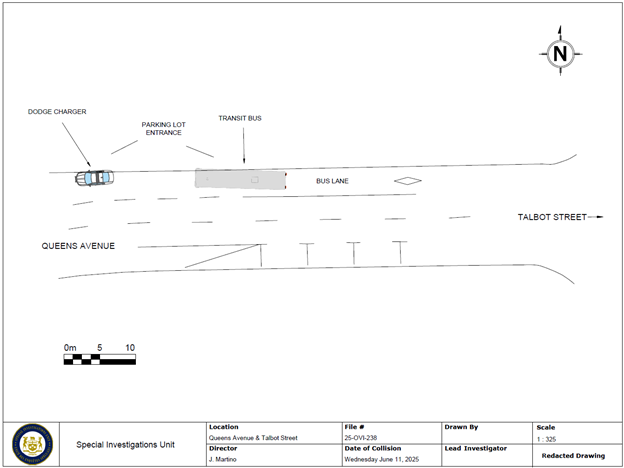
The events in question transpired on Queens Avenue, London, between Talbot Street and Ridout Street North.
Scene Diagram
Physical Evidence
Queens Avenue was a one-way street comprising two westbound traffic lanes. On the south side of the roadway was a parking lane, and on the north side of the roadway was a dedicated bus lane, painted red. North of the roadway, at 100 Queens Avenue, was a municipal parking lot. On the south side of Queens Avenue was the Court of Justice, 80 Dundas Street.
To the east of the collision scene, Talbot Street intersected Queens Avenue in a northbound-southbound orientation. There were traffic cameras mounted on the utility poles at that intersection.
The police vehicle operated by the SO had damage to the right rear corner area. The London Transit Commission (LTC) bus had damage to the left front corner and a bicycle carrier mounted on the front of the bus was destroyed.
In the red paint of the dedicated bus lane, skid marks were identified behind the bus tires, indicating the bus operator, the CW, had applied the brakes with force.
Expert Evidence
The SIU collision reconstructionist, having examined the scene and reviewed various records related to the investigation, including video recordings collected by the SIU, determined:
? The road and weather conditions were good and did not contribute to the collision. The collision occurred during daylight and there were no visibility issues.
? The area of impact between the police vehicle and the bus was in the dedicated bus lane, which was painted red, at the entrance driveway to a parking lot on the north side of Queens Avenue, west of Talbot Street.
? The bus stopped immediately after the collision, within a metre or two of the area of impact. The cruiser was brought to a controlled stop a few metres in front of the bus.
? Behind the bus, leading to the rear tires, were short skid marks consistent with the bus operator having applied the brakes heavily. There were patches on the surface of the bus tires consistent with the brakes having been locked, and the locked tires sliding, thereby creating the skid marks.
? There was no evidence on the road from the police vehicle, either pre-impact, or post-impact, which was not surprising given the low speed of the cruiser and the dynamics of the collision.
? Damage to the bus and police vehicle was minimal.
? The police vehicle was examined by an LPS mechanic and was found to be in good condition. The mechanical fitness of both the police vehicle and the bus was not a contributing factor in the collision.
? From a City of London traffic camera recording, the average speed of the bus between the Talbot Street crosswalk and the collision was calculated to be approximately 45 km/h, and the average speed of the police was approximately 30 km/h.
? A download of the onboard collision data from the SO’s vehicle revealed no collision event was recorded. The lack of collision event was consistent with the low forces involved in the collision.
? The Complainant appeared to have been injured when the bus suddenly decelerated as the operator attempted to avoid the collision. She had been sitting in a sideways facing seat at the front of the bus. When the bus decelerated suddenly, the Complainant rolled off the seat and onto the floor.
? The LTC bus was travelling west in the dedicated transit lane at a speed slightly faster than traffic in the other two through lanes, including the vehicle operated by the SO, who was driving in the lane immediately next to the transit lane.
? Approximately 50 metres west of the intersection of Talbot Street, the SO commenced a right turn across the transit lane towards a parking lot entrance. The transit bus struck the cruiser in a minor collision.
? There was no physical evidence to suggest the bus operator was at fault in the collision, or that he was able to avoid the collision.
Video/Audio/Photographic Evidence[2]
Video Footage - Queens Avenue and Talbot Street
The footage consisted of images from a traffic camera mounted on a utility pole on the southwest corner of the intersection of Queens Avenue and Talbot Street. At the time of the collision, the weather was clear and sunny.
Starting at about 00:26 minutes [elapsed time], the SO’s fully marked cruiser entered the intersection at Talbot Street, travelling westbound in the northernmost westbound traffic lane. A LTC bus was about four car lengths behind and to the right of the SO’s vehicle, travelling westbound in the dedicated bus lane. Both vehicles approached the entrance to the parking lot at 100 Queens Avenue. The LTC bus was travelling faster than the SO’s vehicle. Just prior to the parking lot entrance, the SO signaled his intention to turn right into the parking lot.
Starting at about 00:34 minutes, the SO started to make a right turn towards the entrance of the parking lot, and the brake lights of the LTC bus illuminated. The left front corner of the bus struck the right rear corner of the SO’s cruiser, and the bus turned to the right, before coming to an abrupt stop. After the collision, the SO pulled forward to the other side of the parking lot entrance.
Video Footage - LTC Bus
The footage consisted of images from four cameras inside the bus. The recording documented 13 passengers aboard the bus at the time of the collision. The Complainant was seated in the front seating area, sitting lateral to the direction of travel of the bus. One passenger was seated next to the Complainant. The bus came to an abrupt stop, and the Complainant fell to her right side and rolled, striking her left shoulder on the wheel well fixture inside the bus. The person who had been seated next to her rolled onto the Complainant.
The camera on the bus windshield recorded the SO’s vehicle turning to the right and entering the path of the bus.
LPS Communications Recordings – Radio
Following the collision, the SO requested an ambulance and a sergeant to attend the scene of the collision.
Materials Obtained from Police Service
Upon request, the SIU obtained the following records from the LPS between June 11, 2025, and June 27, 2025:
? Crash data recorder data from the SO’s cruiser
? Video footage from London Court of Justice, 80 Dundas Street
? Video footage from LTC Bus
? Computer-assisted Dispatch Report
? Statement of LTC driver - the CW
? List of civilian witnesses
? List of involved police officers
? Vehicle inspection reports
? Witness statement and notes of the WO
? Scene photographs
? Vehicle examiner’s field notes
Materials Obtained from Other Sources
The SIU obtained records from the following other sources between June 11, 2025, and June 26, 2025:
? Traffic camera recordings from the intersection of Queens Avenue and Talbot Street, received from City of London
? Video recordings from LTC bus, received from LTC
? The Complainant’s medical records, received from London Health Sciences Centre
Incident Narrative
The evidence collected by the SIU, including interviews with the Complainant and a civilian eyewitness, and video footage that captured the incident, gives rise to the following scenario. As was his legal right, the SO did not agree an interview with the SIU or the release of his notes.
In the afternoon of June 11, 2025, the Complainant was a passenger on a LTC bus travelling west on Queens Avenue in the northernmost lane - a dedicated bus lane. The bus had just passed Talbot Street and was approaching the entry to a parking lot on the north side of Queens Avenue when it collided with a marked police cruiser and came to a sudden stop. The Complainant was thrown from her seat onto the floor of the bus. She was transported to hospital in ambulance and diagnosed with a fractured scapula and ribs, and a partially collapsed lung.
The driver of the cruiser was the SO. He was travelling west in the lane beside the dedicated bus lane when he attempted to turn right into the parking lot entrance and collided with the bus. The officer exited his vehicle, boarded the bus to assess if everyone was okay, and arranged for an ambulance.
Relevant Legislation
Section 320.13 (2), Criminal Code – Dangerous Operation Causing Bodily Harm
320.13(1) Everyone commits an offence who operates a conveyance in a manner that, having regard to all of the circumstances, is dangerous to the public.
(2) Everyone commits an offence who operates a conveyance in a manner that, having regard to all of the circumstances, is dangerous to the public and, as a result, causes bodily harm to another person.
Section 142 (1), Highway Traffic Act – Signal for Left or Right Turn
142 (1) The driver or operator of a vehicle upon a highway before turning to the left or right at any intersection or into a private road or driveway or from one lane for traffic to another lane for traffic or to leave the roadway shall first see that the movement can be made in safety, and if the operation of any other vehicle may be affected by the movement shall give a signal plainly visible to the driver or operator of the other vehicle of the intention to make the movement.
Section 154 (1)(a), Highway Traffic Act – Where Highway Divided into Lanes
154 (1) Where a highway has been divided into clearly marked lanes for traffic,
(a) a vehicle shall not be driven from one lane to another lane or to the shoulder or from the shoulder to a lane unless the driver first ascertains that it can be done safely;
(b) in the case of a highway that is divided into three lanes, a vehicle shall not be driven in the centre lane except when overtaking and passing another vehicle where the roadway is clearly visible and the centre lane is clear of traffic within a reasonable safe distance, or in preparation for a left turn, or where the centre lane is at the time designated for the use of traffic moving in the direction in which the vehicle is proceeding and official signs are erected to indicate the designation;
(c) any lane may be designated for slowly moving traffic, traffic moving in a particular direction or classes or types of vehicles and, despite section 141, where a lane is so designated and official signs indicating the designation are erected, every driver shall obey the instructions on the official signs.
Analysis and Director’s Decision
The Complainant was seriously injured on June 11, 2025, when the bus in which she was a passenger collided with a LPS vehicle. The SIU was notified of the incident and initiated an investigation, naming the SO the subject official. The investigation is now concluded. On my assessment of the evidence, there are no reasonable grounds to believe that the SO committed a criminal offence in connection with the collision and the Complainant’s injuries.
The offence that arises for consideration is dangerous driving causing bodily harm contrary to section 320.13(2) of the Criminal Code. As an offence of penal negligence, a simple want of care will not suffice to give rise to liability. Rather, the offence is predicated, in part, on conduct that amounts to a marked departure from the level of care that a reasonable person would have observed in the circumstances. In the instant case, the issue is whether there was a want of care in the manner in which the SO operated his vehicle, sufficiently egregious to attract criminal sanction, that caused or contributed to the collision. In my view, there was not.
As the driver turning into the dedicated bus lane, the SO had the onus to ensure that he could perform the maneuver safely before attempting it. The evidence suggests he failed in that duty, in possible contravention of section 142(1) and/or 154(1)(a) of the Highway Traffic Act, when he turned into the path of a transit bus without any opportunity for the bus operator to avoid colliding with the cruiser. That indiscretion, however, would not seem sufficient to ground a charge of dangerous driving. In other respects, the SO’s driving around the time of the collision gave no cause for concern. He was travelling at the speed limit, had activated his turn signal, and was not sharply or abruptly entering the bus lane when the collision occurred. On this record, the officer’s conduct is fairly characterized as a momentary lapse of attention that fell short of a marked departure from a reasonable standard of care.
For the foregoing reasons, there is no basis for proceeding with criminal charges in this case. The file is closed.
Date: October 1, 2025
Electronically approved by
Joseph Martino
Director
Special Investigations Unit
Endnotes
- 1) Unless otherwise specified, the information in this section reflects the information received by the SIU at the time of notification and does not necessarily reflect the SIU’s findings of fact following its investigation. [Back to text]
- 2) The following records contain sensitive personal information and are not being released pursuant to section 34(2) of the Special Investigations Unit Act, 2019. The material portions of the records are summarized below. [Back to text]
Note:
The signed English original report is authoritative, and any discrepancy between that report and the French and English online versions should be resolved in favour of the original English report.