
SIU Director’s Report - Case # 24-PCD-460
Warning:
This page contains graphic content that can shock, offend and upset.
Contents:
Mandate of the SIU
The Special Investigations Unit is a civilian law enforcement agency that investigates incidents involving an official where there has been death, serious injury, the discharge of a firearm at a person or an allegation of sexual assault. Under the Special Investigations Unit Act, 2019 (SIU Act), officials are defined as police officers, special constables of the Niagara Parks Commission and peace officers under the Legislative Assembly Act. The SIU’s jurisdiction covers more than 50 municipal, regional and provincial police services across Ontario.
Under the SIU Act, the Director of the SIU must determine based on the evidence gathered in an investigation whether there are reasonable grounds to believe that a criminal offence was committed. If such grounds exist, the Director has the authority to lay a criminal charge against the official. Alternatively, in cases where no reasonable grounds exist, the Director cannot lay charges. Where no charges are laid, a report of the investigation is prepared and released publicly, except in the case of reports dealing with allegations of sexual assault, in which case the SIU Director may consult with the affected person and exercise a discretion to not publicly release the report having regard to the affected person’s privacy interests.
Information Restrictions
Special Investigations Unit Act, 2019
Pursuant to section 34, certain information may not be included in this report. This information may include, but is not limited to, the following:
- The name of, and any information identifying, a subject official, witness official, civilian witness or affected person.
- Information that may result in the identity of a person who reported that they were sexually assaulted being revealed in connection with the sexual assault.
- Information that, in the opinion of the SIU Director, could lead to a risk of serious harm to a person.
- Information that discloses investigative techniques or procedures.
- Information, the release of which is prohibited or restricted by law.
- Information in which a person’s privacy interest in not having the information published clearly outweighs the public interest in having the information published.
Freedom of Information and Protection of Personal Privacy Act
Pursuant to section 14 (i.e., law enforcement), certain information may not be included in this report. This information may include, but is not limited to, the following:
- Confidential investigative techniques and procedures used by law enforcement agencies; and
- Information that could reasonably be expected to interfere with a law enforcement matter or an investigation undertaken with a view to a law enforcement proceeding.
Pursuant to section 21 (i.e., personal privacy), protected personal information is not included in this report. This information may include, but is not limited to, the following:
- The names of persons, including civilian witnesses, and subject and witness officials;
- Location information;
- Witness statements and evidence gathered in the course of the investigation provided to the SIU in confidence; and
- Other identifiers which are likely to reveal personal information about individuals involved in the investigation.
Personal Health Information Protection Act, 2004
Pursuant to this legislation, any information related to the personal health of identifiable individuals is not included.
Other proceedings, processes, and investigations
Information may also have been excluded from this report because its release could undermine the integrity of other proceedings involving the same incident, such as criminal proceedings, coroner’s inquests, other public proceedings and/or other law enforcement investigations.
Mandate Engaged
Pursuant to section 15 of the SIU Act, the SIU may investigate the conduct of officials, be they police officers, special constables of the Niagara Parks Commission or peace officers under the Legislative Assembly Act, that may have resulted in death, serious injury, sexual assault or the discharge of a firearm at a person.
A person sustains a “serious injury” for purposes of the SIU’s jurisdiction if they: sustain an injury as a result of which they are admitted to hospital; suffer a fracture to the skull, or to a limb, rib or vertebra; suffer burns to a significant proportion of their body; lose any portion of their body; or, as a result of an injury, experience a loss of vision or hearing.
In addition, a “serious injury” means any other injury sustained by a person that is likely to interfere with the person’s health or comfort and is not transient or trifling in nature.
This report relates to the SIU’s investigation into the death of a 46-year-old man (the “Complainant”).
The Investigation
Notification of the SIU[1]
On October 27, 2024, at 3:44 p.m., the OPP contacted the SIU with the following information.
On October 27, 2024, at approximately 12:30 p.m., OPP responded to a ‘break and enter’ and ‘assault’ call at a residence in the area of Axmith Avenue and Mississauga Avenue, Elliot Lake, Ontario. They located the male suspect [now known to be the Complainant] inside the residence. The Complainant resisted and was grounded by police officers. He fought while the police officers attempted to handcuff him to the rear. He continued to fight all the way to the police vehicle and subsequently dropped to the ground. The Complainant was eventually placed in the police vehicle. While the arresting officers went back into the home to check on the victims, an officer who had remained with the Complainant noticed that he was becoming unresponsive, and his lips were turning blue. The Complainant was removed from the vehicle, and officers commenced cardiopulmonary resuscitation (CPR) and administered three doses of naloxone with negative results. Emergency Medical Services (EMS) responded and transported the Complainant to St. Joseph’s Hospital in Elliot Lake. The Complainant was reportedly pronounced deceased in the Emergency Unit of the hospital.
The Team
Date and time team dispatched: 2024/10/27 at 4:52 p.m.
Date and time SIU arrived on scene: 2024/10/27 at 11:22 p.m.
Number of SIU Investigators assigned: 4
Number of SIU Forensic Investigators assigned: 1
Affected Person (aka “Complainant”):
46-year-old male; deceased
Civilian Witnesses (CW)
CW #1 Interviewed
CW #2 Interviewed
CW #3 Interviewed
CW #4 Interviewed
CW #5 Interviewed
The civilian witnesses were interviewed between October 28, 2024, and October 29, 2024.
Subject Official (SO)
SO Declined interview and to provide notes, as is the subject official’s legal right
Witness Officials (WO)
WO #1 Interviewed; notes received and reviewed
WO #2 Interviewed; notes received and reviewed
The witness officials were interviewed on October 29, 2024.
Investigative Delay
The Report of Postmortem Examination was received by the SIU from the Coroner’s Office on August 1, 2025.
Evidence
The Scene
The events in question transpired on and around the porch of a residence located in the area of Axmith Avenue and Mississauga Avenue (Residence #1), Elliot Lake, and in and around a police cruiser - a marked OPP Ford Explorer - parked on the west side of the street between Residence #1 and the residence immediately to its north.
Physical Evidence
The OPP Ford Explorer was a fully marked, full-size SUV equipped with roof lights and push bar. The rear windows and rear quarters were tinted glass. The interior was equipped with a full cage and hard molded rear seats. The divider between the rear compartment and the front seats was a steel plate up to the height of the seat shoulder and Plexiglass above the roof liner. A small centre section above the shoulder line was able to be opened and was protected with expanded steel. The police vehicle was equipped with in-car camera (ICC) that captured the entire rear seat area.
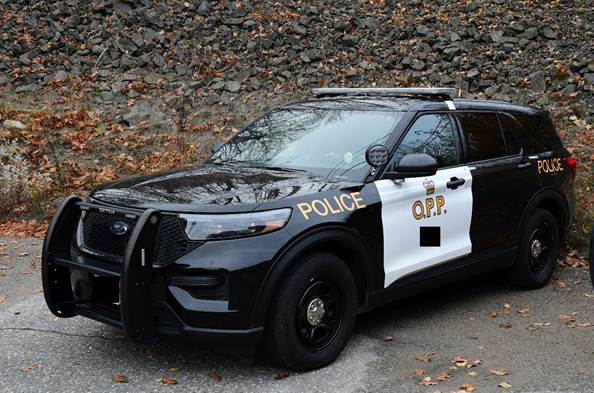
Figure 1: OPP Ford Explorer SUV
The approximate dimensions of the rear seat were as follows:
- From the rear passenger side door to driver side door – 1.95 m
- From the back of the seat to the cage – 0.79 m
- From the front of the seat edge to the cage – 0.33 m
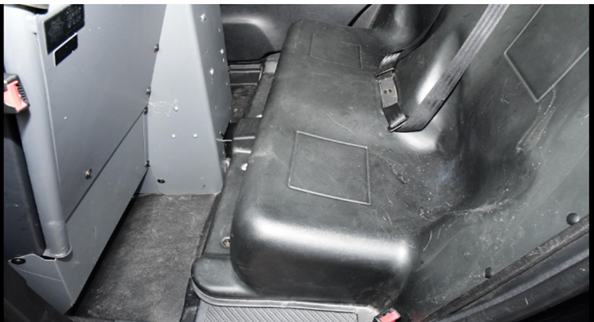
Figure 2: Rear seat of OPP Explorer SUV
The view from the outside to the interior of the rear of the police vehicle was obscured by tinted glass. The view from the driver’s seat to the rear was obscured by the cage and equipment in the front compartment of the police vehicle. The height of the steel plate portion of the cage prevented a view of the lower seat area of the rear compartment of the police vehicle.
Video/Audio/Photographic Evidence[2]
ICC Footage - The SO
The footage began at 1:07:02 p.m., October 27, 2024.
Starting at about 1:07:23 p.m., the left (driver side) rear door was opened. A man [now known to be the Complainant] was yelling, “No!” The Complainant was laying on the ground outside the police vehicle with a police officer standing near him. The Complainant was brought up to his feet and directed towards the back seat of the police vehicle by the police officers. The Complainant was yelling repeatedly, “Help!” and, “No!”
Starting at about 1:08:02 p.m., the Complainant was on his stomach on the back seat of the police vehicle with his head hanging off the seat. The SO went to the right (passenger side) rear door, while WO #1 and WO #2 remained at the left rear door. WO #1 asked the SO to grab the Complainant’s arm to pull him into the police vehicle. The Complainant was on his stomach with his head hanging off the seat and not cooperating with the police officers. The SO got into the back seat. The SO was on the right-side pulling the Complainant into the police vehicle and WO #1 was on the left side pushing him into the police vehicle. A police officer said, “Hold on guys, his head is stuck,” and the Complainant continued to yell, “No!” The SO pulled the Complainant up on his stomach by his armpit area and the Complainant yelled, “No! I need a drink of water.”
Starting at about 1:08:29 p.m., the right rear door was closed. The Complainant was still on his stomach, handcuffed with his hands behind his back, and his head was off the seat. WO #1 pushed the Complainant’s legs and feet into the back seat from the left rear door. The Complainant said, “Help me! Help me!”
Starting at about 1:08:36 p.m., the left rear door was forced closed while the Complainant continued to push his feet and yell, “No!”
Starting at about 1:08:38 p.m., the Complainant’s upper body slid off the bench seat with only his right hip and right leg left on the seat. His head was down on the floorboard with his hands handcuffed behind his back.
Starting at about 1:08:45 p.m., the Complainant said, “Open that up. I need a drink.”
Starting at about 1:08:50 p.m., the Complainant repeatedly said, “Please, please!” while kicking at the door and the back seat.
From about 1:08:54 to 1:09:15 p.m., the Complainant said, “Please, open it up,” “Please,” “Fuck, come on!” and, “Ouch, come on. I can’t breathe,” “Ouch, help. I can’t breathe.” He continued to kick.
Starting at about 1:09:24 p.m., the Complainant said, “Come on!”
Starting at about 1:09:29 p.m., the Complainant stopped kicking.
Starting at about 1:09:33 p.m., an exhalation was heard, and the Complainant’s right leg moved a bit.
Starting at about 1:09:49 p.m., the Complainant stopped moving.
Starting at about 1:10:14 p.m., there was movement and breathing heard from someone out of camera range.
Starting at about 1:12:26 p.m., a police officer - the SO - called out “[Complainant’s first name]” but there was no response from the Complainant.
Starting at about 1:19:04 p.m., the SO opened the windows of the police vehicle and, at 1:20:37 p.m., one of the windows was closed.
Starting at about 1:20:43 p.m., the door of the police vehicle [assumed to be the driver’s door] was heard opening and closing.
Starting at about 1:22:25 p.m., it sounded like the SO got back into the police vehicle. The window was opened again.
Starting at about 1:22:41 p.m., the window was closed and the SO got out of the police vehicle. He walked around the rear of the police vehicle to the right rear door.
Starting at about 1:22:47 p.m., the SO stood at the right rear door calling into the Complainant. He said, “[Complainant’s first name]!” but there was no response.
Starting at about 1:23:01 p.m., the SO said, “Hey [the Complainant’s first name], wake up!” He flashed his flashlight and tapped on the window bars.
Starting at about 1:23:23 p.m., the SO called the Complainant’s name again.
Starting at about 1:23:28 p.m., another police officer - WO #1 - arrived at the right rear door of the police vehicle.
Starting at about 1:23:33 p.m., the SO continued to call-out to the Complainant and bang on the window bars. There was still no response from the Complainant.
Starting at about 1:23:40 p.m., a police officer called for an ambulance and the door was unlocked.
Starting at about 1:23:44 p.m., the right rear door was opened by WO #1. The officer looked in the police vehicle and said, “Oh Jesus, how did he get like that?”
Starting at about 1:23:50 p.m., WO #1 said, “[Complainant’s first name],” tapped him, and said, “Call paramedics.”
Starting at about 1:23:58 p.m., WO #1 continued to call the Complainant and struggled to pull his upper body and head up from the floorboard.
Starting at about 1:24:02 p.m., WO #1 said, “[SO’s first name], give me a hand here. We’ve got to pull him out.” The SO said on the radio, “Can you dispatch EMS; the male is unconscious.” Both police officers struggled to pull the Complainant out from the back seat of the police vehicle.
Starting at about 1:24:20 p.m., the Complainant was pulled from the police vehicle by the SO and WO #1, and put on the ground.
Starting at about 1:24:25 p.m., one of the police officers said, “I don’t know what he took,” and the other police officer said, “[Complainant’s first name], oh fuck. He’s blue.”
Starting at about 1:24:33 p.m., a police officer started chest compressions on the Complainant. A police officer advised on the radio that they were doing chest compressions.
Starting at about 1:24:45 p.m., a police officer asked for the paramedics to be expedited. The door of the police vehicle was closed.
Starting at about 1:25:30 p.m., a police officer said, “Don’t give him mouth to mouth, we don’t know what he took. But keep doing compressions.”
Starting at about 1:25:49 p.m., a police officer said that Narcan was administered.
Starting at about 1:26:40 p.m., a police officer asked another police officer to go and ask if the Complainant had taken anything. The police officer responded that she [now known to be CW #5] said he had smoked an “upper”. The chest compressions continued.
Starting at about 1:30:00 p.m., there was discussion between the police officers as to when to remove the handcuffs, as the chest compressions continued.
Starting at about 1:30:45 p.m., the handcuffs were removed from the Complainant’s hands and the chest compressions continued.
Starting at about 1:31:09 p.m., an ambulance arrived at the scene.
Starting at about 1:31:26 p.m., a paramedic asked if the police officers witnessed him go down. A police officer responded the Complainant was in the back of the car, and he was alive when he was put in there. The paramedic asked if there was any information on the Complainant.
Starting at about 1:31:37 p.m., a police officer said “He’s on uppers and [SO’s first name] here had a bit of a scrap with him. He seemed to be seeing things, broke into his place. We don’t know if he took anything. We gave him three shots of Narcan and continued CPR. Nothing on him except some cash.”
Starting at about 1:31:57 p.m., the window of the police vehicle was closed and, at about 1:33:20 p.m., a police officer sat in the police vehicle, not in camera view.
Starting at about 1:40:24 p.m., a police officer - WO #2 - advised over the air that he would follow the ambulance to the hospital.
Communications Recordings
At about 12:50:26 p.m., October 27, 2024, CW #3 was heard on a 911 call saying, “Get out of my house.” She said she needed the police right now. The dispatcher asked for her address. CW #3 was yelling 911 and a man - the Complainant - was heard in the background. CW #3 provided her address and asked that police hurry because she was scared. The dispatcher asked what was happening and CW #3 asked the police to hurry because the Complainant was breaking her window. The dispatcher asked who was there, and CW #3 said the Complainant was refusing to leave her house and he was “tripping out on drugs”. CW #3 identified herself and said she lived across the street from the Complainant. CW #3 asked the Complainant to get out of her house and he said he would.
At about two minutes and 13 seconds into the recording, CW #3 was crying, and the Complainant yelled, “911, hurry up, hurry up!” The Complainant yelled, “They are coming!” CW #3 said the Complainant just ran into her house. The dispatcher asked CW #3 to go into another room and CW #3 said she was in the same room. The Complainant yelled that someone was coming in through the window and they were going to beat him up. The Complainant continuously yelled for 911 and CW #3 repeatedly tried to keep him calm by telling him he was fine, and no one was coming into the house. The Complainant asked CW #3 to tell 911 to hurry because he was being beaten. CW #3 asked the dispatcher to ask the police to hurry because she was scared. CW #3 provided the Complainant’s name to the dispatcher. The dispatcher told CW #3 to separate herself from the Complainant, and CW #3 said he would break her doors. The Complainant repeatedly yelled, “911,” and CW #3 said he was freaking out. CW #3 told the dispatcher there were no weapons. She then screamed, “[Complainant’s first name], let go of me, ow, ow.” She yelled for the Complainant to get out and asked the dispatcher for help. The dispatcher told her to get away from him, but she said the Complainant was holding onto her. She asked him to let go but he continued to yell. She tried to calm the Complainant and told him to breathe. She said it was getting worse. She asked the Complainant not to hurt her and said he was holding her leg. CW #3 described what the Complainant was wearing. CW #3 continued to try to calm the Complainant and told him the police were coming. CW #3 was breathing heavily and asking the Complainant to let her get up, after which she said the police were there. A male police officer told the Complainant to get off CW #3. CW #3 told the police the Complainant had broken her window. The dispatcher said, “Okay,” and the call ended.
Materials Obtained from Police Service
Upon request, the SIU obtained the following records from the OPP between October 28, 2024, and October 31, 2024:
- Witness List
- List of Involved Officers
- Next-of-kin notification by a sergeant
- Scene Security Log
- SOCO report
- Sudden Death Investigation Report
- Notes – WO #1 and WO #2
- Computer-assisted Dispatch Report
- The Complainant’s history with OPP
- Communications recordings
- ICC footage
- ICC Audit Result – the SO
Materials Obtained from Other Sources
The SIU obtained the following records from the following other sources between October 29, 2024, and August 1, 2025.:
- Cellphone video footage from CW #3
- Video footage from nearby residence
- Report of Postmortem Examination from Coroner’s Office
Incident Narrative
The evidence collected by the SIU, including interviews with police and non-police witnesses, and video footage that captured the incident in part, gives rise to the following scenario. As was his legal right, the SO chose not to interview with the SIU or authorize the release of his notes.
In the early afternoon of October 27, 2024, the OPP received a 911 call from CW #3 from a residence in the area of Axmith Avenue and Mississauga Avenue, Elliot Lake. CW #3 reported that a male had entered her house, and she wanted him out. She explained that he was breaking a window and holding her, refusing to let go.
The male was the Complainant. The Complainant lived across the street and suffered from mental illness and drug addiction. He was impaired on cocaine at the time and experiencing paranoid delusions. He believed that people were trying to do him harm, and continually asked that the police be called.
The SO, WO #2 and WO #1 answered the call and made their way to the address. They located the Complainant holding onto CW #3’s leg and separated them, after which they handcuffed him behind the back following a struggle. No strikes were delivered. The Complainant continually asked for the police in the presence of the officers. The officers attempted to reassure him that they were the police.
The Complainant was lifted to his feet and escorted to the SO’s marked OPP SUV where he refused to seat himself in the rear compartment. The officers forced him inside – the SO pulling him from the passenger side rear door, and WO #1 pushing him from the driver side rear door. The Complainant was initially in a prone position across the rear bench seat, his head by the passenger side door, when the officers closed the doors. Shortly, however, he rolled over so that his head and torso were now in the footwell of the passenger side rear seat (facing rearward), his left leg was in the driver side footwell, and his right leg was draped across the centre and driver side portions of the rear seat. The time was about 1:09 p.m. The Complainant kicked his right leg and appeared to breathe until about 1:10 p.m., from which time no further movements could be discerned. He remained in that position until about 1:24 p.m.
WO #1 had asked the SO to stay and keep an eye on the Complainant while he and WO #2 took statements from CW #3 and checked on the occupants of the Complainant’s house across the street. At about 1:22 p.m., the SO advised WO #1 that something appeared wrong with the Complainant. The SO had attempted to rouse the Complainant from outside the rear passenger side door by calling out his name and banging on the vehicle. WO #1 opened the door and asked how the Complainant had gotten in the position he was in.
The officers called for the paramedics, removed the Complainant onto the ground beside the cruiser and did emergency first-aid. Three doses of naloxone were administered, and chest compressions performed.
The ambulance arrived on scene at about 1:31 p.m. The Complainant was vital signs absent. He was taken to hospital and pronounced deceased at 2:00 p.m.
Cause of Death
The pathologist at autopsy attributed the Complainant’s death to “complications of cocaine toxicity in a man with hypertensive heart disease”.
Relevant Legislation
Section 215, Criminal Code - Failure to Provide Necessaries
215 (1) Every one is under a legal duty
(c) to provide necessaries of life to a person under his charge if that person
(i) is unable, by reason of detention, age, illness, mental disorder or other cause, to withdraw himself from that charge, and
(ii) is unable to provide himself with necessaries of life.
(2) Every person commits an offence who, being under a legal duty within the meaning of subsection (1), fails without lawful excuse to perform that duty, if
(b) with respect to a duty imposed by paragraph (1)(c), the failure to perform the duty endangers the life of the person to whom the duty is owed or causes or is likely to cause the health of that person to be injured permanently.
Sections 219 and 220, Criminal Code - Criminal Negligence Causing Death
219 (1) Every one is criminally negligent who
(a) in doing anything, or
(b) in omitting to do anything that it is his duty to do,
shows wanton or reckless disregard for the lives or safety of other persons.
(2) For the purposes of this section, duty means a duty imposed by law.
220 Every person who by criminal negligence causes death to another person is guilty of an indictable offence and liable
(a) where a firearm is used in the commission of the offence, to imprisonment for life and to a minimum punishment of imprisonment for a term of four years; and
(b) in any other case, to imprisonment for life.
Analysis and Director’s Decision
The Complainant lapsed into acute medical distress while in the custody of OPP officers on October 27, 2024, and was pronounced deceased later that day. The SIU was notified of the incident and initiated an investigation, naming the SO the subject official. The investigation is now concluded. On my assessment of the evidence, there are no reasonable grounds to believe that the SO committed a criminal offence in connection with the Complainant’s death.
The offences that arise for consideration are failure to provide the necessaries of life and criminal negligence causing death contrary to sections 215 and 220 of the Criminal Code, respectively. Both require something more than a simple want of care to give rise to liability. The former is predicated, in part, on conduct that amounts to a marked departure from the level of care that a reasonable person would have exercised in the circumstances. The latter is premised on even more egregious conduct that demonstrates a wanton or reckless disregard for the lives or safety of other persons. It is not made out unless the neglect constitutes a marked and substantial departure from a reasonable standard of care. In the instant case, the question is whether there was any want of care on the part of the SO, sufficiently serious to attract criminal sanction, that endangered the Complainant’s life or caused his death. In my view, there was not.
The Complainant was lawfully in police custody at the time he was placed in the rear of the police cruiser. He had entered onto private premises without authority and grabbed hold of CW #3, rendering himself subject to arrest for break and enter, and assault.
There are aspects of the care the Complainant received from the SO that are subject to scrutiny, but the overall evidence falls short of reasonably establishing the officer transgressed the limits of care prescribed by the criminal law. With the Complainant in his custody, the SO owed him a duty of care. Beyond that, the officer had explicitly been told by the sergeant on scene to remain with the Complainant to keep an eye on him. With that in mind, one wonders why the Complainant was allowed to remain in the position he was for as long as he was. Arguably, the SO ought to have exercised greater vigilance and noticed the Complainant’s compromised position and non-responsiveness sooner than he did, especially in light of the signs that the Complainant was suffering the effects of an illicit substance. On the other hand, just prior to his placement in the rear of the cruiser, the Complainant, though intoxicated and delusional, was able to walk and talk. He had also demonstrated a measure of vigour by physically resisting the officers at the time of his arrest and as they went to place him in the cruiser. In the circumstances, the SO might have reasonably believed that the Complainant was well enough to not require the kind of heightened observation that would have been necessary to possibly notice his medical distress at an early stage and take action to intervene. Moreover, it should be noted that the pathology evidence was inconclusive as to whether the Complainant’s final resting position in the rear of the cruiser (angled head-down in a narrow space across the backseat footwell) played a role in his death. Lastly, once the Complainant was discovered in medical crisis, the SO assisted with emergency care measures, including CPR and the administration of naloxone. On this record, there is insufficient evidence to reasonably conclude that the SO’s conduct amounted to a marked departure from a reasonable standard of care.
For the foregoing reasons, there is no basis for proceeding with criminal charges in this case. The file is closed.
Date: October 1, 2025
Electronically approved by
Joseph Martino
Director
Special Investigations Unit
Endnotes
- 1) Unless otherwise specified, the information in this section reflects the information received by the SIU at the time of notification and does not necessarily reflect the SIU’s findings of fact following its investigation. [Back to text]
- 2) The following records contain sensitive personal information and are not being released pursuant to section 34(2) of the Special Investigations Unit Act, 2019. The material portions of the records are summarized below. [Back to text]
Note:
The signed English original report is authoritative, and any discrepancy between that report and the French and English online versions should be resolved in favour of the original English report.