
SIU Director’s Report - Case # 25-PFI-209
Warning:
This page contains graphic content that can shock, offend and upset.
Contents:
Mandate of the SIU
The Special Investigations Unit is a civilian law enforcement agency that investigates incidents involving an official where there has been death, serious injury, the discharge of a firearm at a person or an allegation of sexual assault. Under the Special Investigations Unit Act, 2019 (SIU Act), officials are defined as police officers, special constables of the Niagara Parks Commission and peace officers under the Legislative Assembly Act. The SIU’s jurisdiction covers more than 50 municipal, regional and provincial police services across Ontario.
Under the SIU Act, the Director of the SIU must determine based on the evidence gathered in an investigation whether there are reasonable grounds to believe that a criminal offence was committed. If such grounds exist, the Director has the authority to lay a criminal charge against the official. Alternatively, in cases where no reasonable grounds exist, the Director cannot lay charges. Where no charges are laid, a report of the investigation is prepared and released publicly, except in the case of reports dealing with allegations of sexual assault, in which case the SIU Director may consult with the affected person and exercise a discretion to not publicly release the report having regard to the affected person’s privacy interests.
Information Restrictions
Special Investigations Unit Act, 2019
Pursuant to section 34, certain information may not be included in this report. This information may include, but is not limited to, the following:
- The name of, and any information identifying, a subject official, witness official, civilian witness or affected person.
- Information that may result in the identity of a person who reported that they were sexually assaulted being revealed in connection with the sexual assault.
- Information that, in the opinion of the SIU Director, could lead to a risk of serious harm to a person.
- Information that discloses investigative techniques or procedures.
- Information, the release of which is prohibited or restricted by law.
- Information in which a person’s privacy interest in not having the information published clearly outweighs the public interest in having the information published.
Freedom of Information and Protection of Personal Privacy Act
Pursuant to section 14 (i.e., law enforcement), certain information may not be included in this report. This information may include, but is not limited to, the following:
- Confidential investigative techniques and procedures used by law enforcement agencies; and
- Information that could reasonably be expected to interfere with a law enforcement matter or an investigation undertaken with a view to a law enforcement proceeding.
Pursuant to section 21 (i.e., personal privacy), protected personal information is not included in this report. This information may include, but is not limited to, the following:
- The names of persons, including civilian witnesses, and subject and witness officials;
- Location information;
- Witness statements and evidence gathered in the course of the investigation provided to the SIU in confidence; and
- Other identifiers which are likely to reveal personal information about individuals involved in the investigation.
Personal Health Information Protection Act, 2004
Pursuant to this legislation, any information related to the personal health of identifiable individuals is not included.
Other proceedings, processes, and investigations
Information may also have been excluded from this report because its release could undermine the integrity of other proceedings involving the same incident, such as criminal proceedings, coroner’s inquests, other public proceedings and/or other law enforcement investigations.
Mandate Engaged
Pursuant to section 15 of the SIU Act, the SIU may investigate the conduct of officials, be they police officers, special constables of the Niagara Parks Commission or peace officers under the Legislative Assembly Act, that may have resulted in death, serious injury, sexual assault or the discharge of a firearm at a person.
A person sustains a “serious injury” for purposes of the SIU’s jurisdiction if they: sustain an injury as a result of which they are admitted to hospital; suffer a fracture to the skull, or to a limb, rib or vertebra; suffer burns to a significant proportion of their body; lose any portion of their body; or, as a result of an injury, experience a loss of vision or hearing.
In addition, a “serious injury” means any other injury sustained by a person that is likely to interfere with the person’s health or comfort and is not transient or trifling in nature.
This report relates to the SIU’s investigation into the serious injury of a 50-year-old man (the “Complainant”).
The Investigation
Notification of the SIU[1]
On May 21, 2025, at 6:17 p.m., the Ontario Provincial Police (OPP) contacted the SIU with the following information.
On May 21, 2025, at about 4:55 p.m., Collingwood OPP officers responded to a dispute at a residence in the area of Campbell Street and Maple Street, Collingwood. The first police officer to arrive was the Subject Official (SO). As she approached the home, the Complainant tossed an incendiary device towards her and then fired a flare gun attempting to ignite the flammable substance in the device. The SO drew her pistol and fired at the Complainant, striking him with an unknown number of rounds. Emergency Medical Services (EMS) attended and transported the Complainant to the Collingwood General and Marine Hospital (CGMH) for emergency surgery.
The Team
Date and time team dispatched: 2025/05/21 at 6:42 p.m.
Date and time SIU arrived on scene: 2025/05/21 at 7:57 p.m.
Number of SIU Investigators assigned: 3
Number of SIU Forensic Investigators assigned: 2
Affected Person (aka “Complainant”):
50-year-old male; interviewed; medical records obtained and reviewed
The Complainant was interviewed on May 22, 2025.
Civilian Witnesses (CW)
CW #1 Interviewed
CW #2 Interviewed
CW #3 Interviewed
CW #4 Interviewed
The civilian witnesses were interviewed between May 22, 2025, and May 26, 2025.
Subject Official
SO Declined interview and to provide notes, as is the subject official’s legal right
Witness Officials (WO)
WO #1 Interviewed; notes received and reviewed
WO #2 Interviewed; notes received and reviewed
WO #3 Interviewed; notes received and reviewed
The witness officials were interviewed on May 22, 2025.
Evidence
The Scene
The events in question transpired in the rear yard of a residence in the area of Campbell Street and Maple Street, Collingwood.
Physical Evidence
The property was a residence in an urban neighborhood located in the area of Campbell Street and Maple Street. In the backyard was a shed.
The SO’s use of force equipment was secured in a locker at the Collingwood OPP Detachment. Her uniform, body armour, boots and duty belt were placed in bags and sealed to preserve evidence of a potential accelerant. All equipment was examined and photographed.
A Glock model 17M handgun assigned to the SO was collected as evidence. There were 13 live cartridges in the magazine and 1 live cartridge in the chamber. The magazine normally had a 17-round capacity.[2]
There were three Winchester nine-millimetre Luger cartridge casings collected at the scene. All three casings were located close together in the backyard south of the shed. Two of the casings were located on the ground on top of a tarp. A third casing was located on the dirt just west of the tarp. No spent rounds were recovered from the scene. Due to the litter-strewn state of the backyard, it was impossible to identify projectile strikes.
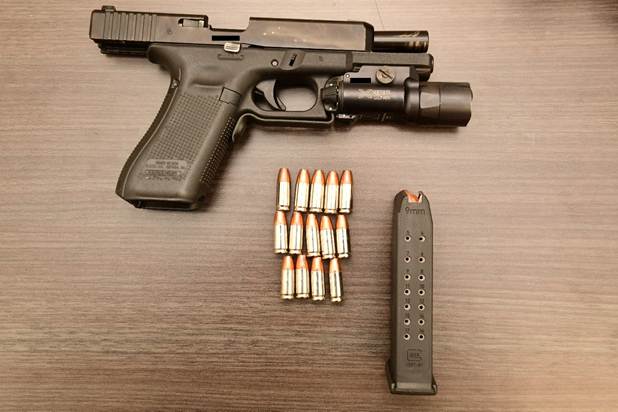
Figure 1 – The SO’s firearm and magazine
A conducted energy weapon (CEW) assigned to WO #1 was photographed and returned to the OPP for download. The CEW was a Taser X2 model. There was an undeployed cartridge, which had been removed from the CEW prior to SIU arrival. A deployed CEW cartridge was recovered from the scene north of the shed. The CEW wires had been wrapped around the deployed CEW cartridge.
There were numerous glass mason jars on the ground in the backyard with an unidentified liquid inside the jars.
Inside the shed was a flare gun.
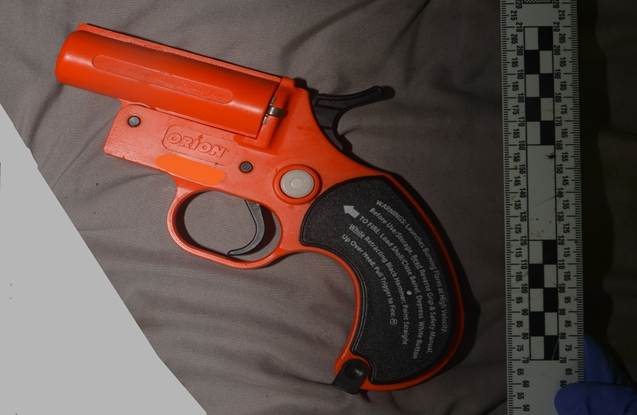
Figure 2 – Flare gun
Forensic Evidence
OPP - CEW Deployment Data - WO #1
On May 21, 2025, at 5:32:08 p.m.,[3] the CEW was armed. At 5:32:19 p.m., a cartridge was deployed and the trigger was depressed for seven seconds. At 5:32:28 p.m., the CEW was rendered safe.
Centre of Forensic Sciences (CFS) Submissions & Results
The SO’s and WO #1’s uniform pants and boots, and a glass bottle, were submitted by the OPP to CFS to be analyzed to confirm the presence and type of accelerant used. On September 9, 2025, the SIU received the results of the CFS analysis. WO #1’s uniform pants and boots tested positive for gasoline. The SO’s uniform boots tested positive for gasoline, but her pants did not. The glass bottle tested positive for gasoline.
Video/Audio/Photographic Evidence[4]
OPP BWC Footage - WO #3, WO #2, WO #1, The SO, Officer #1 and Officer #2
On May 21, 2025, starting at about 4:58:31 p.m., the SO, WO #1, WO #2 and WO #3 arrived at the residence. They walked up the driveway and into the backyard. WO #1 entered first, followed by the SO, then WO #3 and WO #2. WO #1 called out to “[Complainant’s first name]”.
Starting at about 4:59:03 p.m., the Complainant emerged from the side of a shed in the backyard. He told the police officers to back up repeatedly. The SO tried to talk to him and reminded him she had been at the property over the weekend. The Complainant held a bottle in front of his chest. He said, “It ain’t gonna end good,” then he disappeared into the shed for three seconds.
Starting at about 4:59:24 p.m., the Complainant emerged from the shed with a flare gun raised and pointed at the SO and WO #1. All the officers stepped backwards a few steps. The Complainant said, “That’s right, get the fuck out of here.” The SO told him to “drop it”.
Starting at about 4:59:29 p.m., the SO and WO #3 pointed their firearms at the Complainant. WO #1 pointed his CEW at the Complainant. The Complainant raised a glass bottle over his right shoulder. He told the officers to shoot him multiple times. The officers continued to tell the Complainant to “drop it”. WO #1 walked closer to the Complainant and crossed in front of the SO.
Starting at about 4:59:42 p.m., the Complainant threw the glass bottle in an overhand fashion at the ground in front of WO #1. WO #1 deployed his CEW at the Complainant at the same time as the Complainant fired the flare gun to the left of WO #1’s feet. The bushes adjacent to the residence burst into flames. The CEW was ineffective. The SO discharged her firearm four times as the Complainant retreated into the shed. The shots were fired at steady regular intervals over several seconds. WO #1 followed at a distance with the CEW still raised.
Starting at about 4:59:57 p.m., the Complainant emerged from the shed and squatted down in the doorway. WO #1 told him to get on the ground. He insisted he was on the ground. WO #1 pointed to his left side and told him to get on the ground. The SO said the same. The Complainant stood up and walked slowly to where WO #1 had pointed. He sat in a chair instead of on the ground. He eventually lowered himself onto the ground. There was blood stained on the back of his shirt. The fire spread to some nearby wooden boards, which laid across the ground. WO #3 stomped on the flames to put them out. He used a nearby tarp to smother the flames.
Starting at about 5:01:06 p.m., the Complainant was handcuffed by WO #1 and WO #2. The police officers rendered first-aid to the Complainant.
Starting at about 5:05:03 p.m., WO #1 and WO #3 moved items out of the way in advance of the arrival of EMS.
Starting at about 5:07:14 p.m., fire services arrived and took over first-aid.
Starting at about 5:10:20 p.m., EMS arrived. WO #1 told the paramedics that the Complainant had consumed lots of alcohol.
Starting at about 5:14:24 p.m., WO #1 picked up his discarded CEW cartridge from the ground and spooled the deployed wires around the cartridge. He exited the backyard with the CEW cartridge.
OPP In-car Camera System (ICCS) Footage – Officer #3’s OPP Vehicle
On May 21, 2025, at 5:22:57 p.m., the ICCS activated. Thirty seconds later, the audio track activated. Officer #3 transported the SO to the hospital for a critical incident stress assessment. The SO appeared to be engaged in a phone call with an unidentified male.
Starting at about 5:23:59 p.m., the SO said, “I called this though, remember?” which appeared to be in reference to a prior interaction with the Complainant. The unidentified male said, “So he was firing a flare gun at you?” to which the SO replied, “He shot the flare gun at me, then I shot him.” The SO said, “[WO #1] tased him, then he shot the flare gun, so obviously the taser didn’t work.”
The unidentified male asked how many rounds the SO had fired. The SO said,
“I thought I fired three but there’s four missing from my gun.” The unidentified male asked if she had a full magazine. The SO confirmed it was.
OPP Communications Recordings
On May 21, 2025, at 4:51:55 p.m., CW #1 called 911. She requested police officers attend a residence in the area of Campbell Street and Maple Street because the Complainant was out of control. She said he had damaged something and tried to hurt himself. He had punched doors and walls. He had consumed alcohol, marijuana and “mushrooms”. He had a flare gun, a knife and gasoline in mason jars. There was also an aluminum baseball bat on top of the shed. He smashed the shed with the bat and then threw it on top of the shed. CW #1 told the dispatcher about the Complainant’s mental health history.
At 20 seconds into the audio, the dispatcher advised CW #1 wanted the Complainant removed from the property. He had consumed alcohol, smoked marijuana and consumed “mushrooms”. He had punched walls and doors, and caused damage.
At one minute and 10 seconds of the audio, the dispatcher advised CW #1 had gone to a nearby residence. The dispatcher reported the Complainant had access to a flare gun and mason jars filled with gasoline. The dispatcher said the Complainant had bipolar disorder and was known to carry weapons.
Materials Obtained from Police Service
Upon request, the SIU obtained the following records from the OPP between May 22, 2025, and May 29, 2025:
- General Occurrence and Supplementary Reports
- Arrest Report
- Computer-aided Dispatch Report
- Communications recordings
- Email – ‘Be on Lookout’ for the Complainant
- BWC footage
- ICCS footage
- CEW deployment data
- Scene and evidence photographs
- Notes – WO #1, WO #3 and WO #2
Materials Obtained from Other Sources
The SIU obtained the following records from other sources between May 23, 2025, and September 9, 2025:
- The Complainant’s medical records from CGMH
- CFS Chemistry Analysis for the presence of ignitable liquids
Incident Narrative
The evidence collected by the SIU, including interviews with the Complainant, and police and non-police witnesses, and video footage that largely captured the incident, gives rise to the following scenario. As was her legal right, the SO did not agree an interview with the SIU or the release of her notes.
In the afternoon of May 21, 2025, OPP officers from the Collingwood Detachment were called out to a residence in the area of Campbell Street and Maple Street. CW #1 had contacted police to report a disturbance involving the Complainant. The two were located in a shed in the rear yard of the property. CW #1, who had left the shed out of concern for her safety, reported that the Complainant was out of control and had damaged property with a bat. He was said to have consumed drugs and alcohol, and be in possession of a flare gun, a knife and mason jars of gasoline.
The SO arrived on scene with WO #1, WO #2 and WO #3. They walked to the rear yard and were immediately confronted by the Complainant, emerging from the west side of the shed with a jar of gasoline in his hands. He told the officers to back up and threatened that things would end badly. WO #1 and the SO told the Complainant to drop the jar and attempted to de-escalate the situation, the latter by drawing attention to recent dealings the two had had. The Complainant remained belligerent. He returned inside his shed and quickly exited again, this time holding a jar in his right hand and a flare gun in his left.
WO #1 was closest to the Complainant, no more then a few metres south of his location. He drew his CEW and ordered the Complainant to drop what he was holding. The SO was slightly behind and to WO #1’s right. She also ordered the Complainant to stand down. WO #3 and WO #2 were behind the SO. The Complainant threw the glass jar at WO #1’s feet. It shattered and its contents dispersed on the ground. He then fired his flare gun at the ground in the vicinity of WO #1, igniting the gasoline behind him. The officer discharged his CEW at about the same time, to no effect. Right after the CEW deployment, the SO fired her gun – four times in a span of about three seconds. The time was 4:59 p.m.
The Complainant re-entered the shed on his feet after the final shot, re-emerging after several seconds. He was ordered to the ground and eventually lowered himself. He had sustained gunshot wounds to the lower torso.
Officers performed first-aid on the Complainant pending the arrival of firefighters and paramedics.
Relevant Legislation
Section 34, Criminal Code - Defence of Person – Use or Threat of Force
34 (1) A person is not guilty of an offence if
(a) They believe on reasonable grounds that force is being used against them or another person or that a threat of force is being made against them or another person;
(b) The act that constitutes the offence is committed for the purpose of defending or protecting themselves or the other person from that use or threat of force; and
(c) The act committed is reasonable in the circumstances.
(2) In determining whether the act committed is reasonable in the circumstances, the court shall consider the relevant circumstances of the person, the other parties and the act, including, but not limited to, the following factors:
(a) the nature of the force or threat;
(b) the extent to which the use of force was imminent and whether there were other means available to respond to the potential use of force;
(c) the person’s role in the incident;
(d) whether any party to the incident used or threatened to use a weapon;
(e) the size, age, gender and physical capabilities of the parties to the incident;
(f) the nature, duration and history of any relationship between the parties to the incident, including any prior use or threat of force and the nature of that force or threat;
(f.1) any history of interaction or communication between the parties to the incident;
(g) the nature and proportionality of the person’s response to the use or threat of force; and
(h) whether the act committed was in response to a use or threat of force that the person knew was lawful.
(3) Subsection (1) does not apply if the force is used or threatened by another person for the purpose of doing something that they are required or authorized by law to do in the administration or enforcement of the law, unless the person who commits the act that constitutes the offence believes on reasonable grounds that the other person is acting unlawfully.
Section 88, Criminal Code - Possession of Weapon for Dangerous Purpose
88 (1) Every person commits an offence who carries or possesses a weapon, an imitation of a weapon, a prohibited device or any ammunition or prohibited ammunition for a purpose dangerous to the public peace or for the purpose of committing an offence.
(2) Every person who commits an offence under subsection (1)
(a) is guilty of an indictable offence and liable to imprisonment for a term not exceeding ten years; or
(b) is guilty of an offence punishable on summary conviction.
Section 267, Criminal Code - Assault with a Weapon or Causing Bodily Harm
267 Every person is guilty of an indictable offence and liable to imprisonment for a term of not more than 10 years or is guilty of an offence punishable on summary conviction who, in committing an assault,
(a) carries, uses or threatens to use a weapon or an imitation thereof,
(b) causes bodily harm to the complainant, or
(c) chokes, suffocates or strangles the complainant.
Section 430, Criminal Code - Mischief
430(1) Every one commits mischief who wilfully
(a) destroys or damages property;
(b) renders property dangerous, useless, inoperative or ineffective;
(c) obstructs, interrupts or interferes with the lawful use, enjoyment or operation of property; or
(d) obstructs, interrupts or interferes with any person in the lawful use, enjoyment or operation of property.
Analysis and Director’s Decision
The Complainant was shot and wounded by an OPP officer just prior to his arrest on May 21, 2025. The SIU was notified of the incident and initiated an investigation, naming the SO the subject official. The investigation is now concluded. On my assessment of the evidence, there are no reasonable grounds to believe that the SO committed a criminal offence in connection with the shooting.
Section 34 of the Criminal Code provides that conduct that would otherwise constitute an offence is legally justified if it was intended to deter a reasonably apprehended assault, actual or threatened, and was itself reasonable. The reasonableness of the conduct is to be assessed in light of all the relevant circumstances, including with respect to such considerations as the nature of the force or threat; the extent to which the use of force was imminent and whether there were other means available to respond to the potential use of force; whether any party to the incident used or threatened to use a weapon; and, the nature and proportionality of the person’s response to the use or threat of force.
The SO and her fellow officers were lawfully placed and in the execution of their duties through the chain of events culminating in gunfire. They had been called to the scene of a disturbance involving a violent individual and, by the time the SO fired her weapon, had grounds to take the Complainant into custody for a variety of offences, including assault with a weapon, weapons dangerous and mischief contrary to sections 267(a), 88(1) and 430(1)(a), respectively, of the Criminal Code.
The evidence indicates that the SO fired her semi-automatic pistol to protect herself and WO #1, WO #2 and WO #3 from a reasonably apprehended attack at the hands of the Complainant. Though the SO did not provide that evidence firsthand in an interview with the SIU, as was her legal right, the inference arises naturally from the circumstances that prevailed at the time, chiefly, the fact that the Complainant had threatened the officers and was holding a flare gun, which he had shot in the direction of WO #1 attempting to ignite gasoline on the ground in the vicinity of the officers.
The evidence also establishes the use by the SO of her firearm constituted reasonable force. The Complainant was a real and present danger to the lives of the officers. He had pointed a flare gun – itself capable of causing serious injury and death – directly at the officers at close range, and had fired it at the ground in what would have appeared a deliberate attempt to set the officers on fire. That the gasoline on the ground did not ignite in a more significant eruption of flames than happened, and the officers were not engulfed in fire, is more fortuity than anything else. On this record, I am unable to reasonably conclude that the SO’s resort to gunfire was precipitous or unwarranted. With every reason to believe that the Complainant was intent on doing her and the other officers mortal harm, and with the CEW discharge by WO #1 without seeming effect, the officer was right to conclude that the immediate stopping power of a firearm was commensurate with the exigencies of the moment.
For the foregoing reasons, there is no basis for proceeding with charges in this case.
There was evidence in the investigation of what appears to have been conduct on the part of WO #1 in possible violation of sections 18 and 20 of the Special Investigations Unit Act, 2019. It should have been immediately apparent to WO #1 that the incident would attract the jurisdiction of the SIU, and yet he removed from the scene the CEW cartridge, and related wiring, he had fired (returning it later). Pursuant to this office’s legal obligation under
section 35.1 of the Special Investigations Unit Act, 2019, I will be referring the matter to the Law Enforcement Complaints Agency.
Date: September 18, 2025
Electronically approved by
Joseph Martino
Director
Special Investigations Unit
Endnotes
- 1) Unless otherwise specified, the information in this section reflects the information received by the SIU at the time of notification and does not necessarily reflect the SIU’s findings of fact following its investigation. [Back to text]
- 2) At the scene, a sergeant advised OPP officers were trained to top off the magazine with an additional round to provide a ready condition of 18 rounds. [Back to text]
- 3) The times are derived from the internal clock of the weapon, and are not necessarily synchronous with actual time. [Back to text]
- 4) The following records contain sensitive personal information and are not being released pursuant to section 34(2) of the Special Investigations Unit Act, 2019. The material portions of the records are summarized below. [Back to text]
Note:
The signed English original report is authoritative, and any discrepancy between that report and the French and English online versions should be resolved in favour of the original English report.