
SIU Director’s Report - Case # 25-OFD-161
Warning:
This page contains graphic content that can shock, offend and upset.
Contents:
Mandate of the SIU
The Special Investigations Unit is a civilian law enforcement agency that investigates incidents involving an official where there has been death, serious injury, the discharge of a firearm at a person or an allegation of sexual assault. Under the Special Investigations Unit Act, 2019 (SIU Act), officials are defined as police officers, special constables of the Niagara Parks Commission and peace officers under the Legislative Assembly Act. The SIU’s jurisdiction covers more than 50 municipal, regional and provincial police services across Ontario.
Under the SIU Act, the Director of the SIU must determine based on the evidence gathered in an investigation whether there are reasonable grounds to believe that a criminal offence was committed. If such grounds exist, the Director has the authority to lay a criminal charge against the official. Alternatively, in cases where no reasonable grounds exist, the Director cannot lay charges. Where no charges are laid, a report of the investigation is prepared and released publicly, except in the case of reports dealing with allegations of sexual assault, in which case the SIU Director may consult with the affected person and exercise a discretion to not publicly release the report having regard to the affected person’s privacy interests.
Information Restrictions
Special Investigations Unit Act, 2019
Pursuant to section 34, certain information may not be included in this report. This information may include, but is not limited to, the following:
- The name of, and any information identifying, a subject official, witness official, civilian witness or affected person.
- Information that may result in the identity of a person who reported that they were sexually assaulted being revealed in connection with the sexual assault.
- Information that, in the opinion of the SIU Director, could lead to a risk of serious harm to a person.
- Information that discloses investigative techniques or procedures.
- Information, the release of which is prohibited or restricted by law.
- Information in which a person’s privacy interest in not having the information published clearly outweighs the public interest in having the information published.
Freedom of Information and Protection of Personal Privacy Act
Pursuant to section 14 (i.e., law enforcement), certain information may not be included in this report. This information may include, but is not limited to, the following:
- Confidential investigative techniques and procedures used by law enforcement agencies; and
- Information that could reasonably be expected to interfere with a law enforcement matter or an investigation undertaken with a view to a law enforcement proceeding.
Pursuant to section 21 (i.e., personal privacy), protected personal information is not included in this report. This information may include, but is not limited to, the following:
- The names of persons, including civilian witnesses, and subject and witness officials;
- Location information;
- Witness statements and evidence gathered in the course of the investigation provided to the SIU in confidence; and
- Other identifiers which are likely to reveal personal information about individuals involved in the investigation.
Personal Health Information Protection Act, 2004
Pursuant to this legislation, any information related to the personal health of identifiable individuals is not included.
Other proceedings, processes, and investigations
Information may also have been excluded from this report because its release could undermine the integrity of other proceedings involving the same incident, such as criminal proceedings, coroner’s inquests, other public proceedings and/or other law enforcement investigations.
Mandate Engaged
Pursuant to section 15 of the SIU Act, the SIU may investigate the conduct of officials, be they police officers, special constables of the Niagara Parks Commission or peace officers under the Legislative Assembly Act, that may have resulted in death, serious injury, sexual assault or the discharge of a firearm at a person.
A person sustains a “serious injury” for purposes of the SIU’s jurisdiction if they: sustain an injury as a result of which they are admitted to hospital; suffer a fracture to the skull, or to a limb, rib or vertebra; suffer burns to a significant proportion of their body; lose any portion of their body; or, as a result of an injury, experience a loss of vision or hearing.
In addition, a “serious injury” means any other injury sustained by a person that is likely to interfere with the person’s health or comfort and is not transient or trifling in nature.
This report relates to the SIU’s investigation into the death of a 30-year-old man (the “Complainant”).
The Investigation
Notification of the SIU[1]
On April 24, 2025, at 7:43 a.m., the Peel Regional Police (PRP) contacted the SIU with the following information.
At 5:46 a.m., Toronto Pearson International Airport security was notified by family members that the Complainant was displaying mental health symptoms or in a drug-induced psychosis. The Complainant was reportedly in a Jeep Grand Cherokee at the departures level of Terminal 1, Post 40. Airport security contacted PRP and three police officers arrived [now known to be Subject Official (SO) #2, Witness Official (WO) #1 and SO #1]. The police officers approached the Complainant in the Jeep and attempted to de-escalate the situation. The Complainant exited the Jeep holding a handgun pointed at the police officers. At about 6:53 a.m., SO #2 and SO #1 discharged their service pistols at the Complainant. He was subsequently pronounced deceased at the scene.
The Team
Date and time team dispatched: 2025/04/24 at 8:10 a.m.
Date and time SIU arrived on scene: 2025/04/24 at 8:44 a.m.
Number of SIU Investigators assigned: 8
Number of SIU Forensic Investigators assigned: 4
Affected Person (aka “Complainant”):
30-year-old male; deceased
Civilian Witnesses (CW)
CW #1 Interviewed
CW #2 Interviewed
CW #3 Interviewed
CW #4 Interviewed
CW #5 Interviewed; next-of-kin
CW #6 Interviewed
CW #7 Interviewed
CW #8 Interviewed
CW #9 Interviewed
CW #10 Interviewed
CW #11 Interviewed
CW #12 Interviewed
CW #13 Interviewed
CW #14 Not interviewed; declined
CW #15 Not interviewed; declined
The civilian witnesses were interviewed between April 24, 2025, and May 1, 2025.
Subject Officials
SO #1 Interviewed; notes received and reviewed
SO #2 Declined interview and to provide notes, as is the subject official’s legal right
The subject official was interviewed on May 27, 2025.
Witness Officials
WO #1 Interviewed; notes received and reviewed
WO #2 Interviewed; notes received and reviewed
WO #3 Not interviewed; notes reviewed and interview deemed unnecessary
The witness officials were interviewed on May 1, 2025.
Evidence
The Scene
The events in question transpired in and around a Jeep Grand Cherokee stopped at Post 40 of Terminal 1 (departures level), Toronto Pearson International Airport.
SIU forensic services arrived on scene at 10:20 a.m., April 24, 2025. In attendance were numerous police officers, as well as SIU investigators, who were receiving a briefing from a police officer on scene.
There were two sets of departure lanes that travelled one way - eastbound.
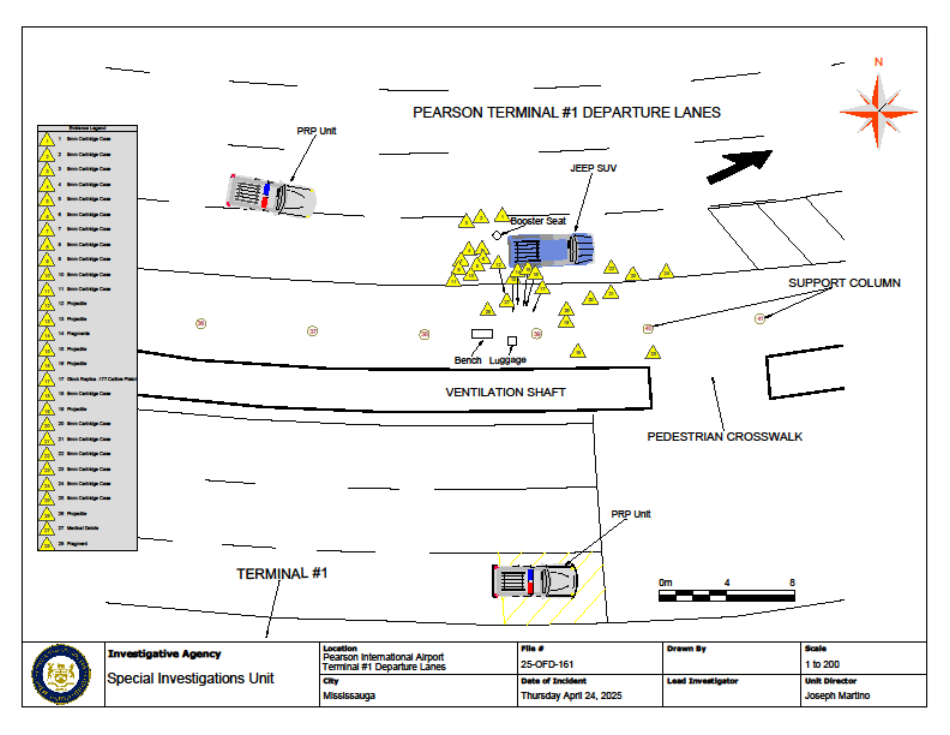
The north side eastbound lanes consisted of four marked lanes. A raised concrete platform separated the north side lanes and south side lanes. There was a pedestrian walkway from Terminal 1 across the sidewalk and south side lanes, which continued across the raised platform. The pedestrian walkway was between Posts 41 and 42. The south side lanes consisted of three eastbound marked lanes. A raised sidewalk was between the south edge of the lane and Terminal 1.
At the scene was a Jeep and a marked police vehicle. The Jeep was parked adjacent to Posts 40 and 41. Both right side doors were open. A total of 11 coffee cups and French fry containers covered cartridge cases behind and to the right side of the Jeep. A child’s booster seat was located on the laneway behind the vehicle. There was an area of bloodstaining in front of the north curb of the raised platform and west of the right rear corner of the Jeep.
There was a yellow emergency blanket covering the body of the Complainant, who was located on his back on the raised platform with his head towards the south and his feet towards the north. His feet were partially over the edge of the platform. A Glock replica .177 air pistol was on the laneway and partially under the left bottom corner of the tarp.
Eighteen 9 mm cartridge cases were located and collected from the incident scene.
Scene Diagram
The scene was photographed and scanned, and a scene drawing created.
Physical Evidence
SO #1’s firearm was a Sig Sauer 9 mm pistol with attached magazine. The pistol had one live round in the chamber and ten live rounds in the affixed magazine, for a total of 11 rounds of 9 mm ammunition. SO #1 discharged seven rounds.
SO #2’s firearm was a Sig Sauer 9 mm pistol with attached magazine. The pistol had one live round in the chamber and six live rounds in the affixed magazine, for a total of seven rounds of 9 mm ammunition. SO #2 discharged 11 rounds.
WO #1’s firearm was a Sig Sauer 9 mm pistol with attached magazine. The pistol had one live round in the chamber and 17 live rounds in the affixed magazine, for a total of 18 rounds of 9 mm ammunition. WO #1 did not discharge his service pistol.
All the involved officials had full spare magazines.
The police officers’ service pistols were collected, as well as numerous 9 mm rounds, fragmented projectile cases, and the Complainant’s clothing.
On the roadway between the passenger side of the Jeep and the body was a black replica Glock .177 calibre air pistol. This was beside the curb and partially covered by the yellow blanket. The grip of the pistol was wrapped in black electrical tape. The item was examined and found to be an accurate replica of a Glock Model 19 semi-automatic pistol. It included the Glock logo and manufacture information stamped onto the receiver, including a serial number. A physical examination showed that the slide mechanism did not function and small markings on the underside of the frame indicated the calibre as being 4.5 mm or .177, an air pistol calibre. The base of the grip where the magazine would fit was threaded for an air cartridge. This area was wrapped in electrical tape and concealed from view.
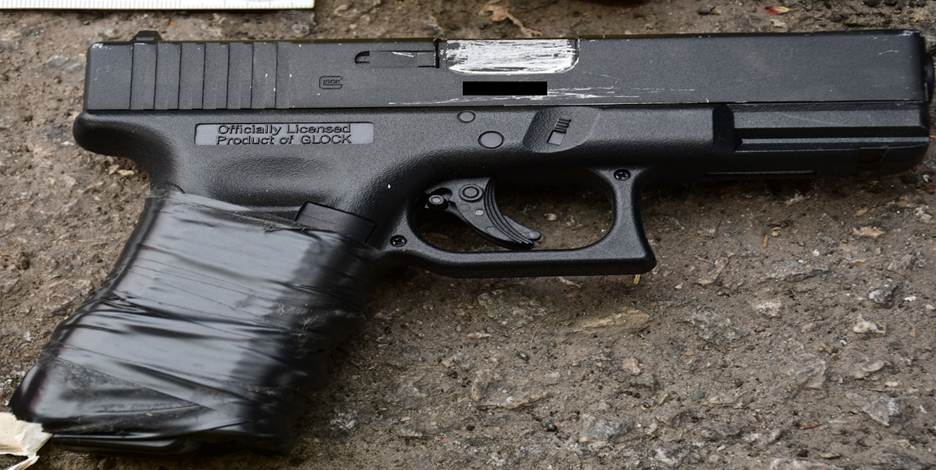
Replica Glock .177 calibre air pistol
Forensic Evidence
The Chief Forensic Pathologist ordered toxicology to be done on the Complainant on April 25, 2025, and the Toxicology Report from the Centre of Forensic Sciences was received June 25, 2025. It showed the Complainant did not have any alcohol in his system, but did have a combination of drugs in his system.
Video/Audio/Photographic Evidence[2]
Body-worn Camera (BWC) Recordings of SO #2 and WO #1
Starting at about 6:38 a.m., April 24, 2025, SO #2 and WO #1 were captured walking north along the departures area and then speaking with CW #15, who was concerned for her brother. She believed he was in a drug-induced psychosis and experiencing mental health symptoms, and that he needed to go to the hospital. CW #15 explained that the Complainant had agreed to go to the Yukon to get help, but at the airport he refused to go.
Starting at about 6:39 a.m., WO #1 made his way to the Jeep as SO #2 spoke with CW #15. CW #14 told the Complainant he wanted him out of the Jeep. WO #1 went to the passenger rear door. For the next few minutes, the Complainant argued about wanting his medications and his cellular telephone, and that he had paid his rent and did not want to go on the flight. He put his hood over his head and his face in his lap and said he did not want to talk as people twisted his words. WO #1 told the Complainant they were there to help him, but the Complainant said that was not true.
Starting at about 6:40 a.m., SO #2 advised dispatch this was not a domestic call but a mental health-related call.
Starting at about 6:41 a.m., airport public safety officers (PSO) arrived (CW #1 and CW #2). There arose a discussion in which taking the Complainant to the hospital was considered as an option. WO #1 told the PSOs that the Complainant was not forced to get into the Jeep Grand Cherokee that morning, and that indications were that he had agreed to travel to a treatment centre in Whitehorse, but changed his mind at the airport. Dispatch updated the police officers that the Complainant was flagged in police records for violence, aggravated assault, and prohibited firearms. He had a related criminal record. SO #2 advised CW #1 of this information.
Starting at about 6:43 a.m., an emotional and agitated Complainant appeared at the left rear side of the Jeep. SO #2 and WO #1 tried to talk with him and get him off the road. The Complainant argued with the officers, saying he was being forced to go. CW #15 tried to talk to him, but he spoke over her and then returned to the right rear seat. CW #14 advised he had the keys for the Jeep. SO #2 told him to lock the doors the next time the Complainant got out.
Starting at about 6:44 a.m., SO #2 opened the right rear door and the Complainant was on the opposite side. The Complainant voiced frustrations and added that he was having a panic attack. SO #2 offered to call an ambulance, which he did not want. The officer then explained that he did not have to get on the plane, and they were trying to help him.
Starting at about 6:47 a.m., the Complainant mentioned he did not want to lose his life forever but at the end of the day he probably would. He stated his whole family had set him up. WO #1 joined SO #1 and the family at Post 40. CW #15 said they did not take him to a shelter as he had agreed to go to Whitehorse.
Starting at about 6:48 a.m., WO #1 went back to the Jeep and the Complainant continued to argue. WO #1 asked the Complainant what he thought the solution was. The Complainant said that a family member controlled people with mental health issues and made them look like “loose cannons”. WO #1 continued to speak to the Complainant, telling him that he was sorry that he had had bad previous experiences with police. The Complainant said he did not care anymore, and that his own family betrayed him.
Starting at about 6:51 a.m., WO #1 stepped away from the door of the Jeep. Meanwhile, CW #15 continued to speak with SO #2, telling her that the Complainant was in psychosis, and it would only get worse. He was supposed to get his medication every three days, but she had no idea if he took them. SO #2 agreed that he was in a crisis, but SO #2 and WO #1 explained that the elements for an apprehension under the Mental Health Act had not been met. The Complainant was not a danger to himself or the public. SO #2 said the most they could do was to get him out of the Jeep Grand Cherokee and put him on a bus. SO #2 and WO #1 returned to the rear passenger door. The Complainant said he feared for his life. SO #2 told him they would not force him to go anywhere but he needed to get out of the Jeep, and he would be walked to a bus stop. The Complainant refused because if he got out of the Jeep things would not be good; his life would be over. SO #2 told him, once at the bus stop, he was a free man. On several occasions, SO #2 told the Complainant to get out of the vehicle, but the Complainant argued about his property.
Starting at about 6:52 a.m., WO #1 walked away and eventually met SO #1 by Post 40. The Complainant was still in the vehicle, and he yelled at SO #2 to “stop talking about me”. The Complainant then quickly moved to the right rear side and exited the Jeep with what appeared to be a handgun in his left hand. He yelled, “Shut the fuck up.” A woman was heard screaming. WO #1 turned, and the Complainant was outside the Jeep with the gun pointed directly at WO #1. WO #1 ran towards the post for protection and SO #1 stepped away, drew his service pistol and began firing. SO #2 retreated to the rear driver side of the Jeep Grand Cherokee and drew her service pistol, firing the first of many shots. SO #2’s extended arms blocked the view of her camera. It appeared as if the Complainant collapsed by the rear passenger side of the Jeep after the first three or four shots. More shots were heard. The Complainant lay on his left side by the curb with his knees bent towards his face and his hands between his knees and face. SO #2 told CW #15 to back up as she approached the Complainant, saying he had a gun. SO #1 approached the Complainant and kicked the handgun aside. SO #2 made a radio transmission, “10-33, gun, gun, gun, gun.” CW #15 said, “You murdered him,” and SO #2 told her several times he had a gun. An ambulance was requested. The Complainant was pulled onto the sidewalk by SO #1 and WO #1. WO #1 began life-saving measures. SO #2 said, “Oh my fucking God.” Other police officers arrived to assist. An emergency nurse, who was at the airport, arrived to assist. CW #1 asked SO #2 if she was okay, and she said, “No,” and repeated, “Oh my fucking God.” Another police officer arrived and SO #2 said, “He pulled a fucking gun on me.” Life-saving measures continued and SO #2 said, “I’m going to fucking die,” as she watched.
Starting at about 6:59 a.m., SO #1 approached SO #2 and asked if she shot first, but the verbal response was not captured. The nurse who stopped to assist told the police officers that he was likely deceased.
Paramedics arrived at about 7:01 a.m. and took over the Complainant’s care.
An unknown police officer asked SO #2 if the Complainant had fired. SO #2 replied, “He came barrelling out of the car,” and she demonstrated how he held his firearm.
A supervisor attended and took charge of the scene, directing the involved officers to gather their service pistols and gun belts and put them in one police vehicle.
Communications Recordings – Radio
At about 6:36 a.m., April 24, 2025, SO #2 and WO #1 were dispatched to a mental health call at Terminal 1, departures level, by Post 40. Airport security was monitoring the situation on security camera. At the time, a man [now known to be the Complainant] was standing behind a Jeep. PSOs were also dispatched. WO #1 advised police officers were on scene at about 6:38 a.m. A records check was requested, and the Complainant was said to have cautions for violence and prohibited firearms, and a related criminal record.
At about 6:52 a.m., SO #2 announced, “10-33, gun, gun, gun, gun.” Fifteen seconds later, SO #2 announced that a man had multiple gunshots wounds.
WO #2 arrived, and CPR was being preformed. Emergency Medical Services was requested to rush to the scene for an unconscious Complainant. No police officers were injured.
At about 7:26 a.m., dispatch was updated that the Complainant had been pronounced deceased remotely by Sunnybrook Health Sciences Centre.
Communications Recordings - Telephone Calls
At about 6:35 a.m., Palladin Security called PRP to attend at Terminal 1, departures level, Post 40, for a family dispute. The driver of a Jeep had reportedly asked his brother-in-law to leave, but he refused.
At about 6:54 a.m., PRP dispatch called Palladin Security to advise that there had been a shooting.
At about 6:57 a.m., a telephone call was made to the duty inspector to advise of the situation.
Materials Obtained from Police Service
Upon request, the SIU obtained the following records from the PRP between April 24 and 29, 2025:
- Communications recordings
- Computer-assisted Dispatch Report
- Incident Details Report
- Notes of all witness officials
- BWC footage of all officials except SO #1[3]
- PRP Directive – Incident Response
Materials Obtained from Other Sources
The SIU obtained the following records from the following other sources between April 25, 2025, and June 25, 2025:
- Preliminary Autopsy Findings Report from the Ontario Forensic Pathology Service
- Video footage from the Greater Toronto Airport Authority
- Toxicology Report from the Centre of Forensic Sciences
- Report of Postmortem Examination from the Coroner’s Office
Incident Narrative
The evidence collected by the SIU, including interviews with SO #1 and police and non-police eyewitnesses, and video footage that largely captured the incident, gives rise to the following scenario. As was her legal right, SO #2 did not agree an interview with the SIU or the release of her notes.
In the morning of April 24, 2025, PRP was asked by airport security to attend at the departures level outside Terminal 1 of Toronto Pearson International Airport. CW #15 had approached security for assistance in relation to her brother – the Complainant. The Complainant was reportedly in distress, owing to some combination of mental illness and drug consumption, and refusing to leave their vehicle to catch a flight. SO #2 and her partner, WO #1, present at the airport, made their way to the vehicle, a Jeep Grand Cherokee, arriving at about 6:38 a.m.
CW #15 spoke to the officers and explained what was happening. Despite having earlier agreed, the Complainant was refusing to exit their Jeep to take a flight to the Yukon where he had been registered in a treatment program. She and her husband, also present on scene, wanted him out of the Jeep. Talk turned to possible options, including having the Complainant exit the vehicle to take a bus to wherever he wanted to go, or offering to take him to hospital on a voluntary basis. SO #1 arrived shortly after SO #2 and WO #1’s attendance, and joined in the conversation with CW #15 and CW #14.
At the same time, SO #2 and WO #1 alternately spoke to the Complainant, seated in the back seat of the Jeep. He complained that he had been taken against his will to the airport, and did not want to attend the program. Repeatedly asked to exit the vehicle, he refused, indicating he wanted to be driven back to his residence. When asked whether he had been evicted from his residence – information provided the officers by CW #15 – the Complainant adamantly denied that was the case. He expressed frustrations with the police, whom he did not trust, and his sister and her husband, whom he believed were manipulating him. As talks continued, the Complainant became more fatalistic. He indicated that he was concerned for his life, and thought that his life would end if he stepped out of the Jeep. SO #2 became more insistent that he exit the vehicle.
Approximately 15 minutes after the officers’ arrival on scene, as SO #2 was speaking with the Complainant, the Complainant suddenly stepped out of the vehicle through the open rear passenger door holding what appeared to be a gun in his left hand. He told SO #2 to “shut the fuck up” and pointed the weapon in her direction. SO #2 ran towards the rear driver side of the Jeep, as SO #1 backed up towards the front end of the vehicle and WO #1 sought cover behind a post directly across from the Jeep’s rear passenger side door. From those positions, the officers drew their firearms. The Complainant pointed his gun from side to side at the officers. Approximately four seconds after his exit from the Jeep, he was shot and collapsed to the pavement beside the rear passenger side corner of the vehicle. The gunfire continued for another three seconds before coming to an end. The time was 6:53 a.m.
SO #2 had fired 11 times in rapid succession. SO #1 had discharged seven continuous rounds. WO #1 did not fire his weapon.
The officers administered CPR. Paramedics arrived on scene at about 7:00 a.m. and took charge of the Complainant’s care. He was pronounced deceased at the scene at 7:26 a.m.
Cause of Death
The pathologist at autopsy was of the view that the Complainant’s death was attributable to gunshot wounds of the chest.
Relevant Legislation
Section 34, Criminal Code - Defence of Person – Use or Threat of Force
34 (1) A person is not guilty of an offence if
(a) They believe on reasonable grounds that force is being used against them or another person or that a threat of force is being made against them or another person;
(b) The act that constitutes the offence is committed for the purpose of defending or protecting themselves or the other person from that use or threat of force; and
(c) The act committed is reasonable in the circumstances.
(2) In determining whether the act committed is reasonable in the circumstances, the court shall consider the relevant circumstances of the person, the other parties and the act, including, but not limited to, the following factors:
(a) the nature of the force or threat;
(b) the extent to which the use of force was imminent and whether there were other means available to respond to the potential use of force;
(c) the person’s role in the incident;
(d) whether any party to the incident used or threatened to use a weapon;
(e) the size, age, gender and physical capabilities of the parties to the incident;
(f) the nature, duration and history of any relationship between the parties to the incident, including any prior use or threat of force and the nature of that force or threat;
(f.1) any history of interaction or communication between the parties to the incident;
(g) the nature and proportionality of the person’s response to the use or threat of force; and
(h) whether the act committed was in response to a use or threat of force that the person knew was lawful.
(3) Subsection (1) does not apply if the force is used or threatened by another person for the purpose of doing something that they are required or authorized by law to do in the administration or enforcement of the law, unless the person who commits the act that constitutes the offence believes on reasonable grounds that the other person is acting unlawfully.
Analysis and Director’s Decision
The Complainant died on April 24, 2025, the result of gunshot wounds inflicted by one or both of two PRP officers. The SIU was notified of the incident and initiated an investigation, naming SO #1 and SO #2 subject officials. The investigation is now concluded. On my assessment of the evidence, there are no reasonable grounds to believe that either subject official committed a criminal offence in connection with the Complainant’s death.
Section 34 of the Criminal Code provides that conduct that would otherwise constitute an offence is legally justified if it was intended to deter a reasonably apprehended assault, actual or threatened, and was itself reasonable. The reasonableness of the conduct is to be assessed in light of all the relevant circumstances, including with respect to such considerations as the nature of the force or threat; the extent to which the use of force was imminent and whether there were other means available to respond to the potential use of force; whether any party to the incident used or threatened to use a weapon; and, the nature and proportionality of the person’s response to the use or threat of force.
The police officers, including SO #1 and SO #2, were lawfully placed and in the execution of their duty through the series of events culminating in gunfire. They had been asked to assist with a passenger in mental distress refusing to exit a vehicle, and were within their rights as peace officers in trying to find a constructive resolution to the problem. The video footage establishes that the officers approached the situation with care, quickly recognizing that they were dealing with a mental health issue. They listened carefully to the involved parties and attempted to de-escalate the situation by suggesting possible solutions to the standoff. Their determination that the Complainant was not subject to apprehension under the Mental Health Act was a reasonable one. Though he exhibited signs of mental disorder, there were no explicit indications that he was a threat to himself or others until the time he pointed a gun at the officers.
I am satisfied that SO #1 and SO #2 fired their weapons to protect themselves and others from a reasonably apprehended attack by the Complainant. SO #1 provided the SIU a statement and gave that evidence directly. His account is supported by what is captured on the video footage, namely, the Complainant quickly exiting the Jeep with a gun pointed at the officers. Though the gun was an air pistol, it gave every indication of being an actual firearm capable of causing grievous bodily harm or death. SO #2, as was her legal right, did not avail herself of an opportunity to provide the SIU an interview. It is, nevertheless, safe to infer based on the same video footage that she too harboured an honest belief that defensive force was necessary to protect herself and others from the Complainant.
Lastly, I am satisfied that the subject officials’ resort to their firearms constituted reasonable defensive force. When the Complainant emerged suddenly from the Jeep with what appeared to be a firearm pointed at the officers, SO #1 and SO #2 would have had every reason to believe that their lives were in imminent peril. Withdrawal or retreat were not options given the speed with which events unfolded and the presence of other persons in the area. What was required was the immediate incapacitation of the Complainant, and the only weapons capable of doing that were the officers’ firearms. On this record, the first three or four gunshots were clearly justified. The more difficult issue is whether the gunfire that continued after the Complainant collapsed to the ground following the initial shots was justified. In retrospect, it is apparent on the BWC footage that the Complainant had been struck and seriously wounded. Very likely, he was at that point no threat to anyone. That said, faced with what must have felt like a grave and mortal threat to their lives, neither SO #1 nor SO #2 had the luxury of hindsight or the benefit of time. Their foremost concern in the highly charged atmosphere of the moment was to make absolute certain that the Complainant was no longer a threat. When allowance is made for that imperative, the delay inherent in reaction times and the common law principle that officers embroiled in dangerous situations are not expected to measure their responsive force with precision,[4] I am unable to reasonably conclude that either subject official exceeded the remit of authorized force through their gunfire.
For the foregoing reasons, there is no basis for proceeding with criminal charges in this case. The file is closed.
Date: August 21, 2025
Electronically approved by
Joseph Martino
Director
Special Investigations Unit
Endnotes
- 1) Unless otherwise specified, the information in this section reflects the information received by the SIU at the time of notification and does not necessarily reflect the SIU’s findings of fact following its investigation. [Back to text]
- 2) The following records contain sensitive personal information and are not being released pursuant to section 34(2) of the Special Investigations Unit Act, 2019. The material portions of the records are summarized below. [Back to text]
- 3) SO #1 was not equipped with a BWC. [Back to text]
- 4) R v Nasogaluak, [2010] 1 SCR 206; R v Baxter (1975), 27 CCC (2d) 96 (Ont. CA) [Back to text]
Note:
The signed English original report is authoritative, and any discrepancy between that report and the French and English online versions should be resolved in favour of the original English report.