
SIU Director’s Report - Case # 25-OVI-122
Warning:
This page contains graphic content that can shock, offend and upset.
Contents:
Mandate of the SIU
The Special Investigations Unit is a civilian law enforcement agency that investigates incidents involving an official where there has been death, serious injury, the discharge of a firearm at a person or an allegation of sexual assault. Under the Special Investigations Unit Act, 2019 (SIU Act), officials are defined as police officers, special constables of the Niagara Parks Commission and peace officers under the Legislative Assembly Act. The SIU’s jurisdiction covers more than 50 municipal, regional and provincial police services across Ontario.
Under the SIU Act, the Director of the SIU must determine based on the evidence gathered in an investigation whether there are reasonable grounds to believe that a criminal offence was committed. If such grounds exist, the Director has the authority to lay a criminal charge against the official. Alternatively, in cases where no reasonable grounds exist, the Director cannot lay charges. Where no charges are laid, a report of the investigation is prepared and released publicly, except in the case of reports dealing with allegations of sexual assault, in which case the SIU Director may consult with the affected person and exercise a discretion to not publicly release the report having regard to the affected person’s privacy interests.
Information Restrictions
Special Investigations Unit Act, 2019
Pursuant to section 34, certain information may not be included in this report. This information may include, but is not limited to, the following:
- The name of, and any information identifying, a subject official, witness official, civilian witness or affected person.
- Information that may result in the identity of a person who reported that they were sexually assaulted being revealed in connection with the sexual assault.
- Information that, in the opinion of the SIU Director, could lead to a risk of serious harm to a person.
- Information that discloses investigative techniques or procedures.
- Information, the release of which is prohibited or restricted by law.
- Information in which a person’s privacy interest in not having the information published clearly outweighs the public interest in having the information published.
Freedom of Information and Protection of Personal Privacy Act
Pursuant to section 14 (i.e., law enforcement), certain information may not be included in this report. This information may include, but is not limited to, the following:
- Confidential investigative techniques and procedures used by law enforcement agencies; and
- Information that could reasonably be expected to interfere with a law enforcement matter or an investigation undertaken with a view to a law enforcement proceeding.
Pursuant to section 21 (i.e., personal privacy), protected personal information is not included in this report. This information may include, but is not limited to, the following:
- The names of persons, including civilian witnesses, and subject and witness officials;
- Location information;
- Witness statements and evidence gathered in the course of the investigation provided to the SIU in confidence; and
- Other identifiers which are likely to reveal personal information about individuals involved in the investigation.
Personal Health Information Protection Act, 2004
Pursuant to this legislation, any information related to the personal health of identifiable individuals is not included.
Other proceedings, processes, and investigations
Information may also have been excluded from this report because its release could undermine the integrity of other proceedings involving the same incident, such as criminal proceedings, coroner’s inquests, other public proceedings and/or other law enforcement investigations.
Mandate Engaged
Pursuant to section 15 of the SIU Act, the SIU may investigate the conduct of officials, be they police officers, special constables of the Niagara Parks Commission or peace officers under the Legislative Assembly Act, that may have resulted in death, serious injury, sexual assault or the discharge of a firearm at a person.
A person sustains a “serious injury” for purposes of the SIU’s jurisdiction if they: sustain an injury as a result of which they are admitted to hospital; suffer a fracture to the skull, or to a limb, rib or vertebra; suffer burns to a significant proportion of their body; lose any portion of their body; or, as a result of an injury, experience a loss of vision or hearing.
In addition, a “serious injury” means any other injury sustained by a person that is likely to interfere with the person’s health or comfort and is not transient or trifling in nature.
This report relates to the SIU’s investigation into the serious injuries of a 43-year-old man (the “Complainant”).
The Investigation
Notification of the SIU[1]
On March 27, 2025, at 8:30 p.m., the Peel Regional Police (PRP) contacted the SIU with the following information.
On March 27, 2025, at 4:19 p.m., the Subject Official (SO) was proceeding northbound on Mississauga Road, with Witness Official (WO) #1 behind him, responding to an assault in-progress call. Both cruisers were fully marked and had their emergency lights and sirens activated. Upon arriving at the intersection of Steeles Avenue West, the traffic signal was red for the SO and WO #1. The SO stopped and then proceeded into the intersection when he was struck by a civilian vehicle driven by the Complainant. The SO’s cruiser lost control and struck two additional civilian vehicles. WO #1 was not involved in the collision. The injuries to the SO included cuts and bruises. The injuries to the Complainant included a broken bone in his right hand.[2]
The Team
Date and time team dispatched: 2025/03/27 at 8:44 p.m.
Date and time SIU arrived on scene: 2025/03/27 at 10:06 p.m.
Number of SIU Investigators assigned: 3
Number of SIU Forensic Investigators assigned: 2
Number of SIU Collision Reconstructionists assigned: 1
Affected Person (aka “Complainant”):
43-year-old male; interviewed; medical records obtained and reviewed
The Complainant was interviewed on March 28, 2025.
Civilian Witnesses (CW)
CW #1 Interviewed
CW #2 Interviewed
The civilian witnesses were interviewed on March 28, 2025.
Subject Official (SO)
SO Interviewed, but declined to submit notes, as is the subject official’s legal right
The subject official was interviewed on April 7, 2025.
Witness Officials (WO)
WO #1 Interviewed; notes received and reviewed
WO #2 Interviewed; notes received and reviewed
The witness officials were interviewed on April 3, 2025.
Evidence
The Scene
The events in question transpired in and around the intersection of Mississauga Road and Steeles Avenue West, Brampton.
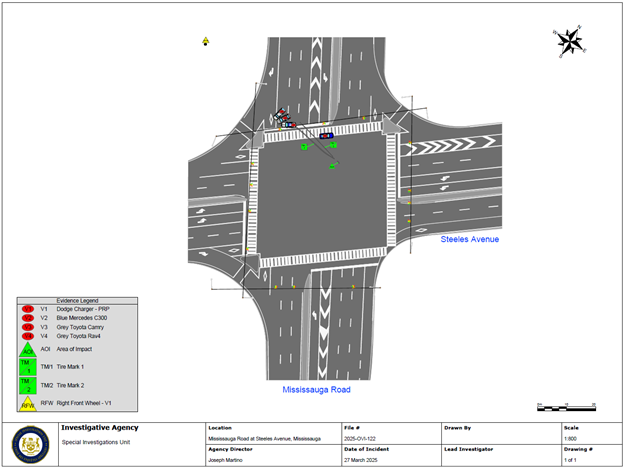
Scene Diagram
Physical Evidence
On March 27, 2025, at 10:30 p.m., the SIU forensic investigators arrived at Steeles Avenue West and Mississauga Road, Brampton. The intersection was a major artery for vehicle traffic. The roads met at 90°. The intersection was controlled by traffic signals, and there were crosswalks across all four corners. The asphalt roads were straight and level, and lane markings were visible. There were raised islands at the intersection to divide the traffic moving in opposite directions. There were overhead streetlights providing adequate lighting.
Mississauga Road was considered the north-south road. It was a multi-lane road with traffic in both directions and a posted 60 km/h zone. There were three lanes in each direction. The road surface widened at Steeles Avenue West to accommodate a left and right turn lane. Steeles Avenue West was considered the east-west road. It was a multi-lane road with traffic in both directions. It was a posted 70 km/h zone. There were three lanes in each direction. The road surface widened at Mississauga Road to accommodate for two additional left turn lanes and one right turn lane.
There were four vehicles within the scene that had collision damage.
Vehicle #1 was a white and blue PRP Dodge Charger - a marked cruiser displaying graphics and emergency lighting. There was significant damage to the front end and lesser damage to the right rear corner. The right front wheel had separated from the vehicle and was found on the northwest corner of the intersection. Both side airbags had deployed. The driver’s steering wheel airbag and knee airbag had deployed. The front passenger airbag had also deployed. The seatbelt was extended and locked indicating its use at the time of the collision. The cruiser was in the northwest quadrant of the intersection. It was positioned facing west across the southbound lanes of Mississauga Road. It was in contact with the left front corner of Vehicle #3.
Vehicle #2 was a blue Mercedes Benz C300. There was significant damage to the front end which was concentrated at the left front corner. There was further damage to the left rear door. The left side airbag, steering wheel airbag, knee airbag and the side driver’s seat airbag had all deployed. The seatbelt was retracted and not locked. The vehicle was facing east in the westbound lanes at the centre median of Mississauga Road.
Vehicle #3 was a grey Toyota Camry. There was damage to the right and left front side. It was positioned facing southwest in the southbound lanes of Mississauga Road, just north of the intersection. It was sandwiched between Vehicles #1 and #4.
Vehicle #4 was a grey Toyota RAV4. There was damage to the left front side. It was positioned facing southwest in the southbound lanes of Mississauga Road, just north of the intersection. It was against the right side of Vehicle #3.
There was a gouge mark on the road surface in the northeast quadrant of the intersection, indicating the area of impact. There were tire marks leading from the gouge mark to the police cruiser.
The evidence suggested the cruiser was northbound on Mississauga Road when it came into contact with the Mercedes that was westbound on Steeles Avenue West. The cruiser then careened in a northwest direction hitting the two vehicles that were waiting at the traffic light in the southbound lanes of Mississauga Road.
Expert Evidence
The PRP Reconstruction Report of the collision arrived at the following findings. The report was reviewed by a SIU reconstructionist, whose comments (in italics) in respect of each finding are set out below.
- The cruiser approached the intersection and came to a full stop at a red light.
It was clear from video at the intersection that the cruiser came to a full stop before proceeding into the intersection.
- The cruiser entered the intersection against the red light with its emergency lights activated.
The cruiser’s lights were visible in the video footage when it entered the intersection, and in the time leading to the crash.
- The cruiser accelerated quickly to a top speed of 54-59 km/h prior to impact.
The cruiser accelerated at an average acceleration rate of 0.39g over a 4.1-second timeframe and was travelling about 57 km/h at 0.4 seconds before impact. This was an aggressive acceleration and matched the 100% throttle being applied by the officer throughout most of the Event Data Recorder (EDR) data.
- The cruiser EDR data suggested the driver perceived the collision after it became imminent and evasive action was futile.
The EDR data showed that 0.4 seconds before impact, the driver released the accelerator and, at 0.2 seconds before impact, applied the brakes. This suggested the driver started to react to the Mercedes 0.4 seconds before impact. There were no sightline obstructions between the cruiser and the Mercedes, meaning both drivers would have had a clear view of the other vehicle in the time before impact. The Mercedes was located about 90 metres east of the intersection when the cruiser started to enter the intersection. The Mercedes entered the intersection about one second before impact. Assuming a perception-response time of 1.5 seconds for the officer, he likely first realized the Mercedes was a hazard when it was about one second east of the intersection.
- Data from the Mercedes’s EDR provided a top speed of 88 km/h prior to impact. This was adjusted to a range of 84-91 km/h.
The SIU Reconstructionist agreed the top speed of the Mercedes, about 1 second before impact, was 88 km/h.
- Video analysis was conducted to corroborate the EDR data and determine the speed of the Mercedes approximately three seconds prior to impact. This yielded a range of 82-83 km/h. The EDR data provided a speed of 86 km/h three seconds prior to impact. When adjusted for the +-4% variance, the range became 82-89 km/h. The speed derived from the video analysis fell within this range; however, it suggested the lower end of the range from the speedometer reading should be used. For this reason, a top speed of 84 km/h should be used for the Mercedes.
The SIU Reconstructionist agreed the video footage matched the EDR data.
- A Time and Distance Analysis revealed the Mercedes was approximately 117.53 metres back from the AOI (Area of Impact) when the cruiser began to accelerate. If travelling at the posted speed limit, the Mercedes would have only covered 91.36 metres.
Had the Mercedes been travelling the speed limit, there might not have been a collision [all else being equal]. The Mercedes was about 110 metres from impact and about 90 metres from the intersection edge when the cruiser started to accelerate [about four seconds before impact]. At 70 km/h [the posted speed limit], the Mercedes would have travelled about 80 metres, which was about 30 metres less than in the incident scenario. This would have delayed the Mercedes’s arrival to the point of impact by about 1.5 seconds. The cruiser would have cleared the path of the Mercedes [assuming a speed of 57 km/h] in about 0.4 seconds. This meant the vehicles would not have collided had the Mercedes been travelling the speed limit at the time.
- It was unknown if the driver of the Mercedes perceived the impending collision prior to occurring. It also was unknown if perception would have changed if travelling at the posted speed limit.
There was a clear line of sight to the cruiser from the perspective of the Mercedes driver. The lights activated on the cruiser would have helped in seeing the accelerating cruiser. The cruiser entered the intersection about 3.5 seconds before impact. Assuming a 1.5-second perception-response time for the driver, he would have had about two seconds [and about 50 metres] to brake to a stop. A vehicle travelling 88 km/h needs about 40 metres to come to an emergency stop, meaning there was enough time for the Mercedes driver to see the cruiser and brake to a stop before colliding with the cruiser.
- The speed of the Mercedes might have been a factor in this collision.
The speed of the Mercedes was a factor in this collision.
- The cruiser entering the intersection against a red light is the primary cause of this collision.
The cruiser had its lights activated at the time and came to a full stop before accelerating into the intersection. All traffic was stopped at the intersection except for the Mercedes and one other westbound vehicle. The Mercedes was about 90 metres away from the intersection and travelling 85 km/h when the cruiser started to accelerate. It was likely not obvious to the police officer that the Mercedes would enter the intersection until two seconds before impact. This would not have provided the officer enough time to avoid a collision.
Video/Audio/Photographic Evidence[3]
In-car Camera (ICC) Footage - WO #1’s Cruiser
On March 27, 2025, at 4:18 p.m., WO #1’s cruiser was stopped just before the pedestrian crossing on the southside of the intersection of Mississauga Road and Steeles Avenue West. The SO’s cruiser was seen positioned close to a Toyota Camry and a Toyota RAV4 on the northwest corner of the intersection. A Mercedes was positioned in the middle of the intersection facing eastward. WO #1 waited for a few seconds, proceeded into the intersection, and parked slightly to the rear of the Mercedes. The SO exited his cruiser and walked to the driver’s door of the Mercedes.
Video Footage - City of Brampton Traffic Camera
On March 27, 2025, a fully marked cruiser driven by the SO entered the screen northbound on Mississauga Road in a lane with painted chevron markings, between the left-turn lane and lane #1. The SO stopped his cruiser halfway into the pedestrian crosswalk. The traffic signal for eastbound vehicles on Mississauga Road was green and the traffic signal for vehicles turning left [two left turn lanes] from Steeles Avenue West to northbound Mississauga Road was red. The eastbound vehicles on Mississauga Road came to a stop. The emergency lights of the SO’s cruiser were activated, and he proceeded northbound through the intersection. As the SO drove northbound through the intersection, two vehicles [one silver and one dark in colour] were westbound on Steeles Avenue West approaching the intersection. The silver-coloured vehicle, a Volkswagen, was in lane #1 and the dark-coloured vehicle, a Mercedes operated by the Complainant, was in lane #2. The Volkswagen and the Mercedes appeared to travel at a similar speed, but the Mercedes was slightly ahead of the Volkswagen. The Mercedes entered the intersection and came into collision with the passenger side of the cruiser. The force of the impact caused the Mercedes to spin to the right. The Volkswagen continued westbound through the intersection and did not stop. The cruiser continued in a westerly direction, colliding with a Toyota Camry that was stopped on Mississauga Road in the southbound lane #1 at the intersection of Steeles Avenue West. The force of the impact caused the Toyota to collide with a Toyota RAV4 in lane #2.
Materials Obtained from Police Service
Upon request, the SIU obtained the following records from the PRP between from March 28, 2025, and May 9, 2025:
- Incident History – Assault Call
- Incident History – Motor Vehicle Accident
- List of involved police officers
- Directive - Operation of Police Vehicles
- Driver Training Record - the SO
- Notes - WO #1, WO #2, Officer #1, Officer #2, Officer #3 and Officer #4
- PRP drone photographs
- Occurrence Report
- Major Collision Bureau Reconstruction Report
- ICC footage
- Video recorded statement – CW #2
- Instagram video
Materials Obtained from Other Sources
The SIU obtained the following records from the following other sources between March 28, 2025, and April 3, 2025:
- Video footage from City of Brampton
- Husky Gas Bar video
- Dashcam video from the Complainant
- Reddit video
- The Complainant’s medical records from Credit Valley Hospital
Incident Narrative
The material events in question are clear on the evidence collected by the SIU and may briefly be summarized.
In the afternoon of March 27, 2025, the Complainant was driving his Mercedes westbound on Steeles Avenue West going home. It was sunny and the roads were dry. He approached Mississauga Road at upwards of 80 km/h on a green light, entered the intersection, and struck the passenger side of a PRP marked cruiser. The Mercedes rotated and came to rest facing east in the intersection. The Complainant had sustained a fractured left finger in the collision.
The SO was driving the cruiser. He and another PRP officer in a separate cruiser – WO #1 – were responding to an assault in-progress call at the time. With WO #1’s cruiser behind him, the SO was northbound on Mississauga Road stopped for a red light at Steeles Avenue West. His emergency lights and siren on, the officer entered the intersection after eastbound traffic had come to a stop. He continued to accelerate into the northern end of the intersection and was broadsided by the Complainant’s vehicle. The collision propelled the cruiser westward, causing it to collide with a southbound vehicle stopped at the red light.
Relevant Legislation
Section 320.13, Criminal Code – Dangerous Operation Causing Bodily Harm
320.13 (1) Everyone commits an offence who operates a conveyance in a manner that, having regard to all of the circumstances, is dangerous to the public.
(2) Everyone commits an offence who operates a conveyance in a manner that, having regard to all of the circumstances, is dangerous to the public and, as a result, causes bodily harm to another person.
Sections 144(18) and 144(20), Highway Traffic Act – Red light exemption
144 (18) Every driver approaching a traffic control signal showing a circular red indication and facing the indication shall stop his or her vehicle and shall not proceed until a green indication is shown.
144 (20) Despite subsection (18), a driver of an emergency vehicle, after stopping the vehicle, may proceed without a green indication being shown if it is safe to do so.
Analysis and Director’s Decision
The Complainant was seriously injured when the vehicle he was operating collided with a PRP cruiser on March 27, 2025. The SIU was notified of the incident and initiated an investigation. The driver of the cruiser – the SO – was identified as the subject official. The investigation is now concluded. On my assessment of the evidence, there are no reasonable grounds to believe that the SO committed a criminal offence in connection with the collision.
The offence that arises for consideration is dangerous driving causing bodily harm contrary to section 320.13(2) of the Criminal Code. As an offence of penal negligence, a simple want of care will not suffice to give rise to liability. Rather, the offence is predicated, in part, on conduct that amounts to a marked departure from the level of care that a reasonable person would have observed in the circumstances. In the instant case, the issue is whether there was a want of care in the manner in which the SO operated his vehicle, sufficiently egregious to attract criminal sanction, that caused or contributed to the collision. In my view, there was not.
The SO was in the execution of his lawful duties through the series of events culminating in his decision to enter the intersection when he did and the resulting collision. He was responding to a high priority call involving a reported assault in progress.
While the SO must shoulder his share of the blame for the collision with the Complainant’s vehicle, the evidence does not reasonably establish that his conduct transgressed the limits of care prescribed by the criminal law. Consistent with the officer’s legal obligations under section 144(20) of the Highway Traffic Act, the SO brought his cruiser to a stop ahead of the red light at Steeles Avenue West before entering the intersection. Though vigilant to ensure that all eastbound traffic had seen him and come to a stop before continuing northward, it does not appear that he exercised that same vigilance with respect to two westbound vehicles approaching the intersection without any indication they were slowing or coming to a stop. The SO says that he simply did not see any westbound traffic until it was too late. That might well be true but, there being no sightline obstructions in the area, it suggests the officer was not as careful as he ought to have been before attempting to clear the final half of the intersection. On the other hand, it is clear that the SO’s indiscretion at the intersection was singular. To reiterate, he had come to a complete stop over several seconds and ensured that eastbound traffic was yielding before he entered the intersection. He also had his emergency lights and siren operating, giving traffic in the vicinity notice of his presence, and was responding to a priority call for service where response time was of the essence. On this record, it is fair to characterize the SO’s impugned conduct as a momentary lapse of attention, which, as the case law makes clear, will rarely attract criminal liability.
For the foregoing reasons, there is no basis for proceeding with criminal charges in this case. The file is closed.
Date: July 22, 2025
Electronically approved by
Joseph Martino
Director
Special Investigations Unit
Endnotes
- 1) Unless otherwise specified, the information in this section reflects the information received by the SIU at the time of notification and does not necessarily reflect the SIU’s findings of fact following its investigation. [Back to text]
- 2) Later determined to be his left hand. [Back to text]
- 3) The following records contain sensitive personal information and are not being released pursuant to section 34(2) of the Special Investigations Unit Act, 2019. The material portions of the records are summarized below. [Back to text]
Note:
The signed English original report is authoritative, and any discrepancy between that report and the French and English online versions should be resolved in favour of the original English report.