
SIU Director’s Report - Case # 25-OCD-105
Warning:
This page contains graphic content that can shock, offend and upset.
Contents:
Mandate of the SIU
The Special Investigations Unit is a civilian law enforcement agency that investigates incidents involving an official where there has been death, serious injury, the discharge of a firearm at a person or an allegation of sexual assault. Under the Special Investigations Unit Act, 2019 (SIU Act), officials are defined as police officers, special constables of the Niagara Parks Commission and peace officers under the Legislative Assembly Act. The SIU’s jurisdiction covers more than 50 municipal, regional and provincial police services across Ontario.
Under the SIU Act, the Director of the SIU must determine based on the evidence gathered in an investigation whether there are reasonable grounds to believe that a criminal offence was committed. If such grounds exist, the Director has the authority to lay a criminal charge against the official. Alternatively, in cases where no reasonable grounds exist, the Director cannot lay charges. Where no charges are laid, a report of the investigation is prepared and released publicly, except in the case of reports dealing with allegations of sexual assault, in which case the SIU Director may consult with the affected person and exercise a discretion to not publicly release the report having regard to the affected person’s privacy interests.
Information Restrictions
Special Investigations Unit Act, 2019
Pursuant to section 34, certain information may not be included in this report. This information may include, but is not limited to, the following:
- The name of, and any information identifying, a subject official, witness official, civilian witness or affected person.
- Information that may result in the identity of a person who reported that they were sexually assaulted being revealed in connection with the sexual assault.
- Information that, in the opinion of the SIU Director, could lead to a risk of serious harm to a person.
- Information that discloses investigative techniques or procedures.
- Information, the release of which is prohibited or restricted by law.
- Information in which a person’s privacy interest in not having the information published clearly outweighs the public interest in having the information published.
Freedom of Information and Protection of Personal Privacy Act
Pursuant to section 14 (i.e., law enforcement), certain information may not be included in this report. This information may include, but is not limited to, the following:
- Confidential investigative techniques and procedures used by law enforcement agencies; and
- Information that could reasonably be expected to interfere with a law enforcement matter or an investigation undertaken with a view to a law enforcement proceeding.
Pursuant to section 21 (i.e., personal privacy), protected personal information is not included in this report. This information may include, but is not limited to, the following:
- The names of persons, including civilian witnesses, and subject and witness officials;
- Location information;
- Witness statements and evidence gathered in the course of the investigation provided to the SIU in confidence; and
- Other identifiers which are likely to reveal personal information about individuals involved in the investigation.
Personal Health Information Protection Act, 2004
Pursuant to this legislation, any information related to the personal health of identifiable individuals is not included.
Other proceedings, processes, and investigations
Information may also have been excluded from this report because its release could undermine the integrity of other proceedings involving the same incident, such as criminal proceedings, coroner’s inquests, other public proceedings and/or other law enforcement investigations.
Mandate Engaged
Pursuant to section 15 of the SIU Act, the SIU may investigate the conduct of officials, be they police officers, special constables of the Niagara Parks Commission or peace officers under the Legislative Assembly Act, that may have resulted in death, serious injury, sexual assault or the discharge of a firearm at a person.
A person sustains a “serious injury” for purposes of the SIU’s jurisdiction if they: sustain an injury as a result of which they are admitted to hospital; suffer a fracture to the skull, or to a limb, rib or vertebra; suffer burns to a significant proportion of their body; lose any portion of their body; or, as a result of an injury, experience a loss of vision or hearing.
In addition, a “serious injury” means any other injury sustained by a person that is likely to interfere with the person’s health or comfort and is not transient or trifling in nature.
This report relates to the SIU’s investigation into the death of a 42-year-old woman (the “Complainant”).
The Investigation
Notification of the SIU[1]
On March 17, 2025, at 12:53 p.m., the Ottawa Police Service (OPS) contacted the SIU with the following information.
On March 17, 2025, at around 11:30 a.m., Service Employee Witness (SEW) #1 went to a cell in the Ottawa courthouse to serve lunch when he found the Complainant[2] had hung herself. The Complainant was well known to the OPS and had been recently arrested on March 13, 2025, for arson. Paramedics arrived at 11:40 a.m., and transported the Complainant to the Ottawa Civic Hospital (OCH), where her death was pronounced at 12:50 p.m.
The Team
Date and time team dispatched: 2025/03/17 at 1:50 p.m.
Date and time SIU arrived on scene: 2025/03/17 at 6:15 p.m.
Number of SIU Investigators assigned: 2
Number of SIU Forensic Investigators assigned: 2
Affected Person (aka “Complainant”):
42-year-old female; deceased
Civilian Witness (CW)
CW Interviewed
The civilian witness was interviewed on April 2, 2025.
Subject Official (SO)
SO Declined interview and to provide notes, as is the subject official’s legal right
Witness Officials (WO)
WO #1 Interviewed; notes received and reviewed
WO #2 Not interviewed; notes reviewed and interview deemed unnecessary
The witness official was interviewed on March 17, 2025.
Service Employee Witnesses (SEW)
SEW #1 Interviewed; notes received and reviewed
SEW #2 Interviewed; notes received and reviewed
SEW #3 Interviewed; notes received and reviewed
SEW #4 Interviewed; notes received and reviewed
SEW #5 Interviewed; notes received and reviewed
SEW #6 Interviewed; notes received and reviewed
SEW #7 Interviewed; notes received and reviewed
SEW #8 Interviewed; notes received and reviewed
SEW #9 Interviewed; notes received and reviewed
The service employee witnesses were interviewed between March 19, 2025, and March 25, 2025.
Evidence
The Scene
The events in question transpired in and around a cell of the courthouse situated at 161 Elgin Street, Ottawa.
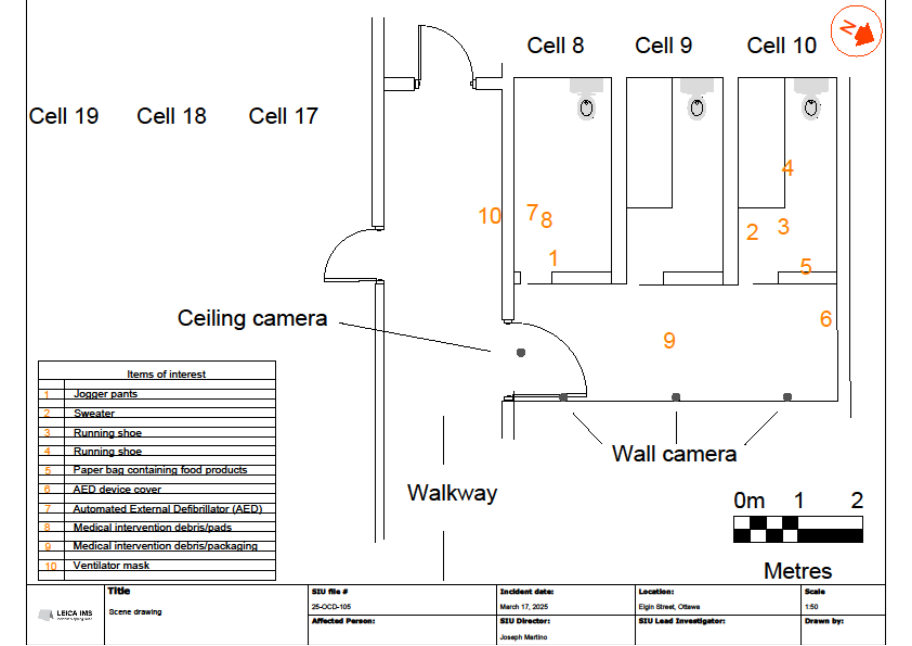
Scene Diagram
Physical Evidence
On March 17, 2025, at 9:09 p.m., a SIU forensic investigator arrived at the Ottawa courthouse located at 161 Elgin Street, Ottawa, and met two SIU investigators. They were escorted to the basement of the complex and the holding cell area, which was properly guarded.
The hallway in front of the cell block hallway for Cells 8, 9 and 10 had a camera dome visible on the ceiling, near the entrance door. Police tape was draped over the door, which was locked. The solid metal door had a small viewing window with a sliding portion that allowed for privacy.The sliding portion of this viewing window was in the open position. A ventilator mask rested on the floor in the hallway near the metal door. A key was provided to unlock the door and the SIU forensic investigator and investigators entered and viewed the scene. The forensic investigator photographed and video recorded the inner hallway and cell areas.
A camera dome was visible on the ceiling inside of the hallway for Cells 8, 9 and 10, over the door. Three additional camera domes were visible on the wall, opposite each cell door, 1.8 metres from the cell doors. Medical debris was strewn across the floor in front of the cells. Three separate holding cells were in this hallway. The cells were separated by cinder block walls, and they were positioned side-by-side to one another. Each cell had a metal sliding door system composed of two sections. One section of the door system was stationary and fastened to a wall, and the other section slid across the opening, allowing for entry/exit. Each door section was made of vertical metal rods. The metal rods were threaded through horizontal metal plates. The plates were located near the top, lower and base sections of the door. Each cell door was found in the open position, and each cell had a designated number – 8, 9 and 10.
Cell 8 was positioned near the south side of the hallway. An automated external defibrillator (AED) device, a pair of jogger pants, and medical pads/debris rested on the cell floor. A metal toilet was positioned near the west wall, and there was no bed in the cell. Cell 9 was positioned between Cell 8 and Cell 10.
Cell 10 [determined to be the cell the Complainant was lodged in] was positioned near the north side of the hallway. A metal toilet was positioned near the west wall, and there was a metal bed in the cell. Toilet paper rolls rested on the bed and on the floor beneath the bed. A sweater, a pair of lace-less running shoes, and a brown paper bag containing food products rested on the floor inside the cell. An AED device cover rested on the floor outside the cell, near the cell’s stationary door. The cell’s dimensions were 3.0 metres long by 1.5 metres wide by 2.7 metres tall. The metal bed’s dimensions were 2.0 metres long by 0.7 metres wide by 0.4 metres tall. The cell door opening was 0.6 metres wide. The lower horizontal door plate was 0.5 metres in height, from the floor. Yellow identification markers were placed near items of interest.
On March 18, 2025, at 12:01 a.m., a second SIU forensic investigator attended. Measurements delineating where items were located were taken along with measurements for a planned drawing. Exhibits were collected and catalogued. At 12:47 a.m., a security seal was placed over the metal door, which led into the hallway for Cells 8, 9 and 10, and the door was locked. The key was returned to OPS police officers, who were advised that the hallway for Cells 8, 9 and 10 was to remain secure until the completion of the autopsy.
The following items were collected as exhibits by the SIU:
- Exhibit 1 was a pair of green track pants, which were found on the floor of Cell 8. They were turned inside out, with horizontal straight cuts to the fabric on both legs. A clump of hair was located on the waistband of the pants, and there were no labels on the garment.
- Exhibit 2, found on the floor of Cell 10, was a green crewneck-styled sweatshirt cut open at the front of the garment.
- Exhibit 3 was a blue and white rubber, lace-less slip-on shoe (right) found on the floor in Cell 10.
- Exhibit 4 was a matching blue and white rubber, lace less slip-on shoe (left) found on the floor in Cell 10.
- Exhibit 5, found on the floor in Cell 10, was a brown paper bag containing food (apple juice, sandwich, and snacks).
- Exhibit 6 was a green AED cover with ‘Ottawa Paramedic’ markings on the floor of the hallway outside of Cell 10.
- Exhibit 7 was a green defibrillator unit on the floor of Cell 8 with attachments.
- Exhibit 8 was medical debris and defibrillator pads on the floor of Cell 8.
- Exhibit 9 was medical debris on the hallway floor inside the cell block.
- Exhibit 10 was medical debris on the floor of the main hallway outside of the cell block.
- Exhibit 11 was green track pants cut open through the front leg, found inside the body bag at autopsy.
- Exhibit 12 was a DNA sample from the Complainant taken at autopsy. The exhibit was placed in an envelope and sealed at the morgue.
- Exhibit 13 was finger and palm prints from the Complainant taken after autopsy.
Video/Audio/Photographic Evidence[3]
Video Footage – Ottawa Courthouse Cell Area
The video started at 8:15:24 a.m., on March 17, 2025.
Starting at about 8:16 a.m., the Complainant entered a corridor, followed by a female special constable [now known to be Special Constable (S/Cst) #1]. She turned right and entered another corridor, which she walked down before turning left into a third corridor leading to the hallway to Cells 8, 9 and 10.
Starting at about 8:25 a.m., the Complainant entered Cell 10, after which the door was closed by SEW #1 with S/Cst #1 present. The Complainant immediately crawled under the metal bench on the left side of the cell, preventing her from being seen.
Starting at about 9:46 a.m., SEW #4 opened the door to Cell 10. The Complainant appeared from beneath the bench, put on her shoes and exited the cell [now known to go to the doctor’s room].
Starting at about 9:47 a.m., in the doctor’s room, the Complainant stood and held onto the counter before she lowered herself to the floor on her hands and knees. Papers were seen to move through the glass window in the room. [It is now known that the doctor was at the other side of the glass.] The Complainant started to shake.
Starting at about 9:50 a.m., the Complainant got back to her feet and sat on a stool. She then lay back on the floor and, at 9:53 a.m., the door opened. The Complainant got up and left the room.
Starting at about 9:53 a.m., the Complainant was placed back into Cell 10 by SEW #4. The Complainant immediately crawled underneath the bench.
Starting at about 10:13 a.m., the Complainant was removed from the cell by a male special constable [now known to be S/Cst #2]. Also present was another special constable - SEW #3. [It is now known that the Complainant was taken to the Fingerprint/DNA Room.] The parties entered the DNA Room at 10:14 a.m., and SEW #3 removed the Complainant’s handcuffs. The Complainant lowered herself to the floor on her hands and knees. S/Cst #2 had the Complainant stand up, but she was behind boxes and the view was obstructed. [It is now known that the Complainant was fingerprinted.]
Starting at about 10:21 a.m., the Complainant was returned to her cell by the same two special constables.
Starting at about 10:34 a.m., the Complainant was removed from her cell by SEW #4 [now known to be taken to the visitation room to see her counsel]. The Complainant entered the visitation room and immediately lay on the floor.
Starting at about 10:39 a.m., the Complainant started to bang her forehead on the floor.
Starting at about 10:43 a.m., the door opened, and the Complainant exited.
Starting at about 10:44 a.m., the Complainant was returned to her cell by SEW #4, and again she crawled underneath the bench.
Starting at about 10:49 a.m., the Complainant appeared from under the bench. She took off her leggings and tied them around her neck. She then tied the leggings to the horizontal metal bar, which was the second horizontal bar up from the floor. The Complainant stretched out on the floor and turned her whole body in a counterclockwise direction four times to tighten the noose. She then lay on her stomach with her left hand under her torso.
Starting at about 10:52 a.m., the Complainant’s body stopped moving.
Starting at about 11:05 a.m., the prisoner in Cell 9 stood up in his cell and then sat on the end of the bench.
Starting at about 11:34 a.m., SEW #1 approached Cell 10. He had a brown bag in each of his hands [now known to be lunch bags]. He placed a lunch bag between the cell bars, and onto the floor beside the Complainant’s head, and then went to Cell 9 and gave the prisoner a lunch bag. SEW #1 turned and went back to Cell 10. From the way the Complainant lay, it appeared she slept on the floor with the bottom of the cell door as a support for her head. Her long hair covered the ligature on her neck.
Starting at about 11:34:23 a.m., SEW #1 entered the cell and lifted the Complainant, and appeared to realize the severity of the situation. Within three seconds, a male special constable – SEW #6 – appeared. SEW #1 struggled to get the noose off the Complainant’s neck. There was no sound to the video and the prisoner in Cell 9 did not react to any situation. Within twenty seconds, five special constables were on scene. SEW #4 entered the cell to assist SEW #1. Because of the number of special constables present, the Complainant’s body could not be seen. A pair of scissors was brought to the cell door, and the leggings were removed. SEW #1 performed CPR. SEW #4 took over CPR and SEW #7 prepared an AED. SEW #1 applied the AED pads as CPR was continued.
Starting at about 11:37:13 a.m., the CPR was stopped, and the AED appeared to be activated. After 20 seconds, CPR was continued by SEW #4. Two minutes later, SEW #1 again took over CPR.
Starting at about 11:39 a.m., the SO appeared outside the cell.
Starting at about 11:43:55 a.m., a paramedic appeared outside the cell. The Complainant was pulled out of the cell and the only part of her body to be seen was her legs. Ottawa Fire Service personnel arrived on scene.
Starting at about 11:44:10 a.m., the Complainant was removed from the cell corridor on a stretcher.
Communications Recordings
On March 17, 2025, at 11:36:04 a.m., a special constable from the Ottawa courthouse called 911 and requested an ambulance to the basement of the courthouse at 161 Elgin Street, Ottawa. Information given was that a person had something around her neck, and she was not breathing. At 11:37 a.m., the special constable advised on the 911 line that staff had put an AED on the woman, and they were waiting for directions, as CPR was continued. The OPS inspector was made aware of the situation.
At 11:43 a.m., a paramedic crew was directed to Cell 10.
At 12:00 p.m., the patient – the Complainant – was loaded into the ambulance and WO #2 advised he would ride in the ambulance. CPR was still in progress.
WO #2 advised they had arrived at hospital at 12:09 p.m.
The Complainant was pronounced deceased at 12:27 p.m.
Materials Obtained from Police Service
Upon request, the SIU obtained the following records from the OPS between March 18, 2025, and April 11, 2025:
- Video footage - Ottawa courthouse cells
- Communications recordings
- Computer-assisted Dispatch Report
- Cell Checks – Cell 10
- Floorplan – Custody Area of courthouse
- History – the Complainant
- Investigative Action Reports – SEW #7, SEW #9, SEW #6, SEW #1, SEW #5, SEW #4, SEW #2, SEW #3, SEW #8, and WO #1
- Prints – the Complainant
- Notes – SEW #7, WO #2, SEW #9, SEW #6, SEW #1, SEW #5, SEW #4, SEW #2, SEW #3, WO #1, and SEW #8.
- Policy – Prisoner Care and Control.
- General Occurrence – Sudden Death Report
- Training logs – the SO
Materials Obtained from Other Sources
The SIU obtained the following records from other sources between March 18, 2025, and June 17, 2025:
- The Complainant’s medical records from OCH.
- The Complainant’s medical records from a doctor of Mental Health Court
- Ambulance Call Report from Ottawa Paramedic Service
- Preliminary Autopsy Findings Report from Ontario Forensic Pathology Service
- Report of Postmortem Examination from the Coroner’s Office
Incident Narrative
The evidence collected by the SIU, including interviews with the Complainant’s immediate custodians and video footage that captured the incident in part, gives rise to the following scenario. As was her legal right, the SO did not agree an interview with the SIU or the release of her notes.
The Complainant was arrested for arson on March 13, 2025, by the OPS. She appeared in court in Ottawa on March 14, 2025, and was remanded in custody with a subsequent court date before the Mental Health Court in Ottawa of March 17, 2025. The plan was to have her assessed by a court psychiatrist on that date to ascertain whether a full psychiatric evaluation was required.
Having spent the weekend housed at the Ottawa-Carleton Detention Centre, the Complainant was transported to the Ottawa courthouse, 161 Elgin Street, the morning of March 17, 2025, and lodged in Cell 10 at about 8:25 a.m. She was removed from the cell at about 9:45 a.m. by a special constable, who escorted her to a medical office to be assessed by a forensic psychiatrist. The Complainant did not wish to cooperate with the assessment. The Complainant behaved strangely – lowering herself to the floor at one point – but was otherwise coherent. The psychiatrist indicated that the Complainant was likely fit to stand trial. The Complainant was returned to her cell at about 9:53 a.m.
The Complainant was removed from her cell at about 10:13 a.m., escorted to a room to have her prints taken, and re-lodged in Cell 10 at about 10:21 a.m. Shortly after, at about 10:34 a.m., the Complainant was taken from the cell and escorted to a room to see her counsel. She laid down and proceeded to bang her forehead on the floor. The Complainant re-entered her cell at about 10:44 a.m., whereupon she crawled underneath the cell bench.
At about 10:49 a.m., the Complainant appeared from under the bench. She removed her leggings and tied them around her neck. She affixed the other end of the leggings to the second horizontal bar up from the floor of the metal door. The Complainant then rotated her body several times, which had the effect of tightening the noose around her neck, before she laid down in a prone position. All movements from the Complainant stopped at about 10:52 a.m.
At about 11:34 a.m., SEW #1 entered the cell area to deliver lunches to the Complainant and another inmate. The special constable entered Cell 10, noticed the ligature around the Complainant’s neck and screamed out for help. Other special constables arrived on scene and assisted in removing the ligature. The Complainant was not breathing. The officers performed CPR and deployed an AED, which advised against shocking the Complainant.
Paramedics arrived on scene at about 11:44 a.m. and assumed care over the Complainant. She was taken to hospital and pronounced deceased at 12:27 p.m.
Cause of Death
The pathologist at autopsy was of the view that the Complainant’s death was attributable to hanging.
Relevant Legislation
Section 215, Criminal Code - Failure to Provide Necessaries
215 (1) Every one is under a legal duty
(c) to provide necessaries of life to a person under his charge if that person
(i) is unable, by reason of detention, age, illness, mental disorder or other cause, to withdraw himself from that charge, and
(ii) is unable to provide himself with necessaries of life.
(2) Every person commits an offence who, being under a legal duty within the meaning of subsection (1), fails without lawful excuse to perform that duty, if
(b) with respect to a duty imposed by paragraph (1)(c), the failure to perform the duty endangers the life of the person to whom the duty is owed or causes or is likely to cause the health of that person to be injured permanently.
Sections 219 and 220, Criminal Code - Criminal Negligence Causing Death
219 (1) Every one is criminally negligent who
(a) in doing anything, or
(b) in omitting to do anything that it is his duty to do,
shows wanton or reckless disregard for the lives or safety of other persons.
(2) For the purposes of this section, duty means a duty imposed by law.
220 Every person who by criminal negligence causes death to another person is guilty of an indictable offence and liable
(a) where a firearm is used in the commission of the offence, to imprisonment for life and to a minimum punishment of imprisonment for a term of four years; and
(b) in any other case, to imprisonment for life.
Analysis and Director’s Decision
The Complainant lapsed into acute medical distress while in the custody of the OPS on March 17, 2025. She was transported to hospital and subsequently pronounced deceased later that day. The SIU was notified of the incident and initiated an investigation naming the officer with overall responsibility for the Complainant’s care – the SO – the subject official. The investigation is now concluded. On my assessment of the evidence, there are no reasonable grounds to believe that the SO committed a criminal offence in connection with the Complainant’s death.
The offences that arise for consideration are failure to provide the necessaries of life and criminal negligence causing death contrary to sections 215 and 220 of the Criminal Code, respectively. Both require something more than a simple want of care to give rise to liability. The former is predicated, in part, on conduct that amounts to a marked departure from the level of care that a reasonable person would have exercised in the circumstances. The latter is premised on even more egregious conduct that demonstrates a wanton or reckless disregard for the lives or safety of other persons. It is not made out unless the neglect constitutes a marked and substantial departure from a reasonable standard of care. In the instant case, the question is whether there was any want of care on the part of the SO, sufficiently serious to attract criminal sanction, that endangered the Complainant’s life or caused her death. In my view, there was not.
The SO had overall responsibility for the care of prisoners at the courthouse through the material events in question, but it is clear she was not immediately involved in the Complainant’s supervision. That task fell on the special constables on duty at the time. Accordingly, any assessment of the SO’s potential criminal liability must begin with an assessment of the conduct of the special constables.
SEW #1 was the special constable on duty responsible for physical checks of the prisoners in the courthouse cell area. As there were no flags suggesting the Complainant was a suicide risk on intake at the courthouse from the correctional facility, it was understood that the Complainant was to be checked every 30 minutes. The Complainant was last checked physically at about 10:44 a.m., when she was re-lodged in Cell 10 following a visit with her lawyer. Presumably, she ought to have been checked again at about 11:15 a.m. or so. However, it was not until about 11:34 a.m. that SEW #1 visited the cell area to deliver lunches and noticed the Complainant in crisis. Similarly, from a bank of computer screens in the ‘console room’, SEW #2 was tasked with keeping an eye on the prisoners, in addition to other duties. It is apparent that he did not detect the Complainant fashioning the ligature around her neck before he went for lunch at about 11:10 a.m. SEW #3 stepped in for SEW #2. He too did not notice anything amiss in Cell 10.
Whether the aforementioned-conduct on the part of the special constables fell short of expectations, I am unable to reasonably conclude that it transgressed the limits of care prescribed by the criminal law. Nothing short of dedicated, continuous monitoring of the Complainant would have guaranteed detection of her efforts at self-harm before it was too late, but there was nothing in the record available to the special constables that suggested the Complainant was suicidal and in need of constant supervision. It is true that the Complainant would have been discovered sooner had not more than 30 minutes lapsed from the moment she was last with a special constable. However - whether a check at the 30-minute interval would have made any difference remains a matter of speculation. The Complainant had been hanging for about 20 minutes before the 30-minute mark had expired at about 11:15 a.m., and might well have been beyond the point of no return by that time. A delay of about 20 minutes past the 30-minute personal check marker would also not appear particularly egregious, nor the fact that the Complainant’s behaviour was not detected on video screen by SEW #2, amid evidence that there were upwards of 40 prisoners in the cell area of the courthouse at one time or another, each of whom would have required attention. On this record, I am not persuaded on balance that there is sufficient evidence to reasonably believe that the care afforded the Complainant fell markedly below a reasonable standard in the circumstances, much less that it amounted to a marked and substantial departure from that standard.
For the foregoing reasons, there is no basis for proceeding with criminal charges against the SO. The file is closed.
Date: July 15, 2025
Electronically approved by
Joseph Martino
Director
Special Investigations Unit
Endnotes
- 1) Unless otherwise specified, the information in this section reflects the information received by the SIU at the time of notification and does not necessarily reflect the SIU’s findings of fact following its investigation. [Back to text]
- 2) The Complainant was a transgender female. [Back to text]
- 3) The following records contain sensitive personal information and are not being released pursuant to section 34(2) of the Special Investigations Unit Act, 2019. The material portions of the records are summarized below. [Back to text]
Note:
The signed English original report is authoritative, and any discrepancy between that report and the French and English online versions should be resolved in favour of the original English report.