
SIU Director’s Report - Case # 24-OFP-301
Warning:
This page contains graphic content that can shock, offend and upset.
Contents:
Mandate of the SIU
The Special Investigations Unit is a civilian law enforcement agency that investigates incidents involving an official where there has been death, serious injury, the discharge of a firearm at a person or an allegation of sexual assault. Under the Special Investigations Unit Act, 2019 (SIU Act), officials are defined as police officers, special constables of the Niagara Parks Commission and peace officers under the Legislative Assembly Act. The SIU’s jurisdiction covers more than 50 municipal, regional and provincial police services across Ontario.
Under the SIU Act, the Director of the SIU must determine based on the evidence gathered in an investigation whether there are reasonable grounds to believe that a criminal offence was committed. If such grounds exist, the Director has the authority to lay a criminal charge against the official. Alternatively, in cases where no reasonable grounds exist, the Director cannot lay charges. Where no charges are laid, a report of the investigation is prepared and released publicly, except in the case of reports dealing with allegations of sexual assault, in which case the SIU Director may consult with the affected person and exercise a discretion to not publicly release the report having regard to the affected person’s privacy interests.
Information Restrictions
Special Investigations Unit Act, 2019
Pursuant to section 34, certain information may not be included in this report. This information may include, but is not limited to, the following:
- The name of, and any information identifying, a subject official, witness official, civilian witness or affected person.
- Information that may result in the identity of a person who reported that they were sexually assaulted being revealed in connection with the sexual assault.
- Information that, in the opinion of the SIU Director, could lead to a risk of serious harm to a person.
- Information that discloses investigative techniques or procedures.
- Information, the release of which is prohibited or restricted by law.
- Information in which a person’s privacy interest in not having the information published clearly outweighs the public interest in having the information published.
Freedom of Information and Protection of Personal Privacy Act
Pursuant to section 14 (i.e., law enforcement), certain information may not be included in this report. This information may include, but is not limited to, the following:
- Confidential investigative techniques and procedures used by law enforcement agencies; and
- Information that could reasonably be expected to interfere with a law enforcement matter or an investigation undertaken with a view to a law enforcement proceeding.
Pursuant to section 21 (i.e., personal privacy), protected personal information is not included in this report. This information may include, but is not limited to, the following:
- The names of persons, including civilian witnesses, and subject and witness officials;
- Location information;
- Witness statements and evidence gathered in the course of the investigation provided to the SIU in confidence; and
- Other identifiers which are likely to reveal personal information about individuals involved in the investigation.
Personal Health Information Protection Act, 2004
Pursuant to this legislation, any information related to the personal health of identifiable individuals is not included.
Other proceedings, processes, and investigations
Information may also have been excluded from this report because its release could undermine the integrity of other proceedings involving the same incident, such as criminal proceedings, coroner’s inquests, other public proceedings and/or other law enforcement investigations.
Mandate Engaged
Pursuant to section 15 of the SIU Act, the SIU may investigate the conduct of officials, be they police officers, special constables of the Niagara Parks Commission or peace officers under the Legislative Assembly Act, that may have resulted in death, serious injury, sexual assault or the discharge of a firearm at a person.
A person sustains a “serious injury” for purposes of the SIU’s jurisdiction if they: sustain an injury as a result of which they are admitted to hospital; suffer a fracture to the skull, or to a limb, rib or vertebra; suffer burns to a significant proportion of their body; lose any portion of their body; or, as a result of an injury, experience a loss of vision or hearing.
In addition, a “serious injury” means any other injury sustained by a person that is likely to interfere with the person’s health or comfort and is not transient or trifling in nature.
This report relates to the SIU’s investigation into the discharge of a firearm by the police at a 26-year-old man (the “Complainant”).
The Investigation
Notification of the SIU[1]
On July 10, 2024, at 9:30 p.m., the Ottawa Police Service (OPS) contacted the SIU with the following information.
On July 9, 2024, an Ontario Provincial Police officer dealt with a man [later identified as the Complainant] on Highway 417. The Complainant wanted to fight the officer and was later learned to have schizophrenia. During the incident, an OPS officer was driving by, saw what was happening, and stopped to assist. The Complainant was apprehended and admitted to the Montfort Hospital’s Mental Health Unit. On July 10, 2024, at about 7:30 p.m., OPS received a call from the Montfort Hospital regarding a “Code White” with a patient - the Complainant - in the Mental Health Unit. Hospital security staff contained the Complainant, who was violent and required restraint. The Complainant was known to be trained in martial arts. OPS tactical officers were deployed and arrived at the hospital at around 8:15 p.m. The Subject Official (SO) discharged a single round from a less-lethal LMT Defence Launcher, which missed the Complainant. Tactical officers subsequently managed to subdue the Complainant using a shield. No injuries were sustained by the Complainant or any involved officer.
The Team
Date and time team dispatched: 2024/07/11 at 7:35 a.m.
Date and time SIU arrived on scene: 2024/07/11 at 10:55 a.m.
Number of SIU Investigators assigned: 3
Number of SIU Forensic Investigators assigned: 1
Affected Person (aka “Complainant”):
26-year-old male; interviewed
The Complainant was interviewed on July 16, 2024.
Subject Official
SO Declined interview and to provide notes, as is the subject official’s legal right
Witness Official (WO)
WO Interviewed; notes received and reviewed
The witness official was interviewed on July 18, 2024.
Evidence
The Scene
The events in question transpired in the Mental Health Unit of the Montfort Hospital, Ottawa.
Physical Evidence
A SIU forensic investigator attended OPS Headquarters, and examined and photographed the Multi-round LMT Defense Launcher used in the course of the events in question. The fired projectile was not available. Three remaining cartridges were photographed.
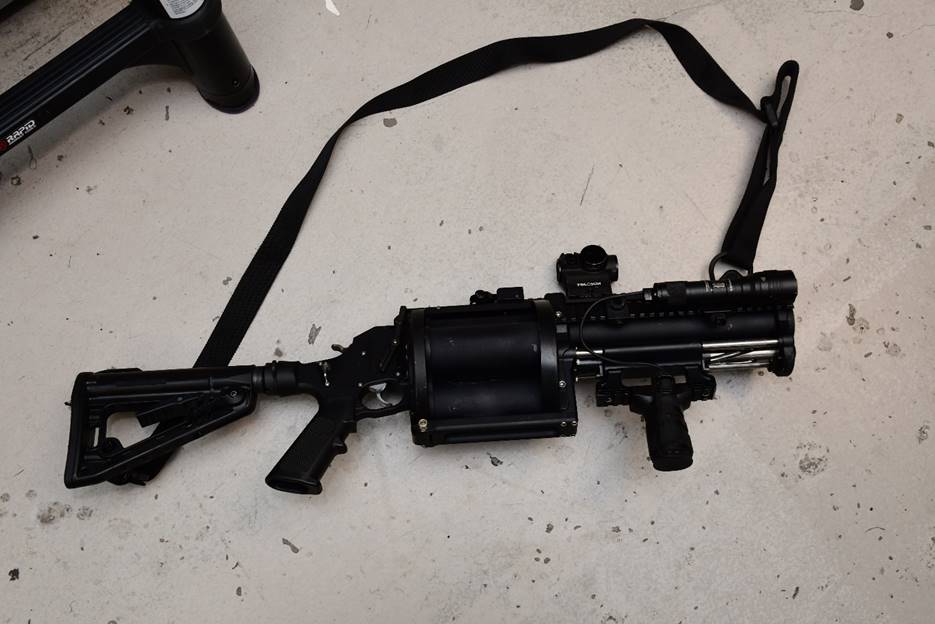
Figure 1 – LMT Defense Launcher
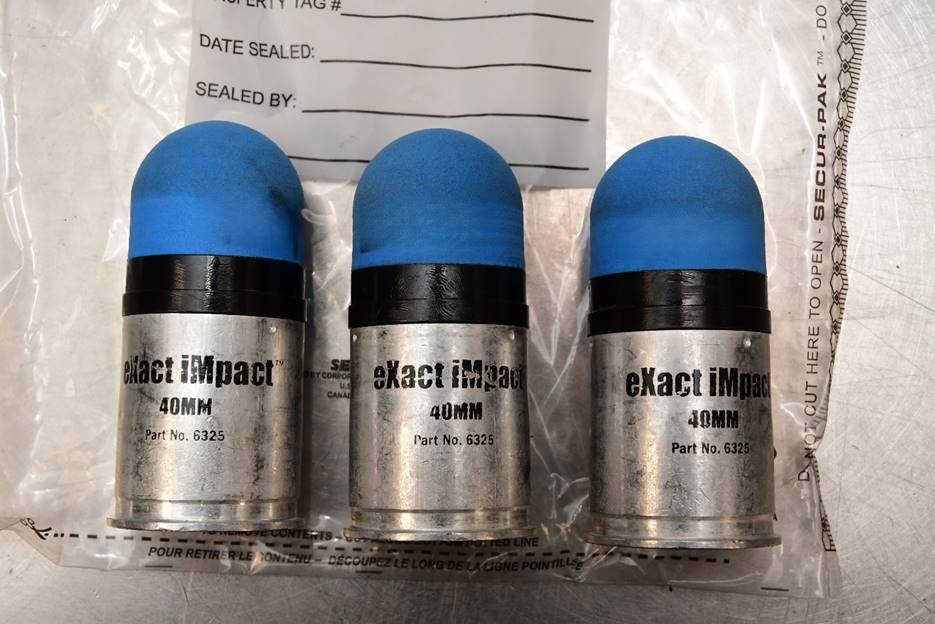
Figure 2 – Three LMT Defense Launcher Cartridges
Video/Audio/Photographic Evidence[2]
911 and Communications Summary
OPS dispatch requested that police officers attend Montfort Hospital. A hospital staff member had called in a panic, reporting that the Complainant was uncooperative and violent. He was contained in a secure area.
Dispatch advised attending officers that the Complainant was flagged for violence, and was trained in martial arts.
Police officers staged in the hospital and approached the mental health ward of the hospital. The patrol sergeant advised the Complainant was isolated in a secure area and appeared ready to fight. The patrol sergeant requested that the OPS Tactical Unit attend to assist.
Materials Obtained from Police Service
Upon request, the SIU obtained the following records from the OPS between July 12, 2024, and July 18, 2024.
- Communications recordings;
- General and Supplementary Reports;
- Computer-assisted Dispatch Report; and
- Notes - the WO.
Materials Obtained from Other Sources
The SIU obtained video footage from Montfort Hospital on July 17, 2024.
Incident Narrative
The evidence collected by the SIU, including interviews with a police witness and video footage that largely captured the events in question, gives rise to the following scenario. As was his legal right, the SO chose not to interview with the SIU or authorize the release of his notes.
In the evening of July 10, 2024, OPS officers were dispatched to the mental health unit of Montfort Hospital. Staff had contacted police seeking assistance with a violent patient – the Complainant. The Complainant had been apprehended and involuntarily admitted at the mental health unit the day before.
Uniform officers were the first to arrive. They found the Complainant contained in an area of the unit. Given what they knew of the circumstances – a patient who had been aggressive and combative with staff – they decided to wait for the assistance of the OPS tactical team.
A tactical team, under the command of the WO, arrived on scene at about 8:28 p.m. By now, officers were aware that the Complainant had cautions on police file for violence. He was also known to be proficient in martial arts. The plan was to open a door to the area containing the Complainant and attempt to speak to him. That plan was foiled when the Complainant rushed at the open door, banging on it as the officers were able to close and lock it.
Shortly thereafter, the tactical team decided on an alternative course. They would again open the door, this time with the SO, a member of the team and armed with a less-lethal launcher, in the lead. The officer would fire his weapon at the Complainant with the intention of sufficiently distracting him to permit the other officers to safely approach and take him into custody. The door was opened by the team and the SO, as planned, fired a single round at the Complainant. Shortly thereafter, the rest of the team entered through the door and, with the use of a shield carried by another member of the team, subdued the Complainant, handcuffing him behind the back.
The Complainant was sedated and taken back to his room, where he was restrained to his bed.
Relevant Legislation
Section 25(1), Criminal Code - Protection of Persons Acting Under Authority
25 (1) Every one who is required or authorized by law to do anything in the administration or enforcement of the law
(a) as a private person,
(b) as a peace officer or public officer,
(c) in aid of a peace officer or public officer, or
(d) by virtue of his office,
is, if he acts on reasonable grounds, justified in doing what he is required or authorized to do and in using as much force as is necessary for that purpose.
Analysis and Director’s Decision
On July 10, 2024, the OPS notified the SIU that one of their officers had earlier that day discharged a less-lethal firearm at a person – the Complainant. The SIU initiated an investigation naming the SO the subject official. The investigation is now concluded. On my assessment of the evidence, there are no reasonable grounds to believe that the SO committed a criminal offence in connection with the incident.
Pursuant to section 25(1) of the Criminal Code, police officers are immune from criminal liability for force used in the course of their duties provided such force was reasonably necessary in the execution of an act that they were required or authorized to do by law.
The Complainant was subject to arrest at the time the SO fired his less-lethal launcher. Given the violence he had exhibited to staff at the mental health unit, the tactical team were within their rights in seeking to arrest the Complainant to preserve the peace.
I am also satisfied that the force used by the SO in the course of the Complainant’s arrest, namely, the discharge of his less-lethal launcher, was legally justified. The tactical team had good reason to believe that the Complainant would physically resist his arrest given his volatile behaviour. In the circumstances, having tried and failed to engage the Complainant peaceably, they were entitled to resort to a measure of force to take him into custody. The deployment of the less-lethal launcher – which fired foam-tipped rounds – made sense. If it worked as designed, the impact of the round would temporarily throw the Complainant off-kilter, without causing serious injury, allowing the officers to safely approach to effect the arrest. On this record, faced with the possibility of having to directly engage the Complainant in a physical struggle, which itself carried the risk of injury to the Complainant and the officers, it would seem the use of the less-lethal launcher was a reasonable tactic.
For the foregoing reasons, there is no basis for proceeding with criminal charges in this case. The file is closed.
Date: November 7, 2024
Electronically approved by
Joseph Martino
Director
Special Investigations Unit
Endnotes
- 1) Unless otherwise specified, the information in this section reflects the information received by the SIU at the time of notification and does not necessarily reflect the SIU’s findings of fact following its investigation. [Back to text]
- 2) The following records contain sensitive personal information and are not being released pursuant to section 34(2) of the Special Investigations Unit Act, 2019. The material portions of the records are summarized below. [Back to text]
Note:
The signed English original report is authoritative, and any discrepancy between that report and the French and English online versions should be resolved in favour of the original English report.