
SIU Director’s Report - Case # 25-OCI-314
Warning:
This page contains graphic content that can shock, offend and upset.
Contents:
Mandate of the SIU
The Special Investigations Unit is a civilian law enforcement agency that investigates incidents involving an official where there has been death, serious injury, the discharge of a firearm at a person or an allegation of sexual assault. Under the Special Investigations Unit Act, 2019 (SIU Act), officials are defined as police officers, special constables of the Niagara Parks Commission and peace officers under the Legislative Assembly Act. The SIU’s jurisdiction covers more than 50 municipal, regional and provincial police services across Ontario.
Under the SIU Act, the Director of the SIU must determine based on the evidence gathered in an investigation whether there are reasonable grounds to believe that a criminal offence was committed. If such grounds exist, the Director has the authority to lay a criminal charge against the official. Alternatively, in cases where no reasonable grounds exist, the Director cannot lay charges. Where no charges are laid, a report of the investigation is prepared and released publicly, except in the case of reports dealing with allegations of sexual assault, in which case the SIU Director may consult with the affected person and exercise a discretion to not publicly release the report having regard to the affected person’s privacy interests.
Information Restrictions
Special Investigations Unit Act, 2019
Pursuant to section 34, certain information may not be included in this report. This information may include, but is not limited to, the following:
- The name of, and any information identifying, a subject official, witness official, civilian witness or affected person.
- Information that may result in the identity of a person who reported that they were sexually assaulted being revealed in connection with the sexual assault.
- Information that, in the opinion of the SIU Director, could lead to a risk of serious harm to a person.
- Information that discloses investigative techniques or procedures.
- Information, the release of which is prohibited or restricted by law.
- Information in which a person’s privacy interest in not having the information published clearly outweighs the public interest in having the information published.
Freedom of Information and Protection of Personal Privacy Act
Pursuant to section 14 (i.e., law enforcement), certain information may not be included in this report. This information may include, but is not limited to, the following:
- Confidential investigative techniques and procedures used by law enforcement agencies; and
- Information that could reasonably be expected to interfere with a law enforcement matter or an investigation undertaken with a view to a law enforcement proceeding.
Pursuant to section 21 (i.e., personal privacy), protected personal information is not included in this report. This information may include, but is not limited to, the following:
- The names of persons, including civilian witnesses, and subject and witness officials;
- Location information;
- Witness statements and evidence gathered in the course of the investigation provided to the SIU in confidence; and
- Other identifiers which are likely to reveal personal information about individuals involved in the investigation.
Personal Health Information Protection Act, 2004
Pursuant to this legislation, any information related to the personal health of identifiable individuals is not included.
Other proceedings, processes, and investigations
Information may also have been excluded from this report because its release could undermine the integrity of other proceedings involving the same incident, such as criminal proceedings, coroner’s inquests, other public proceedings and/or other law enforcement investigations.
Mandate Engaged
Pursuant to section 15 of the SIU Act, the SIU may investigate the conduct of officials, be they police officers, special constables of the Niagara Parks Commission or peace officers under the Legislative Assembly Act, that may have resulted in death, serious injury, sexual assault or the discharge of a firearm at a person.
A person sustains a “serious injury” for purposes of the SIU’s jurisdiction if they: sustain an injury as a result of which they are admitted to hospital; suffer a fracture to the skull, or to a limb, rib or vertebra; suffer burns to a significant proportion of their body; lose any portion of their body; or, as a result of an injury, experience a loss of vision or hearing.
In addition, a “serious injury” means any other injury sustained by a person that is likely to interfere with the person’s health or comfort and is not transient or trifling in nature.
This report relates to the SIU’s investigation into the serious injury of a 31-year-old man (the “Complainant”).
The Investigation
Notification of the SIU[1]
On August 14, 2025, at 8:48 p.m., Subject Official (SO) #1 of the Barrie Police Service (BPS) notified the SIU of an injury to the Complainant.
According to SO #1, on August 14, 2025, at approximately 2:15 a.m., the Complainant attended the BPS station and turned himself in on outstanding warrants. During booking, the Complainant advised he had ingested pills. He was lucid and coherent although he was foaming at the mouth. He was placed in an Acute Detainee Cell for prisoners deemed high risk, which allowed for the monitoring of vital signs. When duty counsel called, the Complainant refused to go to the phone. When required to appear in bail court, the Complainant again refused to leave his cell. He was remanded into custody and held while awaiting transport to a detention facility. At approximately 5:30 p.m., the custody special constable checked on the Complainant and conducted a sternum rub. The Complainant did not respond as expected and Emergency Medical Services were called. He was transported to Royal Victoria Hospital (RVH) and placed into overdose protocol in the Intensive Care Unit.
The Team
Date and time team dispatched: 2025/08/14 at 10:01 p.m.
Date and time SIU arrived on scene: 2025/08/14 at 10:26 p.m.
Number of SIU Investigators assigned: 3
Number of SIU Forensic Investigators assigned: 1
Affected Person (aka “Complainant”):
31-year-old male; interviewed; medical records obtained and reviewed
The Complainant was interviewed on August 17, 2025.
Subject Officials (SO)
SO #1 Declined interview and to provide notes, as is the subject official’s legal right
SO #2 Declined interview and to provide notes, as is the subject official’s legal right
Witness Official (WO)
WO Interviewed; notes received and reviewed
The witness official was interviewed on September 7, 2025.
Service Employee Witnesses (SEW)
SEW #1 Interviewed; notes received and reviewed
SEW #2 Interviewed; notes received and reviewed
The service employee witnesses were interviewed on September 7, 2025.
Evidence
The Scene
The events in question transpired in a biometric sensor cell[2] of the cellblock at BPS Headquarters, 100 Fairview Street, Barrie. SIU forensic services processed the scene.
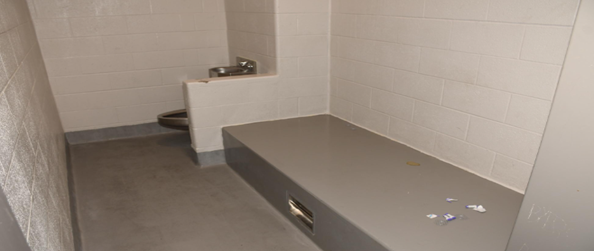
Image – Biometric sensor cell
Video/Audio/Photographic Evidence[3]
BPS Body-worn Camera (BWC) Footage
On August 14, 2025, starting at 2:13 a.m., the WO approached a crying and distraught Complainant in the lobby of a police station. The Complainant indicated he needed to take medication, stood from his chair, and walked to a row of chairs in the centre of the lobby. The WO asked him what they were and told him he was not allowed to take any until he knew what they were. The Complainant bent over [now known to be searching through a bag on the floor] and was asked by a special constable what his medications were. He replied they were Seroquel, antibiotics and another substance, the identity of which was inaudible. The Complainant stood up with his back to the WO and raised his left hand to his mouth [believed to be ingesting an unknown substance(s)]. He was handcuffed, placed under arrest, and walked to the cellblock.
BPS Lobby Footage
On August 14, 2025, starting at 1:47 a.m., the Complainant entered the lobby and approached the public counter. He was swaying and walking unsteadily. He left the counter, and walked and paced the lobby, sitting occasionally and searching through a bag. He removed unknown items from his bag and placed them on a chair beside him. He repeatedly handled the items and placed his hand to his mouth.
Starting at 2:13 a.m., he was approached by the WO and a special constable.
BPS Cellblock Footage
Starting at 2:15 a.m., August 14, 2025, the Complainant was walked by the WO and a special constable into the cellblock and paraded before SO #1. SO #1 asked the Complainant if he was on medication or illicit drugs. His response was inaudible. The WO advised SO #1 that the Complainant had consumed pills but he was unsure what they were. The Complainant indicated he had consumed five or six pills. He was searched and placed in a cell.
BPS Communications Recordings
On August 14, 2025, starting at 5:42 p.m., a man [believed to be SEW #1] telephoned BPS communications centre and indicated there were concerns about the Complainant and emergency medical services (EMS) were required. The Complainant was due to be in bail court and was incapable of coming out of the cell. SEW #1 had conducted a sternum rub and got the Complainant to sit up. He was gurgling, incoherent and not responding.
Materials Obtained from Police Service
Upon request, the SIU obtained the following records from the BPS between August 14, 2025, and September 7, 2025:
- Names and roles of involved police officers and civilian members
- General Occurrence Report
- Arrest Report
- Computer-aided Dispatch Report
- Communications recordings
- BWC footage
- Custody footage
- Notes - the WO, SEW #1 and SEW #2
- Warrant remanding prisoner
- Policies - Special Investigations Unit; Strip and Body Cavity Searches; Search of Persons; Detainee Care and Control; and Detainee Cells Allocation/Process
Materials Obtained from Other Sources
The SIU obtained the Complainant’s medical records from RVH on August 25, 2025.
Incident Narrative
The evidence collected by the SIU, including interviews with the Complainant and members of the police service tasked with his supervision while in custody, and video footage that largely captured the incident, gives rise to the following scenario. As was their legal right, neither subject official agreed an interview with the SIU or the release of their notes.
In the early morning of August 14, 2025, the Complainant went to the BPS station to turn himself in on warrants for his arrest. He had smoked crack cocaine and ingested a quantity of other drugs. The WO met the Complainant and arrested him without incident, searching him before escorting him to the booking area.
The Complainant was paraded before SO #1. The officer was advised that the Complainant had consumed crack cocaine and taken a quantity of unknown medication. The Complainant was searched again and lodged in a cell. Shortly after, he was removed from the cell and placed in a biometric sensor cell. The time was about 2:40 a.m.
SEW #1 was responsible for monitoring the Complainant for the remainder of the nightshift. The officer conducted regular checks of the Complainant and escorted him on a couple of occasions from his cell: once, to speak to duty counsel, and the other time to have his fingerprints and photographs taken.
SEW #1 was relieved by SEW #2 at about 5:15 a.m. She conducted regular cell checks of the Complainant. The Complainant slept for most of this time. At about 12:40 p.m., and then again at about 1:17 p.m., SEW #2 and SO #2, who had relieved SO #1 for the day shift, entered the Complainant’s cell attempting to rouse him from his sleep. The Complainant could not be woken but he opened his eyes and made verbal sounds. On each occasion, SO #2 indicated that he had no immediate concerns for the Complainant’s well-being, but asked SEW #2 to keep an eye on him. SEW #2 last checked the Complainant at about 4:30 p.m. before booking off-duty. The Complainant appeared to be sleeping.
SEW #1 returned to duty at about 5:00 p.m. Having been advised by SEW #2 that they had had trouble waking the Complainant during the night, SEW #1 and another special constable entered his cell and were unable to wake him. When the Complainant could not be woken during a further check at about 5:40 p.m., SEW #1 notified SO #1. EMS were contacted and paramedics arrived.
The Complainant was transported to hospital and diagnosed with polypharmacy overdose.
Relevant Legislation
Section 215, Criminal Code - Failure to Provide Necessaries
215 (1) Every one is under a legal duty
(c) to provide necessaries of life to a person under his charge if that person
(i) is unable, by reason of detention, age, illness, mental disorder or other cause, to withdraw himself from that charge, and
(ii) is unable to provide himself with necessaries of life.
(2) Every person commits an offence who, being under a legal duty within the meaning of subsection (1), fails without lawful excuse to perform that duty, if
(b) with respect to a duty imposed by paragraph (1)(c), the failure to perform the duty endangers the life of the person to whom the duty is owed or causes or is likely to cause the health of that person to be injured permanently.
Sections 219 and 221, Criminal Code - Criminal Negligence Causing Bodily Harm
219 (1) Every one is criminally negligent who
(a) in doing anything, or
(b) in omitting to do anything that it is his duty to do,
shows wanton or reckless disregard for the lives or safety of other persons.
(2) For the purposes of this section, duty means a duty imposed by law.
221 Every person who by criminal negligence causes bodily harm to another person is guilty of (a) an indictable offence and liable to imprisonment for a term of not more than 10 years; or (b) an offence punishable on summary conviction.
Analysis and Director’s Decision
The Complainant lapsed into medical crisis while in a cell of the BPS on August 14, 2025. The SIU was notified of the incident and initiated an investigation naming the officers with overall responsibility for the care of prisoners during the Complainant’s time in custody –SO #1 and SO #2 – subject officials. The investigation is now concluded. On my assessment of the evidence, there are no reasonable grounds to believe that either subject official committed a criminal offence in connection with the Complainant’s medical event.
The offences that arise for consideration are failure to provide the necessaries of life and criminal negligence causing bodily harm contrary to sections 215 and 221 of the Criminal Code, respectively. Both require something more than a simple want of care to give rise to liability. The former is predicated, in part, on conduct that amounts to a marked departure from the level of care that a reasonable person would have exercised in the circumstances. The latter is premised on even more egregious conduct that demonstrates a wanton or reckless disregard for the lives or safety of other persons. It is not made out unless the neglect constitutes a marked and substantial departure from a reasonable standard of care. In the instant case, the question is whether there was any want of care on the part of the subject officials, sufficiently serious to attract criminal sanction, that endangered the Complainant’s life or contributed to his medical event. In my view, there was not.
There are no questions raised in the evidence regarding the lawfulness of the Complainant’s arrest and period in custody. The Complainant himself had surrendered into police custody knowing that there were warrants in effect for his arrest.
With respect to the care the Complainant received while in police cells, I am satisfied that his custodians comported themselves with due care and regard for his well-being. The Complainant was checked regularly and appeared well. He had been placed in a biometric sensor cell, which gave no indication of concern throughout his time in custody. While the Complainant could not be woken at 12:40 and 1:17 p.m. when officers entered his cell, he was not entirely unresponsive; he opened his eyes and made sounds as they tried to rouse him. When the Complainant’s somnolence continued past 5:00 p.m., SO #1 wisely arranged to have EMS contacted. On this record, I am unable to reasonably conclude that the care the Complainant received departed markedly from a reasonable standard, much less that it constituted a marked and substantial departure.
For the foregoing reasons, there is no basis for proceeding with criminal charges against the subject officials. The file is closed.
Date: December 4, 2025
Electronically approved by
Joseph Martino
Director
Special Investigations Unit
Endnotes
- 1) Unless otherwise specified, the information in this section reflects the information received by the SIU at the time of notification and does not necessarily reflect the SIU’s findings of fact following its investigation. [Back to text]
- 2) A biometric sensor in a police cell is a non-contact system that monitors an individual's vital signs like heart rate and breathing patterns to detect medical distress. [Back to text]
- 3) The following records contain sensitive personal information and are not being released pursuant to section 34(2) of the Special Investigations Unit Act, 2019. The material portions of the records are summarized below. [Back to text]
Note:
The signed English original report is authoritative, and any discrepancy between that report and the French and English online versions should be resolved in favour of the original English report.